
Table of Contents
- 1. The Marshill Discovery: Profile of a Prehistoric Elite
- 1.1. An Unparalleled Collection of Wealth
- 2. Reviving the Warrior Identity Against the Threat of Rome
- 3. Beyond Marshill: Shifting Conflict Across the Ages
- 4. Frequently Asked Questions
- 4.1. What makes the Marshill burial so significant to Scottish history?
- 4.2. When did the Marshill warrior live, and how old was he when he died?
- 4.3. Why did the warrior have bronze toe rings in his grave?
- 4.4. What is the Carnoustie Hoard, and how does it relate to the exhibition?
- 4.5. Where and when can the public view these ancient artifacts?
Scotland’s Richest Iron Age Elite Burial Unveiled in New Exhibition
A remarkable collection of rare weapons and luxury ornaments, unearthed from what archaeologists consider the wealthiest Iron Age grave ever discovered in Scotland, is going on public display for the very first time. The 2,000-year-old treasures belonged to an elite young warrior and will serve as the centerpiece of a major new archaeological exhibition at the National Museum of Scotland in Edinburgh.
Titled Scotland’s First Warriors, the highly anticipated exhibition traces the deep evolution of organized conflict across northern Britain. Spanning a vast prehistoric timeline from the late Stone Age to the arrival of professional Roman legions, the curation features more than 200 ancient artifacts that illustrate how warfare, weapon technology, and societal violence shaped early communities long before the dawn of written history.
Scotland’s Richest Iron Age Elite Burial Unveiled in New Exhibition
The Marshill Discovery: Profile of a Prehistoric Elite
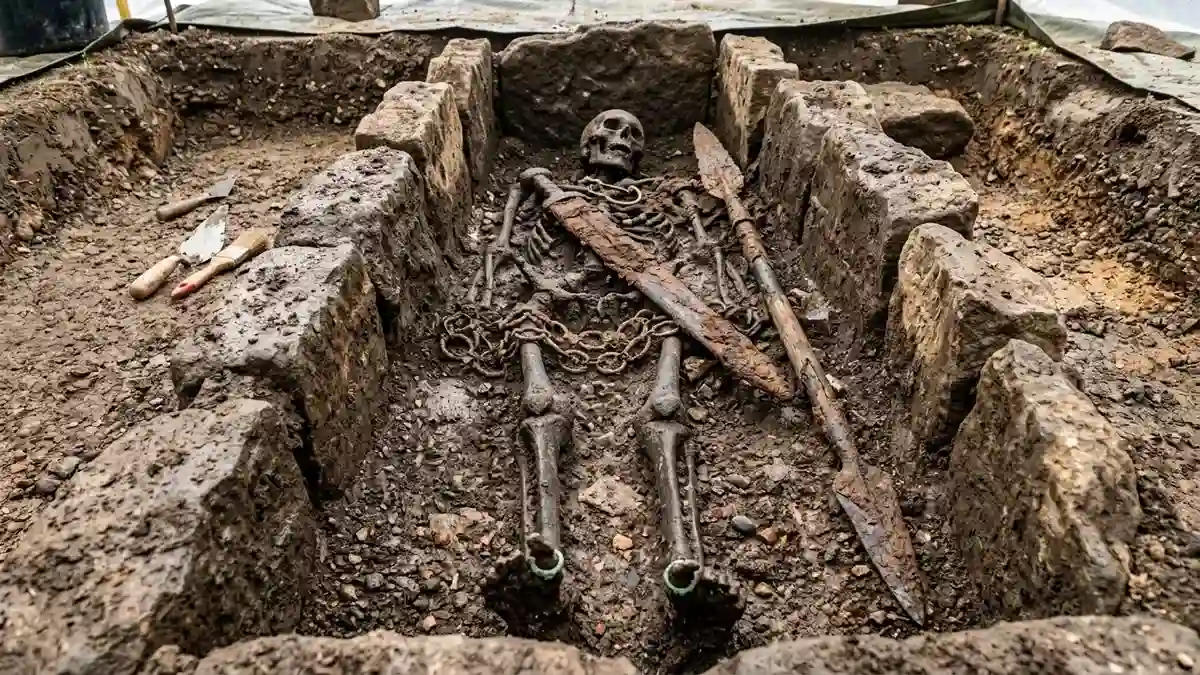
The definitive highlight of the exhibition is a remarkably wealthy burial excavated in 2003 at Marshill, near the town of Alloa in central Scotland. During a routine archaeological excavation of two ancient, stone-lined graves known as cists, researchers uncovered the remarkably preserved skeletal remains of a young man who died between the ages of 17 and 25.
Radiocarbon dating places his life and death somewhere between CE 10 and 70. This specific window represents a highly volatile period in Scottish prehistory, marked by escalating political instability and mounting pressure from the south as the Roman Empire relentlessly expanded its borders into northern Britain.
An Unparalleled Collection of Wealth
While Iron Age burials are exceptionally rare in Scotland, graves containing weapons are practically non-existent. The Marshill skeleton stunned archaeologists due to the unprecedented array of weaponry and personal finery carefully arranged around the young man’s body:
The Weaponry: An iron sword, incredibly preserved inside its original organic leather scabbard, had been laid directly across the young warrior’s chest. A large combat spear rested along the side of his body.
The Elite Garb: The man was outfitted with a complex, high-status belt forged from interlocking bronze and iron rings. His clothing was secured with a beautifully crafted bronze cloak pin.
The Luxury Items: He was buried wearing an exotic glass bead pendant and two bronze toe rings.
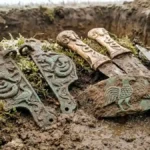
The presence of the bronze toe rings provides critical insight into the man’s daily life and status. Archaeologists believe these rings indicate that the young man wore open sandals—a luxury item directly associated with profound material wealth, high social standing, and continental influence during the British Iron Age.
Reviving the Warrior Identity Against the Threat of Rome
The sheer opulence of the Marshill burial is closely tied to its turbulent historical context. During the first century CE, the independent tribal communities of Scotland were forced to react to the looming military threat of the Roman Empire.
Experts believe that this era of foreign crisis sparked a major cultural renaissance regarding regional identity. The deliberate, ceremonial placement of highly effective, polished weapons in the grave was likely a powerful political statement by the surviving community. It served to immortalize the young man’s physical role as a defender in life and broadcasted the group’s collective resilience, status, and warrior identity to rival tribes and encroaching empires alike.
Restoring the Prehistoric Shine: Following more than two decades of meticulous preservation and scientific analysis at the National Museums Collection Centre, the original, fragile Marshill artifacts will be displayed alongside highly accurate, modern replicas of the sword and spearhead. Forged by master bladesmiths, these gleaming reproductions allow museum visitors to appreciate exactly how imposing and brilliant these weapons would have appeared when freshly polished 2,000 years ago.
Beyond Marshill: Shifting Conflict Across the Ages
While the Marshill warrior anchors the gallery, the exhibition contextualizes his life by showcasing how defensive and offensive technologies mutated across thousands of years.
Among the auxiliary masterpieces on display is the internationally significant Carnoustie Hoard. Discovered adjacent to a prehistoric, Bronze Age circular building, this spectacular cache dates back to roughly 1120–920 BCE and represents one of the most profound Bronze Age discoveries ever made in northern Europe.
The Carnoustie Hoard includes a legendary bronze sword still locked inside its rare, fossilized wooden scabbard, displayed alongside a magnificent spearhead elaborately decorated with delicate gold foil. Separated by nearly a millennium, the contrast between the bronze-and-gold aesthetic of the Carnoustie Hoard and the heavy, functional iron weapons of the Marshill warrior beautifully maps the technological and social shifts that occurred as local chieftains transitioned from ritualistic bronze displays into a deadly, iron-driven era of industrialized warfare.
Frequently Asked Questions
What makes the Marshill burial so significant to Scottish history?
The Marshill burial is officially recognized as the richest Iron Age grave ever discovered in Scotland. Iron Age graves are incredibly uncommon in the region, and finding a skeleton accompanied by a full suite of weapons, personal luxury ornaments, and unique items like bronze toe rings is entirely unprecedented for this archaeological period.
When did the Marshill warrior live, and how old was he when he died?
Osteological analysis revealed that the warrior was a young man between the ages of 17 and 25. He lived and died between CE 10 and 70, placing him at the absolute forefront of the tribal resistance against the Roman invasion of Britain.
Why did the warrior have bronze toe rings in his grave?
Archaeologists believe the presence of bronze toe rings strongly implies that the young man was buried wearing open sandals. In Iron Age Scotland, footwear of this caliber was an expensive, elite luxury item that denoted immense generational wealth and a highly elevated social status within the community.
What is the Carnoustie Hoard, and how does it relate to the exhibition?
The Carnoustie Hoard is a vital Bronze Age treasure cache dating back to 1120–920 BCE. It features an exceptionally rare gold-decorated spearhead and a bronze sword inside a wooden scabbard. It is included in the exhibition to show the stark evolution of weapon manufacturing and metalwork prior to the arrival of Iron Age technology.
Where and when can the public view these ancient artifacts?
The artifacts are being showcased in the Scotland’s First Warriors exhibition hosted at the National Museum of Scotland in Edinburgh. The exhibition officially opens to the public on June 27, 2026, and is scheduled to run through May 16, 2027.