
Table of Contents
- 1. Unlocking Prehistoric Health Through Advanced Imaging
- 2. From a Bolivian Funerary Tower to a Swiss Vault
- 3. Rehumanizing Colonial Collections and Restoring Identity
- 4. Frequently Asked Questions
- 4.1. Why was the mummified head originally misidentified as Inca?
- 4.2. What is artificial cranial modification, and why was it done?
- 4.3. How did the head become mummified?
- 4.4. What did the CT scans reveal about the man’s medical history?
- 4.5. Will the mummified head be returned to Bolivia?
350-Year-Old Mummified Head Reclassified as Indigenous Aymara, Not Inca
A preserved human head housed in a Swiss museum for over a century is rewriting its own history. Long cataloged as the ancient skull of an Inca man, a comprehensive new study has revealed that the remains actually belonged to a member of the Aymara people, an Indigenous group native to the high-altitude Bolivian Highlands.
By combining noninvasive medical imaging with meticulous historical detective work, an international team of researchers has successfully reconstructed the life, cultural practices, and post-mortem journey of this anonymous individual. Published in the International Journal of Osteoarchaeology, the study marks a significant step forward in a global movement to rehumanize colonial-era museum collections.
350-Year-Old Mummified Head Reclassified as Indigenous Aymara, Not Inca
Unlocking Prehistoric Health Through Advanced Imaging
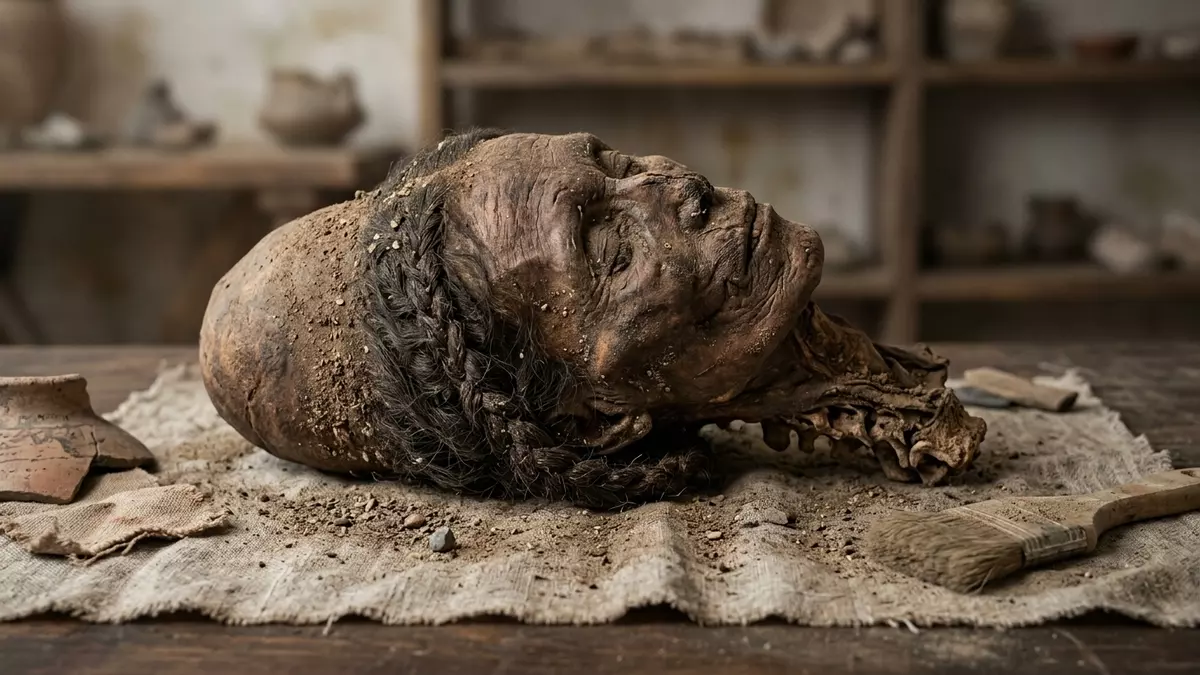
The remains—officially cataloged as individual “Y-001″—consist of a remarkably well-preserved face, cranium, jaw, and a portion of the neck. To investigate the mummy’s true origins without causing physical damage, a research team led by the Cantonal Museum of Archaeology and History in Lausanne, Switzerland, utilized advanced Computed Tomography (CT) scanning.

The scans revealed a wealth of biological data, painting a vivid picture of the man’s life before he passed away at least 350 years ago:
Artificial Cranial Modification: The most striking physical feature of the skull is its distinctively elongated, conical shape. This was the result of intentional cranial binding during infancy—a widespread cultural practice in the Andean region where a baby’s head was tightly wrapped with bandages or boards to shape the growing bone.
Symbolic Trepanation: The skull features a distinct mark from an attempted trepanation, an ancient surgical practice involving drilling or cutting into the skull. Interestingly, the surgical groove never fully penetrated the inner layers of the bone. Because the cut was shallow and showed no signs of a completed medical intervention, researchers believe the procedure may have been purely ritualistic or symbolic.
Dental Pathology: The analysis also noted a severe dental abscess located in the man’s upper jaw, providing direct evidence of the painful oral health conditions he endured during his lifetime.

From a Bolivian Funerary Tower to a Swiss Vault
Beyond the anthropological data, the research team sought to map the ethical and historical trajectory of how individual Y-001 ended up thousands of miles away in Europe.
Historical records indicate that the head was originally taken from the Bolivian Highlands in the late 19th century by a Swiss collector named Louis Kuffré. During this colonial era, the unregulated removal and exportation of Indigenous remains and cultural artifacts to supply European museums was a commonplace and highly exploitative practice.
 Secrets of the Coast: Brain Removal and Long-Distance Dynasties Uncovered in Iron Age Scotland
The head was transported to Europe and officially donated to the Museum of Lausanne in 1914. Upon its arrival, an archival note was attached to the specimen declaring it to be an “Inca” skull. However, modern skeletal analysis combined with the geographic data of Kuffré’s travels firmly aligns the individual’s anatomical traits with the Aymara culture.
The Power of Natural Preservation: Researchers determine that the head was likely looted from a chullpa—a traditional stone funerary tower unique to the Bolivian Highlands. In these high-altitude structures, the exceptionally cold, arid, and windy environment naturally mummified human bodies without the need for artificial embalming chemicals.
Rehumanizing Colonial Collections and Restoring Identity
The reclassification of individual Y-001 goes far beyond simple taxonomy; it addresses the complex, ongoing ethical reckonings currently taking place in museums worldwide. For decades, human remains obtained via colonial expeditions were treated as anonymous, clinical specimens. Modern provenance research aims to reverse this erasure, restoring cultural heritage, dignity, and historical context to these individuals.
At present, the mummified Aymara head is kept away from public view, safely preserved within a climate-controlled storage facility at the museum. While the institution has not yet received an official repatriation request from the Bolivian government or Aymara community representatives, museum officials have stated that they explicitly welcome open dialogues regarding the individual’s potential return home.
Frequently Asked Questions
Why was the mummified head originally misidentified as Inca?
When the Swiss collector Louis Kuffré donated the remains to the Museum of Lausanne in 1914, a note was attached classifying the skull as Inca. During the 19th and early 20th centuries, “Inca” was often used by European collectors as a generic blanket term for any ancient human remains or artifacts recovered from the Andean region.
What is artificial cranial modification, and why was it done?
Artificial cranial modification is the practice of deliberately reshaping a human skull during infancy, while the bones are still soft and pliable. By tightly binding a baby’s head with cloth or specialized boards over several years, communities could create distinct shapes, such as the elongated vault seen on this individual. This practice was typically used to signify social status, tribal affiliation, or regional identity.
How did the head become mummified?
The head was not mummified using artificial embalming techniques like those found in ancient Egypt. Instead, the individual was placed inside a chullpa (an Andean stone funerary tower) where the naturally cold, dry, and windy climate of the Bolivian Highlands evaporated moisture rapidly, preserving the skin and tissues naturally.
What did the CT scans reveal about the man’s medical history?
The noninvasive CT scans revealed that the man suffered from a painful dental abscess in his upper jaw. It also showed an incomplete trepanation (skull surgery) that did not pierce the inner bone, suggesting the procedure may have held a symbolic or spiritual meaning rather than a medical one.
Will the mummified head be returned to Bolivia?
The mummified head is currently kept in a private, climate-controlled museum storage area and is not on display. While no official requests for repatriation have been filed by Bolivian authorities or Indigenous leaders yet, the museum administration has explicitly stated that they are open to discussing repatriation and ethical solutions.