
Table of Contents
- 1. Unearthing a Prehistoric Safe Deposit Box
- 2. An Impossible Survival: Ancient Organic Knots
- 3. Lost-Wax Casting and Long-Distance Trade Routes
- 4. Six Centuries of Continuous Occupation
- 4.1. Mesolithic and Neolithic Footprints
- 4.2. Successive Roundhouses
- 4.3. Local Metal Workshops
- 5. The Mystery of the Unreturned Wealth
- 6. Frequently Asked Questions
- 6.1. Where exactly was the Rosemarkie Hoard discovered?
- 6.2. What makes the circular ornament in the hoard so special?
- 6.3. How did the bark knot survive for nearly 3,000 years?
- 6.4. Where did the bronze metal used to make these ornaments come from?
- 6.5. Why was the Rosemarkie Hoard buried in the first place?
Secrets of 3,000-Year-Old Bronze Age Hoard From Rosemarkie Revealed
Deep within the scenic expanse of Scotland’s Black Isle, an incredible archaeological puzzle has finally been decoded. A spectacular collection of bronze ornaments, intentionally buried nearly 3,000 years ago, is shedding new light on the sophisticated trade, master craftsmanship, and complex spiritual beliefs of a prehistoric community thriving on the shores of the Moray Firth.
Discovered initially during housing development excavations at Greenside in Rosemarkie between 2020 and 2021, the site has undergone comprehensive laboratory analysis. The results offer an unprecedented, high-resolution look into the twilight of the British Bronze Age. What emerged from the soil is a narrative of long-distance connections, community wealth, and a mysterious package tied with a literal knot that was hidden away—but never recovered.
Secrets of 3,000-Year-Old Bronze Age Hoard From Rosemarkie Revealed
Unearthing a Prehistoric Safe Deposit Box
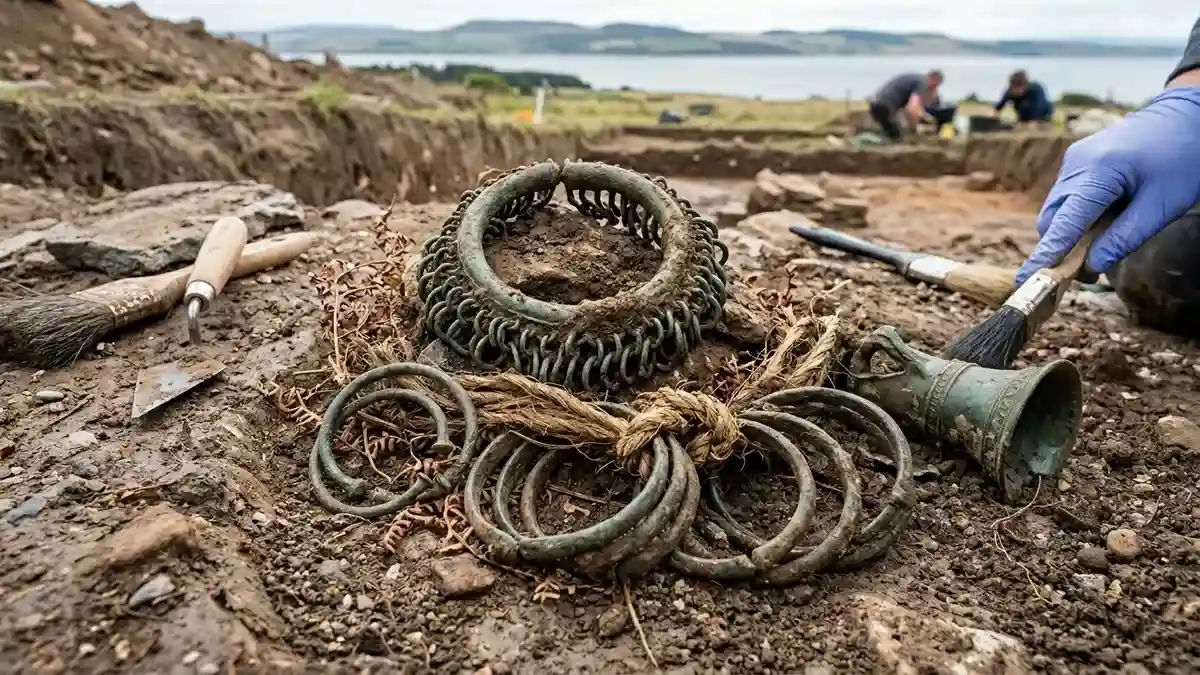
The Rosemarkie Hoard consisted of nine carefully arranged bronze items stacked directly on top of one another. The composition of the cache reveals an intentional selection of highly valuable, decorative finery:
Six matching bronze bracelets
Two penannular (incomplete circle) ringed ornaments
One unique cup-ended ornament
Among these priceless artifacts, the true star of the collection is a massive, ring-shaped ornament intricately adorned with 37 smaller, dangling rings. Conservators have hailed this piece as the single most complex and beautifully preserved artifact of its kind ever pulled from Scottish soil.
Directly beneath this masterpiece lay a damaged, fragmentary version of the exact same style of ringed ornament. Resting at the very base of the pit was the cup-ended piece. This final item was physically bound to the accompanying bracelets using bast—the tough, fibrous inner bark harvested from trees.
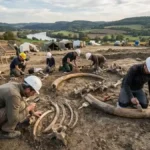
An Impossible Survival: Ancient Organic Knots
In the field of European archaeology, finding prehistoric bronze is exciting, but finding the organic materials used to wrap it is an absolute miracle. Soil chemistry usually destroys wood, plant fiber, and leather within a few centuries. Yet, due to a unique micro-environment within the Rosemarkie pit, delicate organic matter survived intact for three millennia.
Scientists identified fragments of prehistoric bracken stems used as a protective lining, alongside thick strands of tree bast. Most astonishingly, researchers uncovered a intact overhand knot still tied in the bark rope, holding the heavy bronze bracelets firmly against the cup-ended vessel.
Radiocarbon dating performed on these perfectly preserved plant fibers placed the burial of the cache between 894 and 794 BCE. This places the event precisely at the close of the Late Bronze Age, a period of massive cultural transition across the British Isles.
Lost-Wax Casting and Long-Distance Trade Routes
The technical execution of the Rosemarkie jewelry proves that this ancient Highland community was far from isolated. The ornaments were manufactured using a highly complex metallurgical process known as lost-wax casting.
[Sculpt Wax Model] ──► [Encase in Clay Mold] ──► [Melt & Drain Wax] ──► [Pour Molten Bronze]
This laborious technique required creating a unique wax model, encasing it in clay, melting the wax out to leave a hollow cavity, and pouring in liquid metal. At this point in Scotland’s prehistory, lost-wax casting was exceedingly rare and almost exclusively reserved for items of extreme political or religious prestige.
Furthermore, chemical and isotopic analysis of the bronze metal itself revealed that the copper and tin did not originate anywhere near Scotland. The ore was mined in Wales and southern England before being traded up north. This links the residents of the Moray Firth to an extensive, continent-spanning maritime trade network.
Interestingly, no two bracelets found in the hoard are perfectly identical. Several show heavy signs of long-term physical wear and scratches, indicating they were worn for decades before being buried. This suggests that the hoard wasn’t the property of a single elite merchant, but rather a collective contribution pulled together by multiple households or generations within the lineage.
Six Centuries of Continuous Occupation
The housing development site at Greenside revealed that the hoard was buried within a landscape deeply rooted in human history. Archaeologists uncovered a multi-layered story of human life stretching back long before the bronze was cast:
Mesolithic and Neolithic Footprints
The team uncovered evidence of ancient hunter-gatherers and early farmers, including a polished stone axehead fragment and a structural cremation burial containing a charred bear bone—artifacts likely buried as protective spiritual offerings.
Successive Roundhouses
Excavations exposed a clear architectural sequence of wooden roundhouses that were inhabited continuously for over six centuries during the Bronze Age. These structures were built one after the other, representing successive generations of a single extended family lineage living on the exact same plot of land.
Local Metal Workshops
The discovery of clay weapon mold fragments and discarded ornamental metal scraps confirms that this community wasn’t just importing wealth—they had their own active bronze-working smiths living and working inside the village.
The Mystery of the Unreturned Wealth
Archaeologists generally divide ancient European hoards into three distinct categories based on their contents and surroundings:
| Hoard Type | Purpose | Common Location |
| Scrap Collections | Metal recycling and manufacturing storage | Workshops / Smithies |
| Ritual Deposits | Votive offerings to gods or spirits | Lakes, rivers, and marshes |
| Safekeeping Caches | Emergency storage during danger or travel | Near residential domestic homes |
The Rosemarkie Hoard fits perfectly into the third category. Because the precious family ornaments were carefully bundled, tied with a secure bark knot, wrapped in protective bracken, and buried right next to active family roundhouses, it is clear that the owners intended to dig the package back up in the near future.
Yet, for some unknown reason, they never returned. Whether the family was forced to flee due to sudden conflict, succumbed to an epidemic, or met an untimely end away from home remains a mystery locked in the Scottish soil. What they left behind, however, provides modern humanity with an invaluable window into the technical mastery and symbolic traditions of a Highland society on the brink of the Iron Age.
Frequently Asked Questions
Where exactly was the Rosemarkie Hoard discovered?
The hoard was discovered on the Black Isle at a housing development site named Greenside, located in Rosemarkie, a village situated along the coast of the Moray Firth in the Scottish Highlands.
What makes the circular ornament in the hoard so special?
The collection features a rare ring-shaped ornament decorated with 37 smaller dangling rings. It is currently recognized by archaeologists as the most complex and best-preserved bronze artifact of its exact type ever found in Scotland.
How did the bark knot survive for nearly 3,000 years?
Organic materials like tree bark (bast) and bracken stems usually rot away rapidly. In this case, a unique combination of sealed soil conditions and the chemical presence of copper salts from the degrading bronze acted as a natural preservative, staving off decay.
Where did the bronze metal used to make these ornaments come from?
Isotopic analysis of the metal components proved that the copper and tin originated from mines located in Wales and southern England. This indicates that the prehistoric inhabitants of northern Scotland were plugged into highly organized, long-distance trade routes.
Why was the Rosemarkie Hoard buried in the first place?
Because the ornaments were securely tied together and buried directly adjacent to family roundhouses, archaeologists believe the cache was hidden for safekeeping—essentially acting as a prehistoric safe deposit box. The family fully intended to retrieve their valuables but was mysteriously prevented from doing so.