
Table of Contents
- 1. High-Tech Exploration in the Deep Sea
- 2. Knidos F & L: Mapping the Peak of Byzantine Trade
- 2.1. The Pristine Cargo of Knidos F
- 2.2. The Multi-Mile Field of Knidos L
- 3. Knidos N: A Window into Imperial Decline
- 4. Escaping the Destruction of Modern Fishing
- 5. Frequently Asked Questions
- 5.1. Where exactly were these shipwrecks discovered?
- 5.2. What were these ancient Byzantine ships carrying?
- 5.3. What is a Günsenin Type I amphora?
- 5.4. Why is the Knidos N shipwreck unique compared to the others?
- 5.5. How did these fragile wrecks survive modern commercial fishing?
Trio of Deep-Sea Byzantine Shipwrecks Discovered Off Turkey Coast
The deep, ink-black waters off the coast of southwestern Turkey have just provided maritime historians with an unprecedented look into the golden age of medieval commerce. Resting hundreds of meters below the waves, three remarkably well-preserved Byzantine shipwrecks have been discovered near the ancient port city of Knidos on the Datça Peninsula.
The vessels—categorized by researchers as Knidos F, Knidos L, and Knidos N—span several centuries of maritime activity. Packed with hundreds of clay shipping jars, these silent cargo piles act as chronological capsules. They chart the dramatic rise, wide economic reach, and eventual fragmentation of the Byzantine Empire’s commercial shipping lines across the eastern Mediterranean.
Trio of Deep-Sea Byzantine Shipwrecks Discovered Off Turkey Coast
High-Tech Exploration in the Deep Sea
Locating and analyzing these historic wrecks required looking past the limits of traditional scuba diving. The vessels rest at extreme depths, sitting between 400 and 418 meters (roughly 1,300 to 1,370 feet) below the ocean surface.
To explore the sites without physically disturbing the fragile remains, an international research team deployed advanced remotely operated vehicles (ROVs) from the exploration vessel Nautilus. Utilizing high-resolution cameras, laser scanners, and advanced seafloor mapping, the team safely documented the exact layout of the cargo fields, creating a digital record of the ancient disasters.
Knidos F & L: Mapping the Peak of Byzantine Trade
Two of the newly discovered wrecks, Knidos F and Knidos L, date to a period between the 10th and 12th centuries. This era marked a powerful resurgence for the Byzantine Empire. After centuries of intense naval conflict and territorial instability, the empire successfully reclaimed control over vital maritime pathways, sparking a boom in trade connecting Constantinople, the Aegean, southern Anatolia, the Levant, and Egypt.

The Pristine Cargo of Knidos F
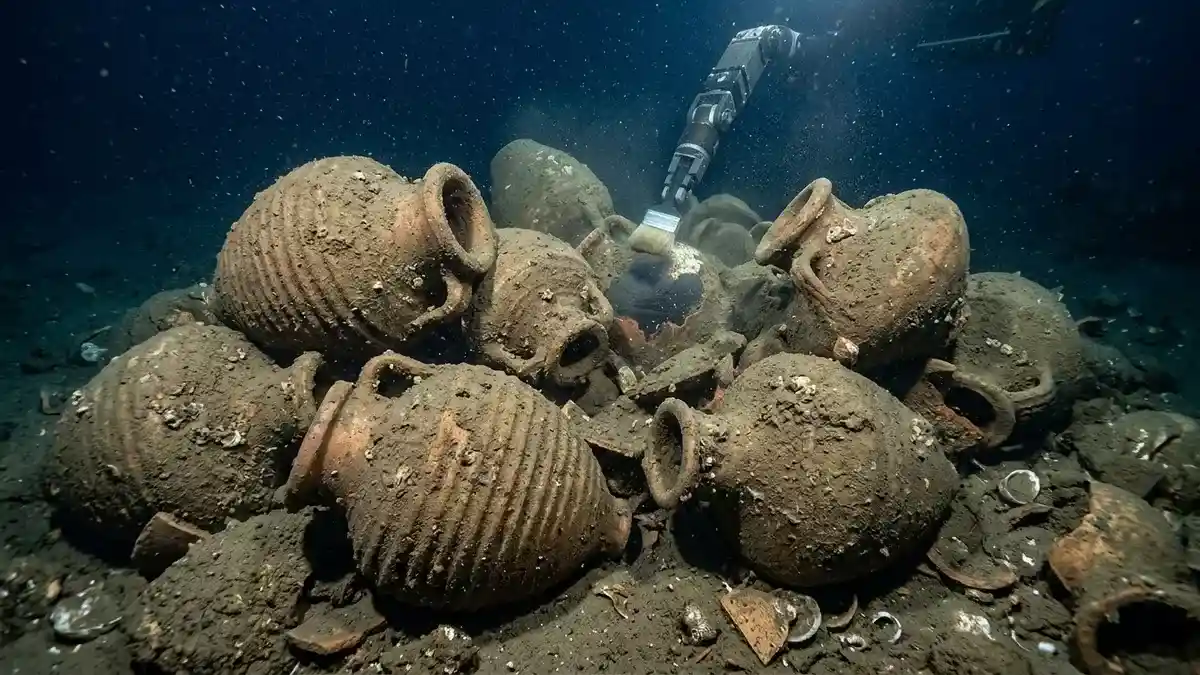
Knidos F stands out as one of the most perfectly preserved Byzantine wrecks ever discovered in the region. On the seafloor, it forms a compact, uniform mound of clay jars, indicating that the ship settled perfectly upright on the seabed after sinking. Because the bottom layers remain buried beneath deep blankets of marine sediment, scientists believe sections of the ship’s ancient wooden hull may still be preserved underneath the pottery.
The Multi-Mile Field of Knidos L
Located roughly three nautical miles south of the Datça Peninsula, Knidos L contains at least 116 visible jars concentrated in a small area. Like Knidos F, this ship reached the seafloor mostly intact, escaping the chaotic scattering that usually happens when a ship breaks apart at the surface.
[Byzantine Shipping Hubs] ──► Distributed via Knidos Corridor ──► Over 100 Global Sites
                                       │
                    ┌──────────────────┴──────────────────┐
                    ▼                                     ▼
        Ganos Region Vineyards                 Multiple Workshop Varieties
       (Primary Wine Production)             (Varying Clay & Production Styles)
Both ships were primarily transporting a highly specific style of storage container known as the Günsenin Type I amphora. These mass-produced clay jars are easily recognizable by their short necks, bulbous rounded bodies, and distinctly ribbed outer surfaces.
Historically, researchers have heavily linked these specific jars to the transport of bulk wine manufactured in the Ganos region, situated along the Sea of Marmara. However, subtle differences in the clay chemistry and manufacturing techniques across the Knidos cargoes suggest that multiple distinct pottery workshops were mimicking this popular design to feed a hungry global trade network. Günsenin Type I jars have been found at nearly one hundred historical sites globally, stretching all the way from the Black Sea to northern Europe.
Knidos N: A Window into Imperial Decline
The third shipwreck, Knidos N, offers a starkly different look at a later chapter in Mediterranean history. Dating to the 13th century, this wreck captures a period when the Byzantine Empire’s iron grip on regional shipping was loosening. Italian maritime powerhouses like Venice, Genoa, and Pisa had aggressively moved in, dominating the local trade networks and reshaping the geopolitics of the Mediterranean.
Yet, despite this political shift, Knidos N proves that local regional ships continued to navigate the Carian coast, keeping local economic pathways alive.
The cargo on Knidos N consists of roughly 95 identified amphorae, but unlike the uniform piles of the older wrecks, its contents are diverse. The ship carried two completely different styles of jars. The primary type features a spherical body, a completely flat base, and a severely compressed neck. The secondary jar type is completely unique, featuring design characteristics that have never been recorded anywhere else in the existing archaeological record.
Escaping the Destruction of Modern Fishing
Beyond their immense historical value, the three Knidos wrecks represent a major victory for cultural preservation. Across the Mediterranean, countless ancient shipwrecks have been thoroughly destroyed by bottom trawling—a commercial fishing practice where heavy, weighted nets are dragged directly across the deep ocean floor, pulverizing fragile pottery and scattering ship timbers.
The Knidos wrecks managed to escape this destructive fate due to a quirk of geology. All three ships sank near extremely steep, rugged underwater cliffs and rocky terrain. This vertical topography makes it impossible for modern fishing trawlers to drop their nets without tearing their gear, accidentally creating a safe sanctuary that preserved these three ancient vessels for nearly a thousand years.
Frequently Asked Questions
Where exactly were these shipwrecks discovered?
The three shipwrecks were found resting between 400 and 418 meters deep off the southwestern coast of Turkey, specifically near the ancient port city of Knidos on the Datça Peninsula.
What were these ancient Byzantine ships carrying?
The primary cargo consisted of amphorae, which were large clay jars used in antiquity to store and transport liquid commodities like wine, olive oil, and various preserved food products.
What is a Günsenin Type I amphora?
It is a specific style of Byzantine storage jar that was widely manufactured between the 10th and 12th centuries. Characterized by a short neck, rounded body, and ribbed surface, these jars were commonly used to ship wine from the Sea of Marmara across Europe and the Mediterranean.
Why is the Knidos N shipwreck unique compared to the others?
Knidos N dates to a later period (the 13th century) and reflects an era of shifting political power in the Mediterranean. It also carried a mixed cargo, including a rare, flat-bottomed style of jar and a second amphora type completely unknown to modern archaeology.
How did these fragile wrecks survive modern commercial fishing?
Many deep-sea ancient wrecks are destroyed by commercial bottom-trawling nets. However, these three vessels sank next to steep, rugged underwater cliffs. This rough terrain naturally prevents fishing boats from dragging nets along the area, protecting the historic sites from harm.