
Table of Contents
- 1. Unearthing a Monumental Secret at Yavneh-Yam
- 2. The Treasures Within: A Tapestry of Mediterranean Trade
- 2.1. The Globalized Economy of the Late Bronze Age
- 2.2. The Egyptian Imperial Footprint
- 3. Echoes of the Amarna Age: Mapping the Port of Muḫḫazu
- 4. Feasting with the Dead: Uncovering Canaanite Rituals
- 5. Preserving History: The Race Against Modern Looters
- 6. Conclusion
- 7. Frequently Asked Questions
- 7.1. What makes the Yavneh-Yam burial complex discovery so significant?
- 7.2. Where is the port of Muḫḫazu mentioned in historical texts?
- 7.3. What kinds of treasures were found inside the tomb?
- 7.4. What evidence was found showing that ancient people held feasts for the dead?
- 7.5. How did archaeologists save the site data after it was looted?
Bronze Age Discovery Gives History Fans New View of Ancient Canaan
An accidental breakthrough by a construction crew has opened a literal window into the ancient world, revealing a remarkably preserved Late Bronze Age burial complex along the Mediterranean coast. Located near the ancient port of Yavneh-Yam within Palmachim Beach National Park in Israel, this monumental rock-cut tomb provides stunning new evidence of Canaanite elite life, ritual practices, and deep geopolitical ties to Pharaonic Egypt roughly 3,300 years ago.
For decades, the historical record regarding Yavneh-Yam during the Late Bronze Age was modest, hinting at a quiet coastal outpost. However, this sudden architectural find completely reshapes our understanding of the region. It proves that this coastal anchorage was once a bustling, prosperous hub integrated into the highest tiers of international commerce and Egyptian imperial administration.
Bronze Age Discovery Gives History Fans New View of Ancient Canaan
Unearthing a Monumental Secret at Yavneh-Yam
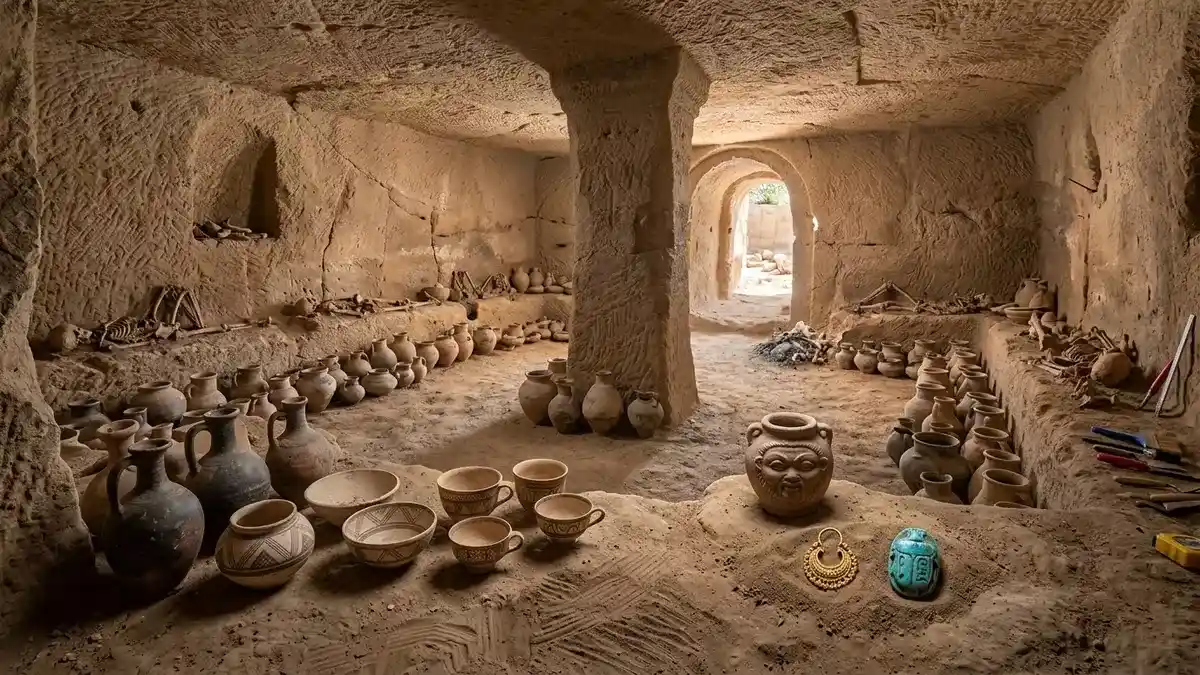
The discovery unfolded unexpectedly when heavy machinery working on a construction project inadvertently punctured the ceiling of a massive, hidden underground chamber. Rather than finding a simple cavern, archaeologists from the Israel Antiquities Authority stepped into a beautifully engineered, nearly square tomb measuring roughly 6.5 meters wide.
Carved directly into the natural coastal sandstone, the chamber exhibits an extraordinary level of craftsmanship. The tomb’s layout features a meticulously cut façade, a perfectly proportioned arched entrance, and a central pillar designed to support the heavy stone ceiling. This sophisticated architecture required immense labor, specialized skills, and substantial financial investment. In the ancient Levant, such monumental subterranean tombs were reserved exclusively for the highest strata of society, signaling that the individuals buried here were members of a powerful local ruling class.
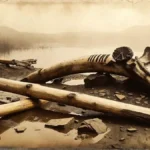
Upon entering the chamber, researchers discovered the remains of at least ten individuals, including both adults and children. The bodies were carefully laid out along the chamber walls in either supine (lying flat on the back) or flexed (fetal) positions, surrounded by an astonishing collection of grave goods meant to accompany them into the afterlife.
The Treasures Within: A Tapestry of Mediterranean Trade
What makes this tomb an archaeological goldmine is the sheer volume and diversity of the artifacts left intact. Ranged around the deceased were more than 140 complete ceramic vessels, many still sitting exactly where they had been placed over three millennia ago. This assemblage serves as a physical map of the vast maritime trade networks that crisscrossed the eastern Mediterranean during the fourteenth and thirteenth centuries BCE.
The Globalized Economy of the Late Bronze Age
Rather than relying solely on local pottery, the elites of Yavneh-Yam filled their final resting place with high-end luxury imports from across the sea. The inventory includes:
Cypriot Base Ring Jugs: Distinctive, high-quality clay vessels imported from Cyprus, often used to transport precious oils or resins.
White Slip Bowls: Highly recognizable Cypriot pottery featuring a bright white coating and painted geometric designs.
Late Helladic Cups: Elegant, fine-ware drinking vessels brought all the way from the Aegean world, showcasing direct contact with Mycenaean Greek civilizations.
The Egyptian Imperial Footprint
Beyond Aegean and Cypriot wares, the tomb yielded striking evidence of a direct relationship with Egypt. Among the most notable discoveries was a localized Egyptian-style Bes vessel—a specialized ceramic jar depicting the dwarf deity Bes, who was revered in Egyptian mythology as a protector of households, mothers, and children.
Even more significant was the discovery of a luxury gold earring resting alongside a scarab amulet inscribed with the royal cartouche of Pharaoh Thutmose III. Although Thutmose III ruled Egypt during the fifteenth century BCE—prior to the construction of this tomb—his scarab remained a powerful symbol of imperial authority, protection, and prestige, passed down through generations or kept as a highly valued heirloom by Canaanite administrators.
Echoes of the Amarna Age: Mapping the Port of Muḫḫazu
The strategic geography of the burial site is just as revealing as the artifacts inside. The tomb sits directly overlooking one of the finest natural anchorages along the southern Levantine coast, positioned perfectly between the ancient powerhouse cities of Jaffa and Ashdod.
Historians have long searched for deeper physical evidence of this specific port’s prominent role in Late Bronze Age geopolitics. In the famous fourteenth-century BCE Amarna Letters—a cache of diplomatic correspondence between the Egyptian pharaoh’s court and various Canaanite vassal rulers—the site is referred to as the vital Egyptian-controlled port of Muḫḫazu.
Prior to this discovery, archaeological digs at Yavneh-Yam had uncovered only sparse clues from this era. This newly found elite tomb completely fills that historical gap. It demonstrates that Muḫḫazu was not just a minor maritime checkpoint, but a highly organized, wealthy polity. The local leaders managing this harbor were deeply embedded in Egypt’s imperial network, serving as crucial facilitators for the pharaoh’s trade and military operations in Canaan.
Feasting with the Dead: Uncovering Canaanite Rituals
One of the rarest and most scientifically valuable aspects of the excavation occurred just outside the tomb’s arched entrance. Here, archaeologists uncovered an open-air courtyard that provided clear, undeniable evidence of ancient mortuary rituals.
The courtyard floor was covered in distinct layers of dark ash, intermingled with broken cooking pots, fragments of a terracotta figurine, and numerous animal bones. According to researchers, these items are the physical remnants of funerary banquets held by living relatives to honor their deceased ancestors. These celebratory feasts allowed mourning families to consume ritual meals, pour libations, and pray for the dead before sealing the tomb.
To add to this picture, modern organic residue analysis performed on the ceramic jars inside the tomb revealed traces of fish, plant matter, and the limbs of sheep and goats. This proves that the dead were left with practical food offerings to sustain them in the next world. While text-based records from the ancient Near East occasionally mention these elaborate mortuary feasts, finding well-preserved, undisturbed physical evidence of these banquets is incredibly rare in Levantine archaeology.
Preserving History: The Race Against Modern Looters
The journey to document this tomb was not without drama. Shortly after the construction crew accidentally exposed the cave in 2022, modern antiquities thieves broke into the chamber, partially looting some of the exposed artifacts.
Fortunately, a rapid-response team of archaeologists managed to secure the site quickly. Before the looters could cause irreversible chaos or obscure the spatial context of the site, researchers conducted an advanced photogrammetric survey. This technology captured thousands of high-resolution overlapping images to generate a highly accurate 3D digital model of the entire space.
Thanks to this quick digital preservation, scientists were able to map out the exact original placement of the burials and their accompanying grave goods. This represents the very first intact, monumental rock-cut burial complex from the Late Bronze Age II period to be scientifically documented in Canaan since the 1960s, making it a monumental milestone for modern archaeological science.
Conclusion
The monumental tomb at Yavneh-Yam is far more than a collection of ancient bones and beautiful pottery; it is a vibrant snapshot of a globalized world that flourished over three thousand years ago. It shows us a society where local Canaanite elites lived at the crossroads of empires, blending Aegean aesthetics, Cypriot commerce, and Egyptian political power into their own distinct cultural identity. As ongoing laboratory analyses continue to investigate the human skeletal remains and soil samples, this long-lost port city will undoubtedly continue to whisper its ancient secrets to the modern world.
Frequently Asked Questions
What makes the Yavneh-Yam burial complex discovery so significant?
This find is uniquely important because it is the first intact, monumental rock-cut tomb from the Late Bronze Age II period to be scientifically documented in Canaan since the 1960s. It provides rare, undisturbed evidence of Canaanite elite funerary practices, international trade, and political ties to ancient Egypt.
Where is the port of Muḫḫazu mentioned in historical texts?
Muḫḫazu is recorded in the fourteenth-century BCE Amarna Letters, which are ancient clay tablets containing diplomatic correspondence between the Egyptian pharaohs and their client kings across the Middle East. The port corresponds directly with the archaeological site of Yavneh-Yam.
What kinds of treasures were found inside the tomb?
Archaeologists recovered over 140 complete ceramic vessels, including imported pottery from Cyprus and Mycenaean Greece. They also discovered a gold earring, an Egyptian-style jar representing the god Bes, and a protective scarab amulet bearing the name of Pharaoh Thutmose III.
What evidence was found showing that ancient people held feasts for the dead?
In an open courtyard directly outside the tomb, scientists uncovered layers of ash, animal bones (from sheep and goats), cooking pots, and pieces of a terracotta figurine. These elements indicate that families organized elaborate funerary banquets to honor the deceased during burial rituals.
How did archaeologists save the site data after it was looted?
Immediately following the break-in by antiquities thieves in 2022, archaeologists utilized advanced photogrammetric mapping to create a comprehensive 3D digital model of the tomb. This allowed them to perfectly preserve the exact spatial arrangements and data of the artifacts before any further disruption occurred.