
Table of Contents
- 1. The Dor Lagoon: An Uncompromised Natural Harbor
- 2. 500 Years of Maritime History: The Three Cargoes
- 2.1. 1. The Dor M Cargo (11th Century BCE): Globalized Rebirth
- 2.2. 2. The Dor L1 Cargo (Late 9th to Early 8th Century BCE): Phoenician Isolation
- 2.3. 3. The Dor L2 Cargo (Late 7th to Early 6th Century BCE): Industrial Iron Trade
- 3. Cyber-Archaeology: Mapping the Deep with Advanced Tech
- 4. Botanical Time Capsules: Refining the Ancient Dates
- 5. Conclusion
- 6. Frequently Asked Questions
- 6.1. What makes the shipwrecks found at the Dor Lagoon unique?
- 6.2. What are “iron blooms” and why were they being shipped?
- 6.3. What is the “Report of Wenamun” and how does it connect to this site?
- 6.4. Why are the storage jars called “basket-handle amphorae”?
- 6.5. What is “cyber-archaeology” and how does it work underwater?
Ancient Shipwrecks Rewrite 500 Years of Iron Age Mediterranean Trade
For decades, historians trying to map the maritime economies of the biblical Iron Age faced a frustrating gap. While ancient texts and inland excavations spoke of powerful seafaring kingdoms, direct physical evidence of early Iron Age ship cargoes inside a major, active port city remained virtually non-existent. Most known deep-sea shipwrecks were found far from shore, disconnected from the urban centers they supplied.
Now, a pioneering underwater investigation has permanently filled this void. An international research team has exposed a chronological sequence of three submerged ship cargoes spanning 500 years of continuous Iron Age history. Discovered inside a prehistoric harbor basin, these time capsules provide the earliest direct physical link between Mediterranean maritime trade and a major Iron Age urban center, revealing how cycles of economic wealth shifted alongside the rise and fall of ancient empires.
Ancient Shipwrecks Rewrite 500 Years of Iron Age Mediterranean Trade
The Dor Lagoon: An Uncompromised Natural Harbor
The extraordinary breakthroughs occurred within the Dor Lagoon (also known as the Tantura Lagoon), a protective sandbar harbor nestled along Israel’s scenic Carmel Coast. In antiquity, this lagoon served as the primary gateway to Dor, a powerful, fortified port city that was occupied for thousands of years.
+------------------------+----------------------------------------------------+
| Harbor Attribute       | Underwater Archaeological Details                  |
+------------------------+----------------------------------------------------+
| Geographic Location     | Dor Lagoon (Tantura), Carmel Coast, Israel         |
| Chronological Scope    | 11th century to 6th century BCE (500-Year Window)  |
| Primary Artifacts      | Three distinct, stratified ship cargo assemblages  |
| Research Institutions  | University of California, San Diego & University of Haifa|
+------------------------+----------------------------------------------------+
Led by Dr. Thomas E. Levy of UC San Diego and Dr. Assaf Yasur-Landau of the University of Haifa, the marine excavation team successfully uncovered three independent clusters of submerged cargo. Because these ships foundered or dropped their goods directly inside the sandy harbor floor, the shifting sediments rapidly buried and sealed the artifacts, preventing them from being smashed by open-sea waves or dragged away by deep-water currents.
500 Years of Maritime History: The Three Cargoes
By systematically mapping and radiocarbon dating the three cargo zones, researchers successfully reconstructed three distinct eras of Mediterranean geopolitics, matching shifting pottery styles to the rise and fall of local empires.
              CHRONOLOGICAL STRATA OF THE DOR HARBOR

  [ Dor M: 11th Century BCE ]  ===> Cypro-Minoan Inscriptions & Egyptian Links
  [ Dor L1: 9th-8th Cent. BCE ] ===> Localized Phoenician Jars, Regional Isolation
  [ Dor L2: 7th-6th Cent. BCE ] ===> Industrial Iron Blooms & Basket-Handle Jars
1. The Dor M Cargo (11th Century BCE): Globalized Rebirth
The oldest assemblage, designated Dor M, dates to the immediate aftermath of the catastrophic Late Bronze Age collapse. Despite an era traditionally viewed as a dark age of isolation, the cargo proved that international shipping networks rebounded rapidly.
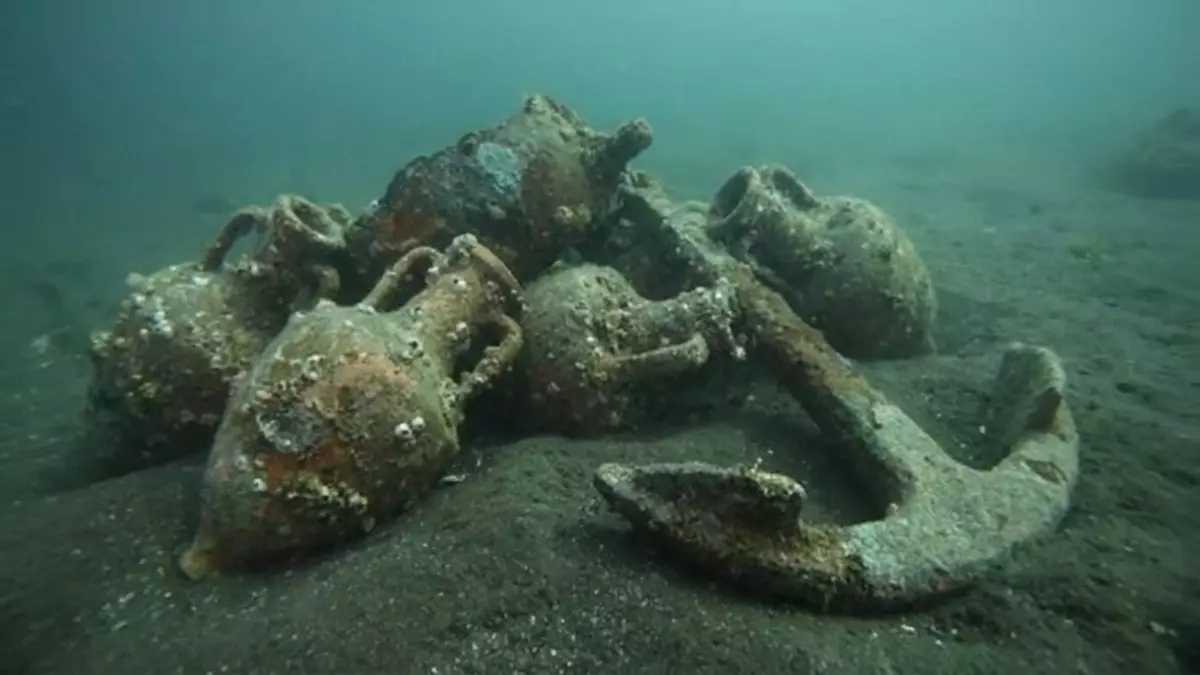
The site yielded heavy stone anchors carved with distinct Cypro-Minoan inscriptions, alongside mass-produced transport jars. This cargo provides a stunning, direct physical parallel to the famous Egyptian literary text, The Report of Wenamun, which explicitly describes contemporary Egyptian trade voyages sailing directly to the harbor of Dor.
2. The Dor L1 Cargo (Late 9th to Early 8th Century BCE): Phoenician Isolation
The secondary cargo layer, Dor L1, captures a period of intense geopolitical contraction. This assemblage consists almost exclusively of uniform Phoenician-style commercial jars and fine, thin-walled ceramic bowls.
Conspicuously absent from this layer are any signs of Cypriot or Egyptian luxury imports. While land-based digs indicate that Dor was experiencing a phase of political isolation during this era, the L1 cargo proves that the city’s local merchants were highly resilient, maintaining active seaborne trade lines within their immediate coastal region.

3. The Dor L2 Cargo (Late 7th to Early 6th Century BCE): Industrial Iron Trade
The most pristine and latest cargo cluster is Dor L2. Dating to a tumultuous window when Dor was conquered and passed between Phoenician, Assyrian, and Babylonian imperial rulers, this site showcases maritime trade operating on a massive, industrial scale.
The L2 ship was packed with massive, Cypriot-style basket-handle amphorae alongside large iron blooms—heavy, semi-refined blocks of raw metal produced during the iron smelting process. This massive industrial metal cache matches wreck data found off the coast of Anatolia (modern Turkey), proving that under imperial Assyrian or Babylonian administration, Dor was thoroughly integrated into a sweeping, high-volume international military-industrial supply line.
Cyber-Archaeology: Mapping the Deep with Advanced Tech
Because excavating in shifting, zero-visibility harbor sands is incredibly difficult, the joint American and Israeli team pioneered a high-tech approach known as cyber-archaeology. Developed through a collaborative partnership between UC San Diego’s Qualcomm Institute and the University of Haifa, the workflow digitized the entire underwater battlefield.
Instead of relying solely on traditional hand-drawn grid slates, divers deployed a sophisticated array of digital recording tools:
3D Photogrammetric Modeling: Creating hyper-accurate, millimetrically precise digital models of the heavy anchors and storage jars exactly as they lay embedded in the sand.
Multispectral Imaging: Utilizing specialized light wavelengths to peer through centuries of marine encrustation to identify hidden makers’ marks or ancient etched text on the pottery surfaces.
Digital Spatial Mapping: Feeding all geographic data into a centralized computer model to instantly reconstruct ancient shipping routes and long-lost coastal harbor structures.
Botanical Time Capsules: Refining the Ancient Dates
To achieve absolute chronological certainty, researchers looked beyond the heavy iron and pottery to analyze the delicate botanical remains trapped inside the sediment. Inside the tightly sealed bases of the basket-handle amphorae, scientists recovered pristine organic residues, including grape seeds, date pits, and sticky tree resin (used to waterproof the interior of the jars).
Because these agricultural products grow and die within a single seasonal cycle, subjecting them to accelerator mass spectrometry (AMS) radiocarbon dating yielded exceptionally tight, accurate historical dates. This organic material confirmed exactly what was being transported—wine and dates—while linking the closing of the jars directly to specific imperial campaigns slashing across the Levant.
Conclusion
The stunning discoveries inside the Dor Lagoon permanently alter our understanding of the ancient world, proving that while empires routinely crumbled, kings were assassinated, and borders were redrawn, the pulse of Mediterranean maritime commerce never truly stopped. To date, archaeologists have systematically exposed only about one-quarter of the expansive Dor sandbar. As the joint team returns for future diving campaigns to excavate the remaining sectors, the shifting sands of Israel will undoubtedly continue to shed light on the resilient merchants and magnificent ships that built the foundations of the global economy.
Frequently Asked Questions
What makes the shipwrecks found at the Dor Lagoon unique?
Unlike the vast majority of ancient shipwrecks which are discovered far out at sea or along remote reefs, the Dor cargoes were uncovered directly inside an active, urban port harbor. This provides the first direct, uncompromised physical connection between seaborne cargo variants and the specific economic cycles of an adjacent Iron Age city.
What are “iron blooms” and why were they being shipped?
An iron bloom is a porous, heavy mass of raw iron and slag produced during the initial smelting of iron ore. They were shipped in bulk as intermediate industrial products, allowing destination blacksmiths across the Mediterranean to heat, forge, and refine the raw metal into specialized weapons, armor, and agricultural tools.
What is the “Report of Wenamun” and how does it connect to this site?
The Report of Wenamun is a famous, ancient Egyptian literary text dating to the 11th century BCE that chronicles the journey of an Egyptian official named Wenamun who sailed to the Levant to purchase cedar wood. The text explicitly names the port of Dor as one of his primary stops, a historical account that is now beautifully verified by the 11th-century Cypro-Minoan artifacts found in the Dor M cargo.
Why are the storage jars called “basket-handle amphorae”?
Basket-handle amphorae are a distinct style of large, ancient shipping pottery characterized by two massive, heavy clay loops attached directly to the very top rim of the jar, resembling the handles of a woven basket. This specific engineering choice allowed dockworkers to run thick ropes through the handles, making it significantly easier to winch the heavy, liquid-filled jars into and out of deep cargo holds.
What is “cyber-archaeology” and how does it work underwater?
Cyber-archaeology is an innovative branch of science that merges traditional field excavation with advanced digital technology. In underwater contexts, it utilizes high-resolution 3D photogrammetry, digital spatial mapping, and multispectral scanning to create exact virtual replicas of fragile, submerged archaeological sites before they can be disturbed or eroded by water currents.