
Table of Contents
- 1. Monumental Foundations of the Saite Dynasty
- 2. Inside the House of the Heart
- 2.1. The Divine Pantheon of the Oasis
- 3. Unearthing the Pre-Saite Ancestral Roots
- 4. The Industrial Transition: From Pharaohs to Rome
- 5. Conclusion
- 6. Frequently Asked Questions
- 6.1. What does the name “Ib-Set” mean?
- 6.2. Who was Pharaoh Psamtik I?
- 6.3. Why did ancient Egyptians build such large temples out in the desert oases?
- 6.4. What is a hypostyle hall?
- 6.5. How long did people continue to use the al-Qasr site?
1,000 Years of Sacred History Uncovered at Desert Temple
An intensive, multi-year archaeological expedition in Egypt’s Western Desert has exposed the deep structural secrets of a monumental sanctuary, reshaping our understanding of the region’s ancient administrative and religious networks. Excavating at the ancient settlement of al-Qasr, once the capital of the remote Bahariya Oasis during the Late Period, an Egyptian scientific mission from the Supreme Council of Antiquities has brought to light previously unknown architectural segments of the historic Temple of al-Qasr.
The extensive findings demonstrate that the sanctuary was far more than a local provincial shrine. Instead, it served as a sprawling, highly influential religious and economic nerve center that actively connected the isolated desert oasis to the centralized geopolitical authorities of the Nile Valley across multiple distinct pharaonic dynasties and imperial occupations.
1,000 Years of Sacred History Uncovered at Desert Temple
Monumental Foundations of the Saite Dynasty
The primary architectural footprint visible at the site today dates back to the 26th Dynasty, historically known as the Saite Dynasty. This era represents one of the final native ruling lineages of ancient Egypt before foreign conquests transformed the region. Field operations spanning more than a decade have successfully uncovered a massive sandstone ceremonial chamber alongside multiple finely inscribed structural blocks.
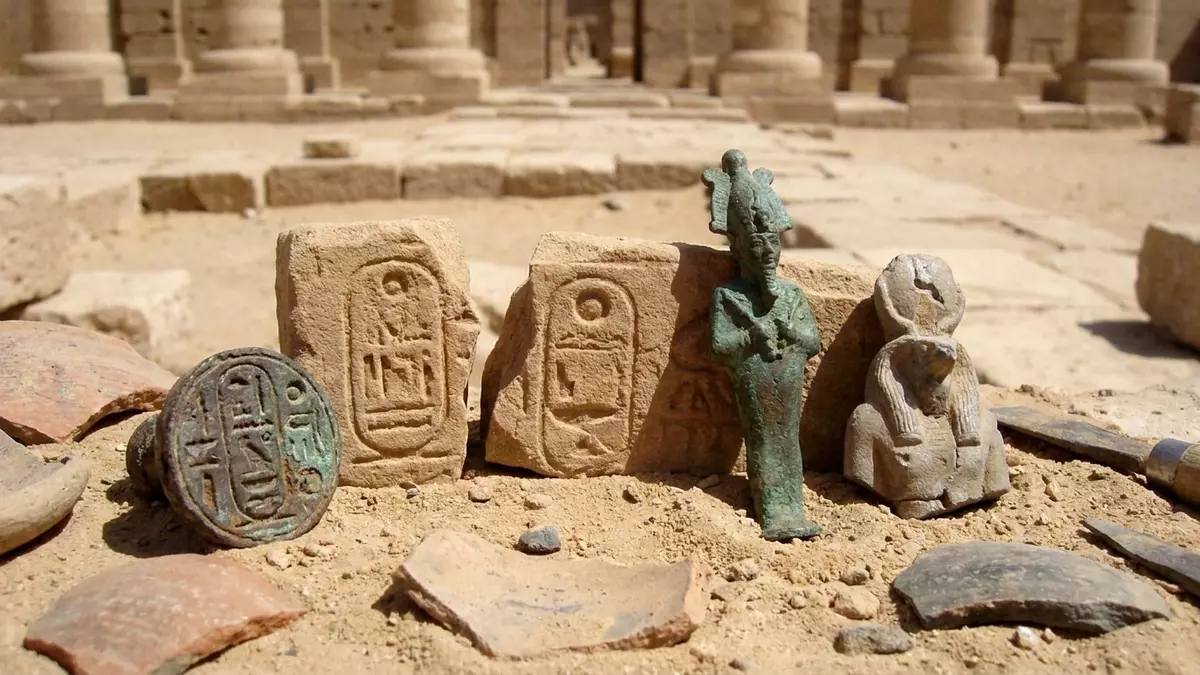
Crucially, these stones bear the official cartouches and ceremonial royal titles of Pharaoh Psamtik I (Psammetichus I), the ambitious ruler who initiated the sanctuary’s construction during the 7th century BCE as part of a broader strategy to fortify and populate Egypt’s western frontier borders.
                  [Evolution of the al-Qasr Sanctuary]
  _________________________________________________________________
 | New Kingdom (18th-19th Dynasties): Early ancestral cult center   |
 | Saite Period (26th Dynasty):        Pharaoh Psamtik I builds temple|
 | Late Period Modifications:          Kings Apries & Amasis expand    |
 | Greco-Roman & Coptic Eras:         Industrial oil/wine production |
 |_________________________________________________________________|
The newly recovered stone masonry provides epigraphic proof of how the temple complex grew over time. While Psamtik I laid the primary foundations, the physical evidence proves that the complex underwent extensive renovations and structural expansions during the subsequent reigns of Pharaoh Apries and Pharaoh Amasis.
By pouring royal resources into this remote oasis, these Saite pharaohs effectively converted al-Qasr into a highly visible symbol of state power, ensuring that traveling trade caravans and nomadic desert populations recognized the authority of the centralized Egyptian crown.

Inside the House of the Heart
As the clearing of the site advanced, the sheer architectural scale of the religious complex became fully evident. The centerpiece of the sanctuary is a grand hypostyle hall—a monumental ceremonial space featuring a roof supported by sixteen massive sandstone columns arranged in a uniform, grid-like pattern. Branching off from this central hall is a network of smaller adjoining chambers, storage vaults, and secluded chapels designed for specific high-level priestly rituals.
The original religious identity of this desert temple was definitively solved when excavation teams recovered an authentic metallic seal buried deep within the complex. The ancient seal preserved the long-lost formal hieroglyphic name of the sanctuary: Ib-Set (alternatively rendered as Ipet-Set), which translates directly to “House of the Heart” or “Place of the Heart.”
       [Sacred Architecture of Ib-Set]
 ___________________________________________
| Structural Feature: | 16-Column Hypostyle |
| Material Used:      | Local Sandstone     |
| Hieroglyphic Name:  | Ib-Set / Ipet-Set   |
| Primary Function:   | Cult Center & State |
 ___________________________________________
The Divine Pantheon of the Oasis
The internal walls of the Ib-Set sanctuary were originally covered in finely detailed painted reliefs and hieroglyphic inscriptions. The fragments of these texts recovered by archaeologists document a diverse pantheon of deities who were actively venerated within the oasis walls, including:
The Theban Triad: Extensive references to Amun-Re (the King of the Gods), his consort Mut, and their lunar child Khonsu indicate that the state-sponsored religion of the capital was thoroughly practiced here.
Amunet: The primordial goddess who personified the hidden forces of the cosmos, holding a highly prominent position within the temple’s local decorative themes.
Thoth and Osiris: Portable votive items discovered in the soil layers include a finely carved statue of Thoth, the god of wisdom and writing, alongside a bronze figure of Osiris, the lord of the underworld, and a protective bronze amulet depicting Ra-Horakhty.
Unearthing the Pre-Saite Ancestral Roots
While the physical stone temple belongs firmly to the Late Period, the ongoing investigations have yielded clear evidence that the site’s sacred status dates back much further into antiquity than the 26th Dynasty. The most historically significant artifact establishing this deeper timeline is a well-preserved stone stela dating back to the New Kingdom reign of Pharaoh Amenhotep II of the 18th Dynasty—roughly 800 years before Psamtik I broke ground on his sandstone temple.
The hieroglyphic inscriptions carved into this early stela provide explicit confirmation that the Bahariya Oasis maintained direct political, economic, and military ties with the central Egyptian government during the height of the New Kingdom empire.
Secondary architectural fragments and pottery shards linked to the subsequent reign of Ramesses II (the Great) further confirm a continuous pattern of religious activity at the location. This leads bioarchaeologists and historians to conclude that an older, ancestral cult center had occupied the site for generations, which the later Saite rulers deliberately chose to dismantle, expand, and immortalize with their own monumental stone architecture.
The discovery of a dedicated shrine belonging to Pa-di-Iza, a powerful local governor and high priest, highlights the complex administrative hierarchy that managed both the spiritual devotions and agricultural wealth of the oasis.
The Industrial Transition: From Pharaohs to Rome
The historical value of al-Qasr extends well beyond the end of the pharaonic era. The archaeological stratigraphy documents that the settlement remained a densely populated and economically productive hub long after the last native pharaohs fell from power.
During the Ptolemaic (Greek) and subsequent Roman periods, the sacred landscape underwent a pragmatic structural transition. While the inner shrines may have retained some religious functions, large portions of the temple complex were repurposed into an active industrial zone.
Archaeologists exposed a highly organized network of large storage facilities, processing basins, and pressing apparatuses used exclusively for the mass production of agricultural commodities, specifically wine and specialized oils. Epigraphic evidence from this later period includes inscribed text written in both Coptic and Latin, proving that the site remained an active, multi-linguistic administrative and commercial settlement well into the 4th and 5th centuries CE.
Conclusion
The excavations at the al-Qasr temple site have successfully illuminated a thousand-year history of resilience, adaptation, and statecraft in Egypt’s Western Desert. By preserving structural traces that connect the New Kingdom to the Saite pharaohs and the Roman Empire, this desert outpost stands as a brilliant monument to human engineering. It proves that despite the immense geographic barriers of the surrounding desert, the “House of the Heart” remained firmly connected to the cultural, economic, and spiritual pulse of the ancient world.
Frequently Asked Questions
What does the name “Ib-Set” mean?
Ib-Set (or Ipet-Set) is the original hieroglyphic name of the al-Qasr temple sanctuary, discovered on an ancient metal seal at the site. It translates to “House of the Heart” or “Place of the Heart,” reflecting the temple’s status as a core spiritual sanctuary.
Who was Pharaoh Psamtik I?
Pharaoh Psamtik I was the founding pharaoh of the 26th Dynasty (the Saite Period), ruling during the 7th century BCE. He is famous for reunifying a fractured Egypt, revitalizing classic art and architecture, and establishing strong military and administrative strongholds throughout the country’s outer desert oases.
Why did ancient Egyptians build such large temples out in the desert oases?
Desert oases like Bahariya were highly strategic locations. They possessed natural water springs that supported agriculture, particularly wine, dates, and oils. Building large state-sponsored temples allowed pharaohs to secure vital trade routes, control valuable resources, and project political power to discourage foreign nomadic invasions.
What is a hypostyle hall?
A hypostyle hall is a classic architectural feature in ancient Egyptian temple design consisting of a large, enclosed hall whose heavy stone flat roof is supported by rows of closely spaced columns. The hypostyle hall at al-Qasr features sixteen sandstone columns arranged in a uniform grid.
How long did people continue to use the al-Qasr site?
The site was used continuously for over a millennium. Activity began during the New Kingdom (around the 15th century BCE), peaked during the pharaonic Late Period (7th-6th centuries BCE), and transitioned into a thriving industrial zone for oil and wine production under Greek, Roman, and early Christian Coptic administrations up until the 5th century CE.