
Table of Contents
- 1. The Halafian Ceramic Masters of Mesopotamia
- 1.1. A Unified Visual Language
- 2. Geometric Progressions: Arithmetic Before Writing
- 2.1. The Power of Doubling
- 3. Born from the Soil: The Practical Roots of Math
- 3.1. From Agrarian Labor to Ceramic Canvas
- 3.2. Cultivating Beauty Over Utility
- 4. Redefining the Timeline of Human Intellect
- 5. Frequently Asked Questions
- 5.1. Who were the Halafians, and when did they live?
- 5.2. How did these ancient people show mathematical thinking without a writing system?
- 5.3. What kind of plants did they paint on their pottery?
- 5.4. Why did these early farming communities need mathematical concepts?
- 5.5. Where can I read the official published study?
8,000-Year-Old Botanical Art Reveals World’s Earliest Mathematical Thinking
A groundbreaking study is rewriting the history of mathematics, pushing the origins of numerical thinking thousands of years further into the past than previously believed. Published in the Journal of World Prehistory, the research suggests that the earliest botanical paintings created by human civilization were far more than mere decorations. Instead, these ancient works of art conveyed a remarkably sophisticated understanding of numbers, spatial division, and geometric order.
By analyzing beautifully painted pottery from the Halafian culture of Northern Mesopotamia, which thrived between 6200 and 5500 BCE, researchers have demonstrated that early agricultural communities were actively embedding complex mathematical concepts into their art at least 8,000 years ago.
8,000-Year-Old Botanical Art Reveals World’s Earliest Mathematical Thinking
The Halafian Ceramic Masters of Mesopotamia
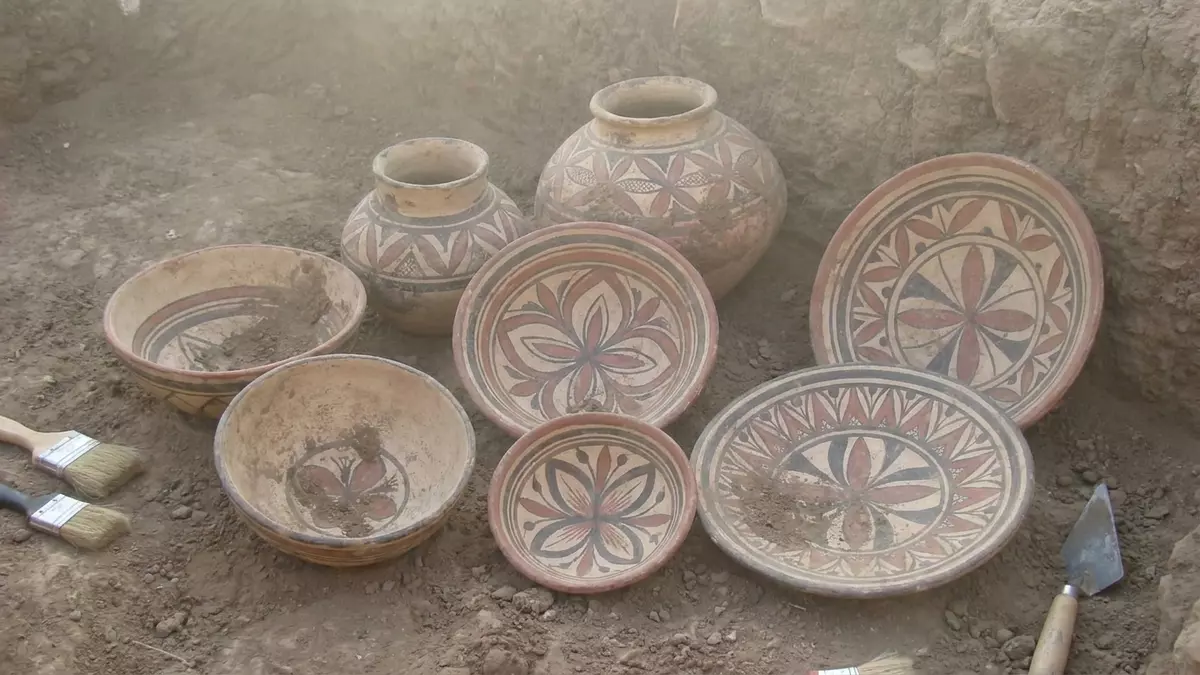
The investigation centers on the finely crafted ceramic vessels produced by the Halafians—small-scale farmers and village dwellers who inhabited regions of what are now Iraq, Syria, and Turkey. While most prehistoric art from earlier eras heavily favored human and animal figures, Halafian culture stood out for its distinct, overwhelming preference for the plant world.
A Unified Visual Language
By gathering data from 29 separate archaeological sites across the region, researchers documented hundreds of unique vegetal motifs on ancient bowls, platters, and jars. The artwork features incredibly balanced renderings of flowers, shrubs, branches, and trees.
While some illustrations mirror real-world plants with anatomical accuracy, others are highly stylized and abstract. Crucially, every single design displays a rigid, deliberate composition and flawless symmetry. Because these precise geometric layouts are identical across dozens of geographically separated villages, scientists conclude that these motifs were not random artistic choices, but rather a shared, region-wide visual language.
Geometric Progressions: Arithmetic Before Writing
The most startling revelation from the study is the systematic, repeated use of exact numerical patterns within these floral motifs. The Halafian potters were not just painting pretty petals—they were executing precise geometric progressions.
The Power of Doubling
Many excavated vessels feature stylized flowers with petals arranged in strict, mathematically sound sequences. The researchers identified a consistent pattern of doubling:
In some complex instances, artists managed to evenly distribute up to 64 individual elements around a single central core.
To create such perfectly demarcated progressions, a painter must possess the cognitive ability to divide a circular space evenly, compute proportional scaling, and understand the concept of doubling. This represents a functional form of applied arithmetic that completely predates the invention of writing, cuneiform, or formal abstract mathematics in the Near East.
Born from the Soil: The Practical Roots of Math
Where did this sophisticated spatial intelligence come from? Archaeologists argue that these cognitive skills were forged in the daily realities of early village life.
From Agrarian Labor to Ceramic Canvas
Transitioning from a nomadic lifestyle to settled agriculture forced humans to solve entirely new practical problems. Surviving as a farming community required:
Dividing land equitably into geometric plots.
Calculating and sharing seasonal harvests.
Organizing collective labor and construction projects over time.
The very same mental faculties required to partition an agricultural field or ration grain were naturally mirrored onto the pottery wheel. The clay surfaces served as a creative testing ground where concepts of symmetry, fractioning, and repetition could be explored, practiced, and passed down through generations.
Cultivating Beauty Over Utility
Intriguingly, the Halafian artists did not paint the domesticated crops that kept them alive, such as wheat or barley. Instead, they decorated their prized vessels with wild flowers and trees—nature chosen purely for its aesthetic and emotional value.
The researchers note that flowers instinctively evoke positive psychological and emotional responses in humans. This indicates that these early mathematicians chose beautiful subjects to explore cold, structured numerical logic, marrying art and science at the very dawn of civilization.
Redefining the Timeline of Human Intellect
This research fundamentally challenges traditional historical timelines regarding when and why human beings started thinking mathematically. For decades, the conventional academic consensus held that mathematics originated suddenly out of necessity alongside written bookkeeping, state taxation, and bureaucracy in later Sumerian urban societies.
The Halafian pottery proves that mathematical thinking was already deeply mature thousands of years before the first word was ever pressed into a clay tablet. It developed organically through visual, artistic practices and the everyday rhythms of early village life, showing that humanity’s drive to find order, pattern, and number in the universe is a core part of our ancient creative spirit.
Frequently Asked Questions
Who were the Halafians, and when did they live?
The Halafian culture consisted of early agricultural village communities that lived in Northern Mesopotamia (modern-day Iraq, Syria, and Turkey) during the Neolithic period, roughly between 6200 and 5500 BCE.
How did these ancient people show mathematical thinking without a writing system?
They expressed mathematical concepts visually through flawless symmetry and geometric progressions on their pottery. They painted flowers with petal counts that perfectly doubled in sequence, such as 4, 8, 16, 32, and 64, which requires an advanced ability to calculate proportions and divide circular space evenly.
What kind of plants did they paint on their pottery?
Instead of painting food crops like wheat or barley, they chose to depict wild flowers, shrubs, and trees. Researchers believe these plants were chosen for their beauty and the positive emotional responses they naturally trigger in people.
Why did these early farming communities need mathematical concepts?
Settling down into agricultural communities required practical problem-solving. Early farmers had to measure and divide land plots, calculate the distribution of harvested food, and organize community labor—tasks that laid the cognitive foundations for mathematical thinking.
Where can I read the official published study?
The study, titled “The Earliest Vegetal Motifs in Prehistoric Art: Painted Halafian Pottery of Mesopotamia and Prehistoric Mathematical Thinking,” was authored by Y. Garfinkel and S. Krulwich and published in the Journal of World Prehistory.