
Table of Contents
- 1. Unveiling the Stone Age Secrets of Lake Baikal
- 1.1. Decoding the DNA of Prehistoric Teeth
- 1.2. Mapping Two Distinct Waves of Infection
- 2. The Genetic Smoking Gun: Why Children Bore the Brunt
- 2.1. Triggering a Fatal Immune Overreaction
- 2.2. The Realities of Pneumonic Transmission
- 3. Challenging the Agricultural Paradigm of Disease
- 3.1. The Wilderness Reservoir
- 4. A Timeline of the Plague’s Global Path
- 5. Gaining Vital Insights for Modern Medicine
- 6. Frequently Asked Questions
- 6.1. How did scientists confirm the plague killed these ancient people?
- 6.2. Why were children uniquely vulnerable to this specific Stone Age strain?
- 6.3. How did nomadic hunter-gatherers catch the plague without living in cities?
- 6.4. Does the plague still pose a major threat to humans today?
- 6.5. What is the difference between pneumonic and bubonic plague?
Ancient 5,500-Year-Old Siberia Graves Reveal Origin of Lethal Plague
A groundbreaking genetic study has rewritten the history of human epidemics, revealing the oldest known evidence of the plague in ancient human remains. Discovered in a 5,500-year-old burial ground in the freezing landscapes of Siberia, this prehistoric strain of the deadly pathogen didn’t just exist—it specifically devastated local communities, with a unique genetic makeup that made it particularly lethal to children.
The finding completely upends the traditional scientific consensus surrounding how and when pandemics first began to plague humanity. For decades, historians and epidemiologists believed that massive, fatal outbreaks only became possible after the dawn of agriculture, when humans settled into dense, crowded farming communities. However, this new discovery proves that nomadic hunter-gatherer families were being ravaged by the plague long before cities or farms ever dominated the globe
Ancient 5,500-Year-Old Siberia Graves Reveal Origin of Lethal Plague

Unveiling the Stone Age Secrets of Lake Baikal
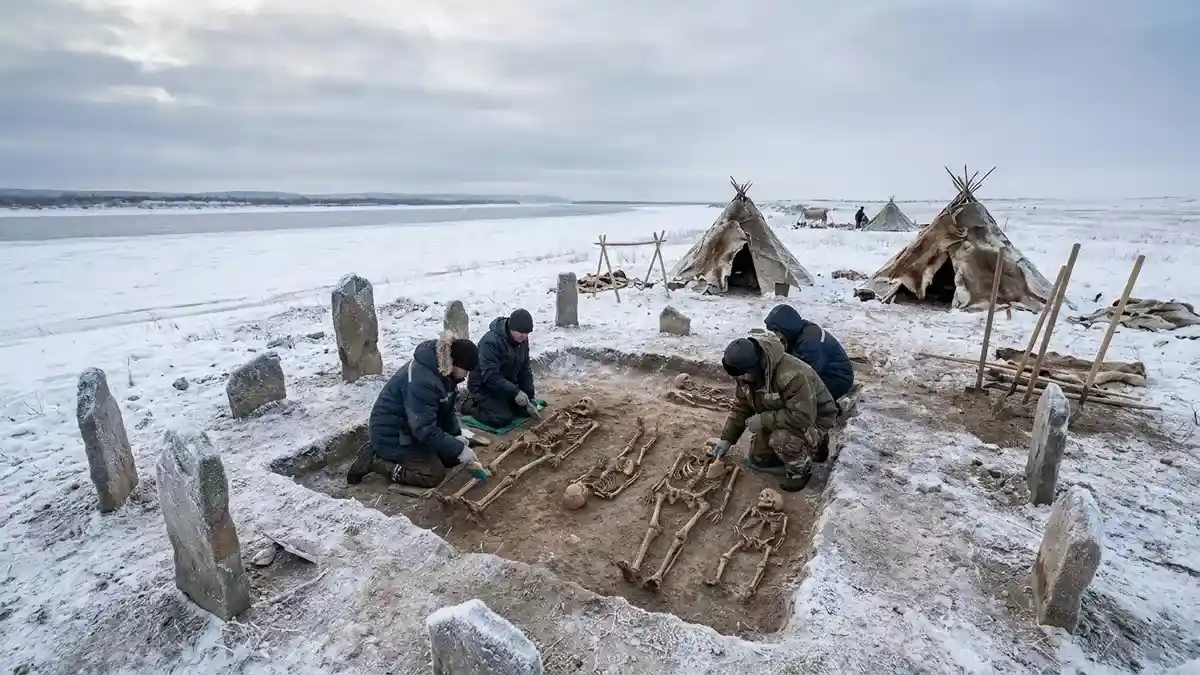
The incredible discovery began along the banks of the Angara River, a massive waterway flowing out of Lake Baikal in southeast Siberia. Archaeologists excavating four distinct prehistoric cemeteries noticed a tragic and perplexing pattern: a disproportionately high number of graves belonged to young children, all buried within a relatively compressed historical window.
Because the skeletons showed absolutely no skeletal trauma, signs of warfare, or physical injuries, researchers were left without an answer. To uncover the invisible killer that had swept through these ancient families, a multinational research team turned to advanced paleogenomics—the study of ancient DNA.
Decoding the DNA of Prehistoric Teeth
Led by researchers from the University of Oxford and the University of Copenhagen, the team extracted and analyzed ancient DNA from the teeth of 46 individuals buried across the four Siberian sites. Teeth act as excellent biological time capsules, often trapping the genetic material of pathogens that were circulating in a person’s bloodstream at their time of death.
 Radiocarbon dating confirms Teutonic Knights built Feldioara Fortress in 13th-century Transylvania
The results, published in the journal Nature, were startling. The team successfully identified massive concentrations of Yersinia pestis—the infamous bacterium responsible for the plague—in 18 of the individuals tested.
Mapping Two Distinct Waves of Infection
The genetic data didn’t just reveal a single isolated incident. Instead, the researchers uncovered evidence of two entirely separate, multi-century plague eras affecting these hunter-gatherer groups:
The First Outbreak: Spanned roughly from 5,596 to 5,341 years ago.
The Second Outbreak: Occurred several centuries later, lasting from approximately 5,126 to 4,926 years ago.

The presence of multiple individuals in shared graves, buried at the exact same time, strongly indicates that these communities were facing rapid, high-fatality events that forced surviving family members to bury their loved ones together.
The Genetic Smoking Gun: Why Children Bore the Brunt
What makes this prehistoric Siberian strain particularly fascinating to evolutionary geneticists is its specific molecular structure. When analyzing the ancient bacterial DNA, the team identified a highly unique, previously unknown gene variant.
Triggering a Fatal Immune Overreaction
This specific gene codes for specialized proteins that are known to provoke an incredibly intense hyper-inflammatory response from the human immune system. In modern medicine, this phenomenon is often referred to as a “cytokine storm,” where the body’s own defense mechanisms go into overdrive, causing massive tissue damage, respiratory failure, and systemic shock.
Because a child’s developing immune system handles severe inflammatory triggers differently than a fully matured adult immune system, this hyper-reactive protein signature explains why the archaeological record at Lake Baikal is so heavily dominated by juvenile graves. The bacterium essentially turned the children’s own immune responses against them, making the infection swiftly fatal.
The Realities of Pneumonic Transmission
While the infamous Black Death of the 14th century was primarily a bubonic plague spread via flea bites from infected rodents, researchers believe the Stone Age Siberian outbreaks took a different, more direct form: pneumonic plague.
Pneumonic plague infects the respiratory system and is spread directly from person to person through airborne droplets. In the tight-knit, sub-zero living conditions of Siberian hunter-gatherers, a highly contagious respiratory plague would have ripped through immediate family structures in a matter of days.
“We got the really striking result that we found lots and lots of plague here far earlier than we expected,” stated study first author Ruairidh Macleod, an ancient genomics researcher at the University of Oxford. This represents “the closest we’ll probably ever get to a direct smoking gun demonstrating the virulence of these early plagues.”
Challenging the Agricultural Paradigm of Disease
For generations, the prevailing theory in evolutionary medicine dictated that dangerous, highly infectious epidemics were a byproduct of the Neolithic Revolution—the transition from hunting and gathering to farming. The logic was simple: farming brought permanent settlements, dense populations, poor sanitation, and close contact with domesticated livestock, creating the perfect melting pot for deadly pathogens to jump from animals to humans.
The Siberian discovery completely shatters this timeline. The communities living around Lake Baikal 5,500 years ago were traditional, nomadic hunter-gatherers. They did not live in permanent cities, grow crops, or keep large herds of livestock.
The Wilderness Reservoir
Instead of domestic animals, the primary source of the spillover was almost certainly wild wildlife. Researchers point to wild marmots—large ground squirrels native to the Siberian steppes—as the most likely natural reservoir for Y. pestis during the Stone Age.
Nomadic hunters frequently targeted these animals for their pelts and meat. A single contact event between a hunter and an infected marmot could have introduced the respiratory pathogen into a family unit, triggering a local localized wildfire of infection without requiring a dense urban center to sustain it.
A Timeline of the Plague’s Global Path
To understand how this discovery repositions our understanding of history, it helps to examine where these Siberian outbreaks sit on the broader timeline of known ancient pandemics.
| Estimated Era | Region affected | Society Type | Historical Impact |
| 5,500 Years Ago | Lake Baikal, Siberia | Nomadic Hunter-Gatherers | Oldest confirmed fatal outbreaks; high child mortality. |
| 5,300–4,900 Years Ago | Scandinavia & Northern Europe | Early Neolithic Farmers | Widespread decline in farming populations; disputed lethality. |
| 541–750 CE | Byzantine Empire / Mediterranean | Urban Empire | The Plague of Justinian; killed an estimated 15-50 million people. |
| 1346–1353 CE | Europe and Asia | Medieval Cities | The Black Death; wiped out up to 60% of the European population. |
Gaining Vital Insights for Modern Medicine
While studying 5,500-year-old teeth might seem purely historical, mapping the ancient evolutionary tree of Yersinia pestis provides critical data for contemporary public health. The plague is not a extinct disease of the past; it remains active today, naturally circulating in rodent populations across the globe, including parts of Asia, Africa, and the western United States.
By tracing exactly how the bacterium mutated, dropped, or acquired specific virulent genes over thousands of years, evolutionary geneticists can better predict how modern strains might adapt or change in the future. Thankfully, when caught early today, modern plague infections are highly treatable with standard antibiotics—a luxury the ancient families of Lake Baikal tragically lacked.
Frequently Asked Questions
How did scientists confirm the plague killed these ancient people?
Scientists extracted ancient DNA directly from the teeth of the skeletons. They found exceptionally high concentrations of Yersinia pestis genetic material, which indicates the bacteria was heavily present in the individuals’ bloodstreams at their time of death.
Why were children uniquely vulnerable to this specific Stone Age strain?
The ancient Siberian strains carried a specific gene variant that triggered an overwhelming, hyper-inflammatory response from the human immune system. This reaction was especially devastating to young children, leading to high juvenile mortality rates within the community.
How did nomadic hunter-gatherers catch the plague without living in cities?
The pathogen likely spilled over from wild animal reservoirs, specifically wild marmots, which the hunter-gatherers hunted for food and fur. Once a human was infected, the pneumonic form of the disease spread rapidly from person to person through respiratory droplets.
Does the plague still pose a major threat to humans today?
While Yersinia pestis still exists in the wild and infects a small number of people globally each year, it is no longer the unstoppable killer it once was. Modern cases can be easily and effectively treated with common antibiotics if diagnosed early.
What is the difference between pneumonic and bubonic plague?
Bubonic plague is transmitted primarily via the bites of infected fleas and targets the lymphatic system, causing swollen lymph nodes. Pneumonic plague is a severe respiratory infection that enters the lungs and spreads directly through the air via coughing, making it far more contagious and rapidly fatal.