
Table of Contents
- 1. Exploring the Brougham Burial Grounds
- 1.1. Forms of Cremation Discovered:
- 2. Wealth, Weapons, and Rare Antiquities
- 3. Forensic Archaeology: The Block-Lifting Method
- 4. Symbolic Offerings and Ritual Choices
- 5. Frequently Asked Questions
- 5.1. What makes the Brougham Roman cemetery excavation significant?
- 5.2. What is the difference between an inhumation and a cremation burial?
- 5.3. What kinds of luxury items were found in the graves?
- 5.4. How does a jar from Dorset prove Roman trade networks existed?
- 5.5. What is “block lifting” and why do archaeologists use it?
Large Roman Cemetery Excavation at Brougham Reveals Diverse Burial Practices on Britain’s Northern Frontier
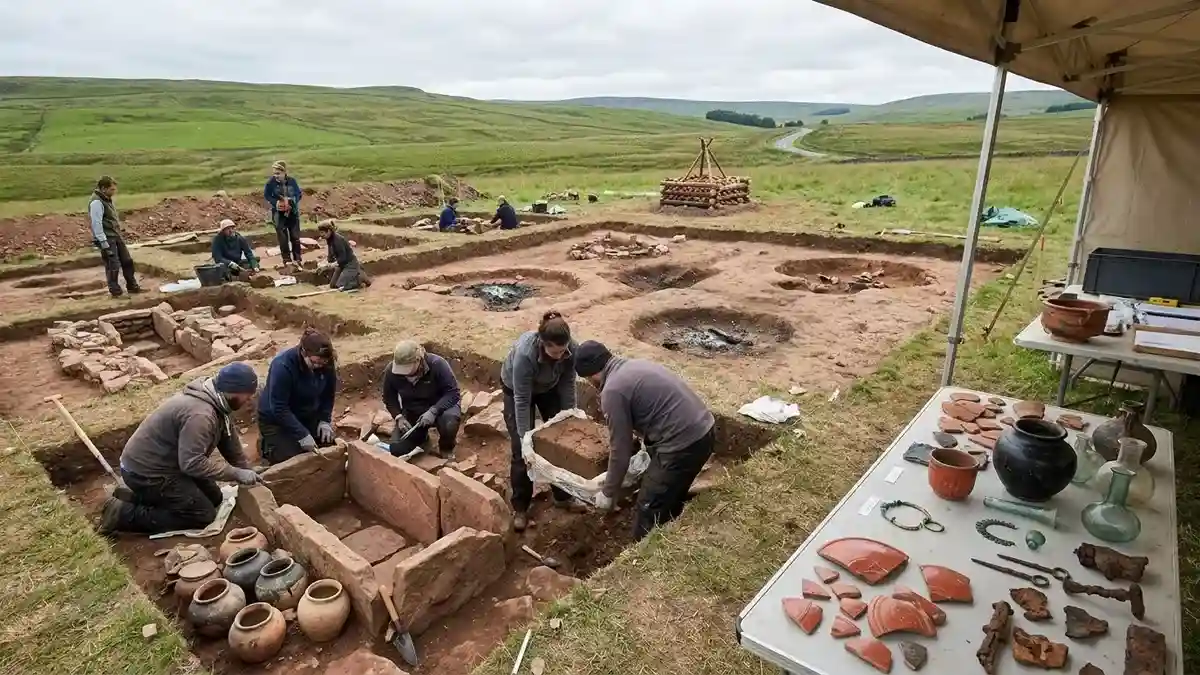
A large-scale archaeological excavation on the edge of the Roman Empire has unveiled a remarkably complex and diverse picture of frontier life and death. Excavating near the Roman fort and settlement at Brougham in Cumbria, England, a team from Oxford Cotswold Archaeology has exposed the full scale of a massive Roman cemetery on what was once the northernmost edge of Roman control in Britain.
The extensive fieldwork, conducted as part of the A66 Northern Trans-Pennine Project, builds upon initial discoveries made during roadworks in the 1960s. By uncovering hundreds of previously hidden graves, the recent project has provided historians with an unprecedented look into the rituals, social variations, and far-reaching trade networks of a classic Roman military frontier community.
Large Roman Cemetery Excavation at Brougham Reveals Diverse Burial Practices on Britain’s Northern Frontier
Exploring the Brougham Burial Grounds
The excavation revealed several hundred graves, demonstrating that the inhabitants of the Brougham frontier settlement did not follow a single, rigid funerary custom. Instead, the cemetery hosted a striking mix of both inhumation (buried bodies) and cremation practices.
The cremation graves, in particular, appeared in a fascinating variety of configurations, showing that families tailored burials to their specific means, traditions, or preferences.
Forms of Cremation Discovered:
Direct Pit Burials: Ashes and charcoal from the funeral pyre were placed directly into a simple earth pit.
Urned Cremations: Cremated bones were carefully gathered and placed inside ceramic vessels or urns.
Organic Containers: Some ashes were deposited inside wooden boxes, which have since decayed but left distinct structural traces.
Stone Cists: The most elaborate cremations were placed inside protective stone-lined cists meticulously constructed from local Cumbrian red sandstone.
The discovery of actual pyre sites (busta) and heavy ash pits scattered among the graves confirms that the intense, multi-stage funerary rituals were conducted directly on the cemetery grounds.
Wealth, Weapons, and Rare Antiquities
The items buried alongside the dead varied dramatically from grave to grave, offering clear evidence of social stratification within the frontier community. While some cremation plots contained nothing more than ashes and charcoal, others were richly furnished with high-status grave goods.
Excavators recovered a wealth of artifacts, including delicate glass vessels, bronze ornaments, personal jewelry, and occasional pieces of military equipment and weaponry—hinting at the cemetery’s close ties to the nearby Roman fort garrison.
Among the standout luxury items were complete glass cups, beautifully decorated local pottery, and glossy, red slip samian ware imported from continental Europe, many still bearing the distinct stamps of their original workshop makers.
Archaeologists also discovered intricately carved fragments of animal bone. These delicate pieces served as decorative inlays and were likely once affixed to elegant wooden jewelry boxes or funeral biers that have long since rotted away.
Additionally, the presence of a classic black-burnished jar manufactured all the way in Dorset—on the south coast of England—provides undeniable physical proof of highly organized, long-distance military supply routes operating across the length of Roman Britain.
Forensic Archaeology: The Block-Lifting Method
Because the skeletal and material remains within the cemetery were incredibly fragile, the Oxford Cotswold Archaeology team utilized a suite of meticulous, high-precision recovery techniques. Field archaeologists systematically peeled away thin layers of soil using small hand tools, while the coordinates of every single pot and artifact were logged using high-precision GPS before being lifted.
To maximize data recovery, all excavated soil from the graves underwent thorough wet sieving. This process washes sediment through fine mesh screens, allowing researchers to catch tiny personal items, micro-beads, and minute fragments of cremated bone that would otherwise be lost in the mud.
[Fragile Cremation Vessel in Field] ──► Stabilized & Wrapped ──► Block Lifted Whole
                                                                        │
                                                             (Transport to Lab)
                                                                        │
[Precision Micro-Excavation]        ──► Scanned & Excavated in 2-Centimeter Micro-Layers
For the most delicate or tightly packed cremation urns, the team utilized a specialized preservation strategy known as block lifting. Instead of excavating the pots out in the open wind and rain, archaeologists dug out the entire block of surrounding earth, wrapped it securely, and transported it intact to a controlled laboratory environment.
Once inside the lab, specialists performed micro-excavations, meticulously removing the urns’ contents in controlled micro-layers measuring just two centimeters at a time. This ultra-precise approach allowed scientists to map the exact internal positioning of bone fragments, melted metal dress accessories, and slumped glass tokens.
Subsequent osteoarchaeological analysis of these fragments successfully provided vital demographic data regarding the age, biological sex, and health issues of several frontier individuals, despite the intense heat damage caused by the ancient funeral pyres.
Symbolic Offerings and Ritual Choices
The micro-excavation of the vessels also revealed a fascinating religious nuance: several buried pots contained absolutely no human bone or pyre ash.
Instead, these empty vessels are believed to have served purely symbolic or spiritual roles during the funeral service. They were likely used as ritual tableware, filled with food portions, wine, or organic oil offerings meant to nourish the soul of the deceased on their journey to the afterlife, or to appease under-world deities.
Ultimately, the sprawling cemetery at Brougham stands as a remarkably detailed library of ancient cultural traditions. The complex tapestry of burial styles and exotic grave goods paints a vibrant picture of a dynamic frontier society, illustrating how diverse military personnel and civilian families continuously blended their unique identities along the wild edges of the Roman world.
Frequently Asked Questions
What makes the Brougham Roman cemetery excavation significant?
The excavation provides an exceptionally large and detailed look at burial practices on the northernmost frontier of Roman Britain. It reveals how a diverse community of soldiers, merchants, and families blended different cultures, trade networks, and religious rituals on the edge of the empire.
What is the difference between an inhumation and a cremation burial?
Inhumation refers to the practice of burying a whole, unburned body in the ground. Cremation involves burning the deceased on a funeral pyre, after which the remaining bone fragments and ash are gathered and placed in a pit, a wooden box, or a ceramic urn. Both methods were used concurrently at Brougham.
What kinds of luxury items were found in the graves?
Archaeologists uncovered high-status goods including complete glass cups, bronze jewelry, military weapons, and imported red samian pottery featuring original makers’ stamps. They also found rare items like a carved pipeclay figurine and intricate bone inlays from decorative wooden boxes.
How does a jar from Dorset prove Roman trade networks existed?
The discovery of a black-burnished ceramic jar made in Dorset (southern England) inside a grave in Cumbria (northern England) proves that highly organized, long-distance commercial distribution networks routinely moved goods across the entire length of Britain to supply frontier outposts.
What is “block lifting” and why do archaeologists use it?
Block lifting is a preservation technique where a fragile artifact, such as a packed cremation urn, is extracted from the ground inside a whole block of its surrounding soil. This protects the item from damage and allows scientists to carefully excavate its contents layer by layer in a clean, controlled laboratory environment.