
Table of Contents
# Bear Attack Killed 15-Year-Old Italian Teen 28,000 Years Ago
A 15-year-old Gravettian hunter-gatherer from Italy suffered a devastating bear mauling and died about 28,000 years ago, according to a groundbreaking new forensic study. Long called “Il Principe” for the treasures in his grave, the teen’s skeleton reveals a raw glimpse into the dangers of life during the Stone Age.
This discovery, detailed in a 2025 study published in the Journal of Anthropological Sciences, changes how we understand violence, healing, and burial rituals in Upper Paleolithic Europe.

Bear Attack Killed 15-Year-Old Italian Teen 28,000 Years Ago

## The Discovery That Rewrote Prehistoric Death Stories
Researchers reopened a decades-old museum mystery when they received permission to examine the bones of “Il Principe” up close. The teenager—identified as about 15 years old—died around 28,000 years ago in Arene Candide Cave in Liguria, Italy. Early observers in 1942 had already noticed severe damage to his jaw and left shoulder, but no one connected the injuries to a fatal bear attack.
The new analysis used magnification, high-resolution photography, and three-dimensional surface models to map every mark across the skeleton. What emerged was a clear picture of a violent encounter that left the boy barely able to survive, let alone defend himself.

## A Detailed Reconstruction of the Fatal Mauling
The trauma pattern tells a story of overwhelming force. Massive fractures shattered the shoulder region and lower face. Teeth were damaged, and possible injuries appeared in the neck vertebrae. Together, these wounds point to a crushing blow and repeated attacks from a large carnivore.
Two tiny details sealed the case for experts. A short linear groove on the left side of the skull matches the exact size and shape of a claw from a large predator. A deep puncture wound on the right fibula—the shin bone—fits the profile of a canine tooth from a brown bear or cave bear, both of which still roamed Late Pleistocene Italy.
When viewed alongside the broader fracture lines, the injuries cannot be explained by a fall, animal stampede, or human conflict. The most likely culprit was a bear that turned its attention to the lone teen.
## Evidence of Survival After the Attack
Microscopic study of the bone tissue painted an even more human picture. Researchers found early stages of healing—intertrabecular bone formation—but no advanced callus growth. This stage typically appears just a few days after injury. The teen did not die immediately. He lived long enough for his body to begin repairing itself.
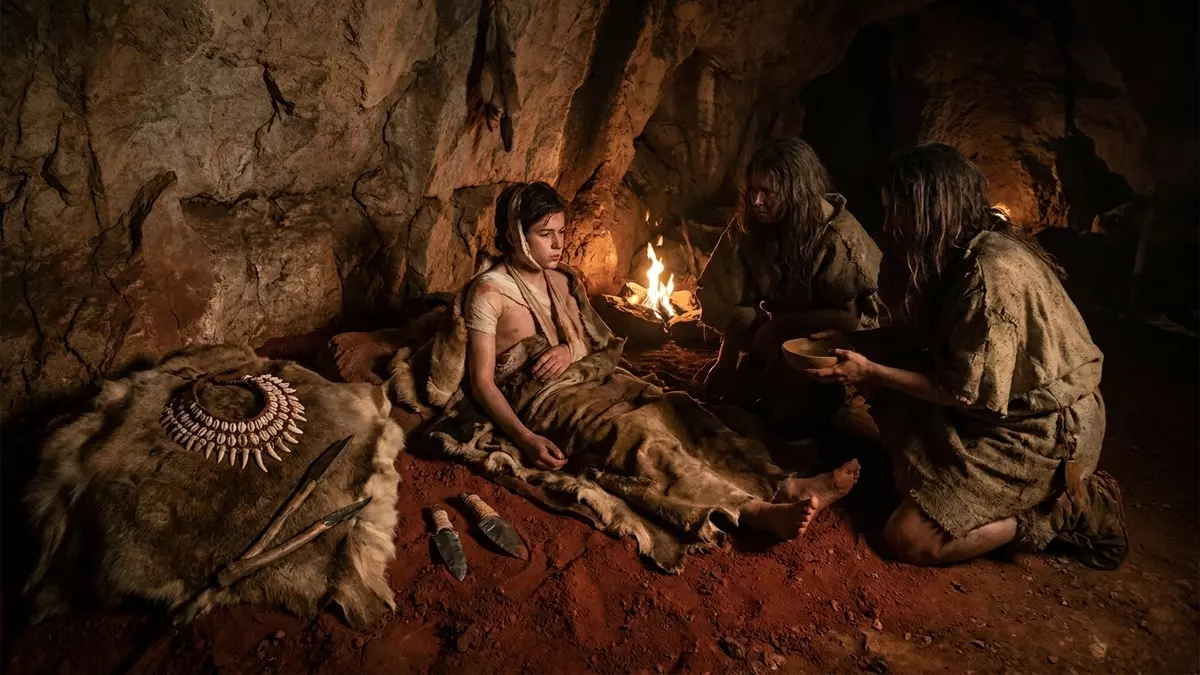
Such resilience suggests the rest of the group noticed his condition and provided care. Severe pain, blood loss, and swelling would have made survival difficult, yet the boy lingered. This rare glimpse into prehistoric caregiving shows that compassion existed even in the harshest Stone Age world.
## Unrelated Injuries That Tell a Larger Story
Beyond the fatal wounds, the skeleton held clues about life before the bear attack. The teen had a healed fracture in the smallest toe of his left foot and a chronic joint disorder in the right ankle. These lower-limb problems would have limited mobility and made everyday tasks—hunting, gathering, walking long distances—far more dangerous.
Such conditions were common among prehistoric foragers, yet they highlight how fragile survival was. Even healthy teens could fall victim to injury or disease, and any weakness made one more likely to become prey.
## Il Principe’s Elaborate Burial
Despite his wounds, Il Principe received one of the most elaborate burials of his time. His group laid him on a bed of red ocher, then crowned him with a headdress made from hundreds of perforated shells and deer teeth. Ivory pendants and a flint blade—sourced from southern France—completed the outfit.
A lump of yellow ocher rested near the injured shoulder and jaw, perhaps a deliberate offering or symbol of protection. This burial stands as one of the earliest formal graves in Arene Candide Cave and one of the richest in the entire Gravettian record. It shows that even a wounded teen was treated with respect and care.
## Why This Discovery Matters for Understanding Ancient Life
Evidence of direct attacks by wild animals is rare in the fossil record of early modern humans. Most cases of predation are inferred from scat, cut marks, or indirect clues. This skeleton gives us direct skeletal signatures of a lethal encounter.
The find also proves that careful reanalysis of museum collections can unlock new insights decades after excavation. What began as a rich grave in 1942 became a window into violence, resilience, and ritual 28,000 years ago.
## FAQ
**What caused the death of Il Principe?**
A bear mauling involving massive fractures to the shoulder and face, combined with claw and tooth marks on the skull and leg bone. Death likely resulted from internal bleeding, brain injury, or organ failure after he survived the initial attack for several days.
**How old was Il Principe when he died?**
He was approximately 15 years old at the time of death, making him a teenage hunter-gatherer.
**Where was the teenager buried?**
In Arene Candide Cave, Liguria, Italy. His grave is one of the most richly furnished from the Gravettian period.
**What evidence supports a bear attack?**
A claw groove on the skull and a deep puncture on the fibula match the anatomy of large carnivores. The overall fracture pattern matches the force and repeated blows expected from a mauling.
**Did Il Principe receive any healing after the attack?**
Yes. Microscopic examination showed early intertrabecular bone formation, indicating he lived for a few days after the injuries. This suggests group members provided care during his final days.
**Why is this burial so special?**
It includes hundreds of shells, deer teeth, ivory pendants, and a flint blade from France—features that make it one of the most elaborate Gravettian burials known. The red ocher and yellow ocher add to its ritual significance.