
Table of Contents
- 1. The Casas del Turuñuelo Massacre: A Layer of Ash and Earth
- 2. The Science: Reading Time Capsules in Tooth Enamel
- 3. High-Value Stallions from Foreign Lands
- 4. The Wandering Donkey vs. The Local Livestock
- 5. A Monument Closed by Coordinated Networks
- 6. Frequently Asked Questions
- 6.1. What was the purpose of the animal sacrifice at Casas del Turuñuelo?
- 6.2. How did scientists figure out where the animals came from?
- 6.3. Were the sacrificed horses raised locally at the site?
- 6.4. What did the horses’ diet and age reveal about their status?
- 6.5. How did the donkey’s life differ from the horses’ lives?
Long-Distance Supply Lines Fuel Massive Iron Age Animal Sacrifice in Spain
A groundbreaking biochemical analysis of a 2,500-year-old mass animal sacrifice has exposed the vast economic power and highly coordinated logistics of the ancient Tartessian civilization. By tracing chemical signatures locked inside ancient teeth, scientists proved that a massive ritual banquet in western Spain drew high-value, prime-age horses from separate herds across long distances, rewriting our understanding of Iron Age animal husbandry and trade networks.
Long-Distance Supply Lines Fuel Massive Iron Age Animal Sacrifice in Spain
The Casas del Turuñuelo Massacre: A Layer of Ash and Earth
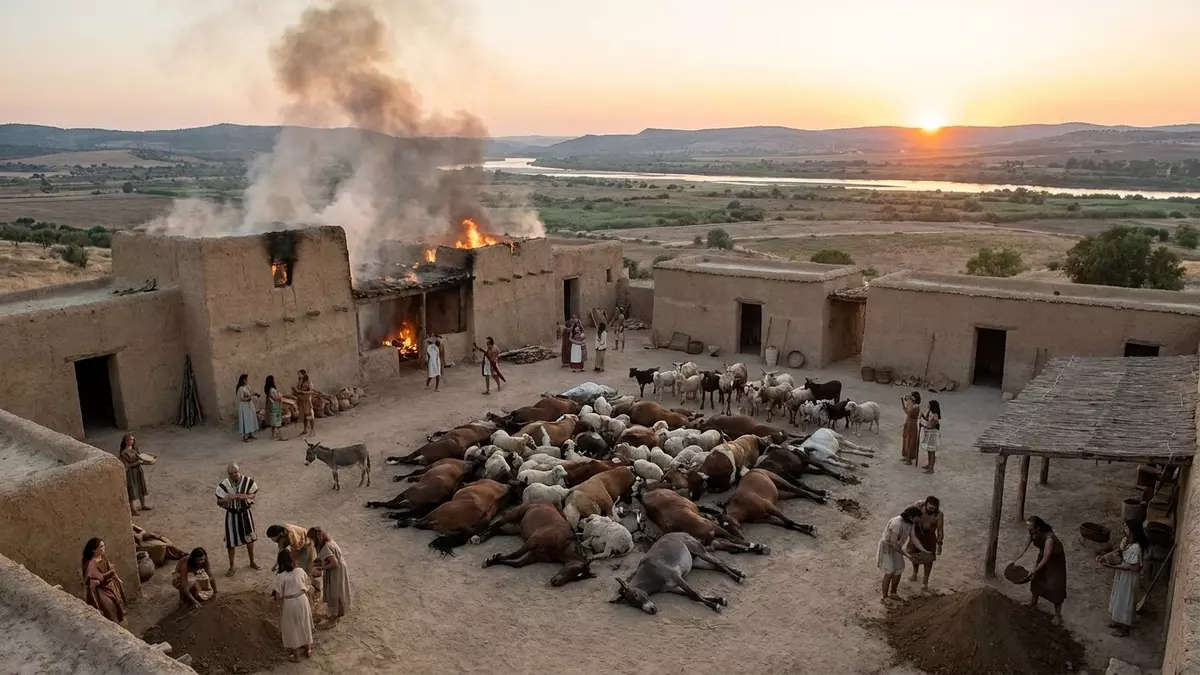
The focus of the discovery is Casas del Turuñuelo, a monumental Tartessian architectural complex located within the Guadiana River basin in Badajoz, Spain. Near the end of the 5th century BCE, the inhabitants executed a highly theatrical, multi-stage ritual. Inside a grand adobe building, they hosted a massive elite banquet.
Immediately following the feast, they slaughtered at least 52 animals inside the building’s 125-square-meter central courtyard. The sacrificial victims included 41 horses and other equids, four cattle, and three sheep or goats.

Once the bloodshed concluded, the practitioners intentionally set the entire monumental building on fire and sealed the smoking ruins beneath a massive, artificial earthen mound. This intentional burial sealed the courtyard from oxygen, moisture, and scavengers, preserving the skeletons in pristine, unviolated detail for 2,500 years.
The Science: Reading Time Capsules in Tooth Enamel
To reconstruct the biographies of these animals, a multi-institutional research team published a definitive study in the Journal of Archaeological Science: Reports. They extracted 23 teeth from 19 of the sacrificed animals, sampling along the vertical length of each tooth crown.
Because tooth enamel forms incrementally during an animal’s youth, analyzing sequential micro-sections acts like a biological tape recorder, preserving a month-by-month record of what the animal ate, drank, and where it walked.
       ┌────────────────────────────────────────────────────────┐
       │             THE ISOTOPIC PROFILE PIPELINE              │
       └───────────────────────────┬────────────────────────────┘
                                   │
         ┌─────────────────────────┼─────────────────────────┐
         ▼                         ▼                         ▼
[ Strontium Isotopes ]    [ Carbon Isotopes ]       [ Oxygen Isotopes ]
• Matches local geology   • Maps vegetation/diet    • Tracks water sources
• Identifies birthplace   • Natural pasture vs.     • Rivers vs. seasonal
  and migration routes      controlled fodder         evaporating ponds
High-Value Stallions from Foreign Lands
The results of the isotopic mapping revealed a clear division between elite, imported animals and local livestock.
The strontium isotope ratios from the horses did not match the local geological signature of Casas del Turuñuelo. Instead, their chemical values pointed to distinct, separate bloodlines raised in the western Guadiana valley—near modern-day Mérida and Badajoz. One horse displayed an entirely unique, outlying signature tracing back to older rock formations far to the east or north.
+-------------------------------------------------------------------------+
|                  CASAS DEL TURUÑUELO ANIMAL PROVENANCE                  |
+-------------------+--------------------+--------------------------------+
| Animal Category   | Isotopic Signature | Biography & Management Profile |
+-------------------+--------------------+--------------------------------+
| Elite Horses      | Non-Local          | Prime males (5–7 years old);   |
| (Stallions)       | (Mérida / Badajoz) | fed high-quality river fodder  |
+-------------------+--------------------+--------------------------------+
| Pack Donkeys      | Highly Variable    | Drastic shifts; a working      |
|                   | (Multi-regional)   | animal used for heavy transport|
+-------------------+--------------------+--------------------------------+
| Cattle & Caprines | Local              | Locally grazed on floodplains; |
| (Sheep/Goats)     | (Site Baseline)    | raised nearby for food source  |
+-------------------+--------------------+--------------------------------+
Genetic testing added a crucial biological layer: all the sacrificed horses were prime males between five and seven years old—an animal’s absolute physical peak.
Their carbon and oxygen values remained remarkably stable throughout their early development. This flat, controlled chemical profile proves they weren’t left to roam wild; they were carefully managed in dedicated stables, drinking from steady river systems or deep wells and eating a highly consistent diet of $C_3$ temperate grasses and supplemented fodder.
The Wandering Donkey vs. The Local Livestock
In stark contrast to the pampered, stable-raised horses, a single sacrificial donkey told a completely different story.
Its strontium values fluctuated wildly along the length of its tooth crown, signaling that the animal was constantly on the move, crossing entirely different geological zones during its youth. Its carbon and oxygen values were similarly chaotic, capturing a life of unpredictable grazing and opportunistic watering. This profile perfectly describes a hard-working beast of burden used to haul goods across the long-distance trade routes of ancient Iberia.
Meanwhile, the cattle, sheep, and goats yielded a highly localized footprint. Their strontium values tightly matched the immediate soil baseline of the site, and their fluctuating carbon readings captured the natural, seasonal shifts of local floodplain grazing. These animals were raised in the immediate vicinity, serving as the primary meat supply for the banquet guests, while the imported stallions were reserved for the ultimate status-driven sacrifice.
A Monument Closed by Coordinated Networks
The collective data demonstrates that the closure of Casas del Turuñuelo was a masterclass in regional organization. The ceremony was not a spontaneous local event fueled by a single farm.
Instead, organizers utilized extensive regional networks to gather a massive fleet of valuable, prime-age stallions from specialized breeding grounds across southwestern Iberia, combining them with local livestock and long-distance transport animals. This intricate gathering of resources highlights a sophisticated, highly centralized Tartessian socio-political authority capable of managing both large-scale animal husbandry and complex inter-regional trade centuries before the Roman era.
Frequently Asked Questions
What was the purpose of the animal sacrifice at Casas del Turuñuelo?
Around 2,500 years ago, the Tartessian people held a massive elite banquet inside a monumental adobe building. Following the feast, they sacrificed at least 52 animals in the courtyard, intentionally burned the structure, and sealed it under a massive mound of earth as part of a ritual closure.
How did scientists figure out where the animals came from?
Researchers used strontium isotope analysis on sequential layers of the animals’ tooth enamel. Strontium acts as a geographic fingerprint, absorbing the distinct chemical signatures of the local bedrock and water where the animal lived during its youth.
Were the sacrificed horses raised locally at the site?
No. Isotopic testing proved most of the horses came from separate, distant regions across the Guadiana basin, such as modern-day Mérida and Badajoz. This shows they were gathered from multiple distinct herds rather than a single local source.
What did the horses’ diet and age reveal about their status?
DNA testing showed the horses were all prime males between 5 and 7 years old. Their stable carbon and oxygen values indicate they were elite animals given high-quality, controlled fodder and steady well or river water, rather than being left to graze wildly.
How did the donkey’s life differ from the horses’ lives?
While the horses showed stable, controlled lifestyles, the donkey’s tooth enamel showed wildly shifting strontium and carbon values. This indicates it traveled across multiple geological zones, matching the lifestyle of a working animal used for long-distance transport.