
Table of Contents
- 1. The Kitsissut Discovery: Landing in the Great Polynya
- 2. Overturning Arctic History: The 50-Kilometer Open-Water Crossing
- 3. Inside the Ancient Outposts: Dwellings and Ecosystem Architecture
- 4. Human Engineers of the High Arctic Landscape
- 5. Center of Innovation: Rethinking Pikialasorsuaq
- 6. Frequently Asked Questions
- 6.1. What makes the Kitsissut islands discovery so historic?
- 6.2. What is a polynya, and why was it important to ancient humans?
- 6.3. What kind of boats did the first Arctic inhabitants use?
- 6.4. What are bilobate tent rings with axial features?
- 6.5. How did these ancient hunters permanently change the Arctic environment?
Seafaring Pioneers: First Arctic Settlers Crossed Open Ocean 4,500 Years Ago
A groundbreaking maritime excavation on the remote Kitsissut islands of northern Greenland has completely rewritten the history of human migration in the High Arctic. The discovery proves that Early Paleo-Inuit groups were accomplished deep-sea mariners who executed daring, planned open-water voyages across 50 kilometers of frigid Arctic ocean nearly 4,500 years ago—centuries earlier than previously believed possible.
Seafaring Pioneers First Arctic Settlers Crossed Open Ocean 4,500 Years Ago
The Kitsissut Discovery: Landing in the Great Polynya
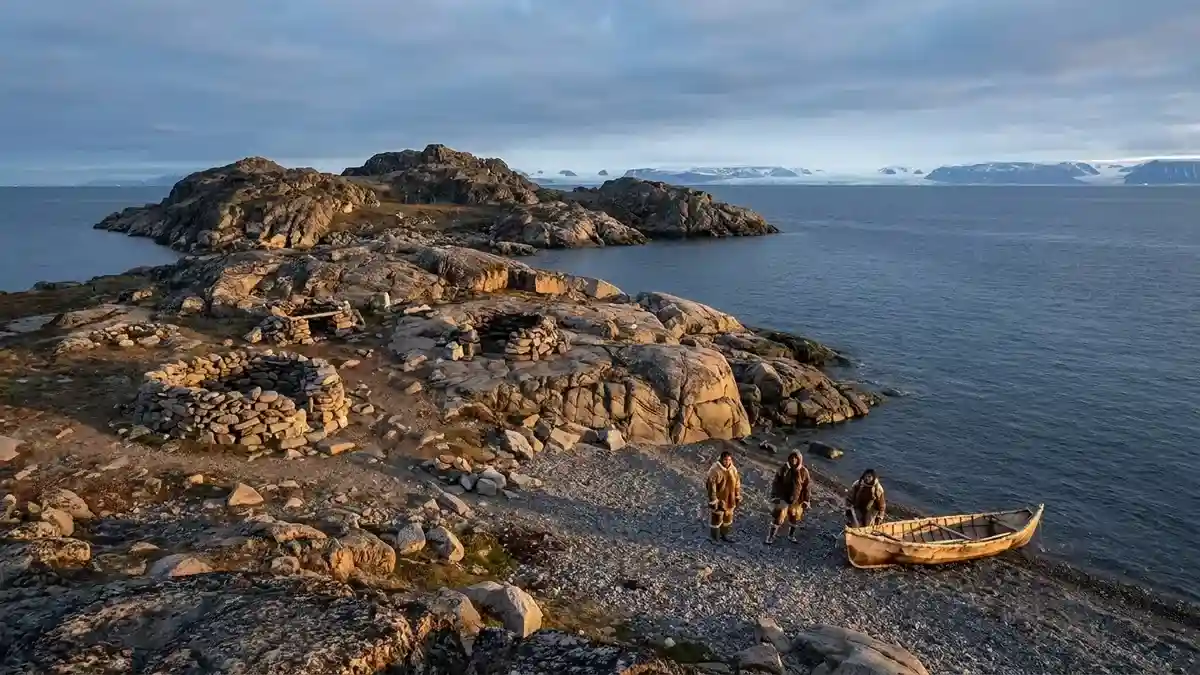
The Kitsissut islands are a jagged, isolated cluster of rocky outcrops sitting far off the mainland coast of northern Greenland. They are located deep within Pikialasorsuaq (the North Water Polynya), a massive, biologically hyper-productive area of the ocean between Greenland and Canada where powerful upwelling currents keep the water completely free of solid ice year-round.
A joint expedition led by researchers from the University of Calgary and the University of Greenland successfully documented close to 300 distinct archaeological features scattered across these remote islands. The ruins include specialized stone tent rings, central hearths, and industrial processing workshops left behind by the very first human waves to step foot in the region.

Radiocarbon dating places these settlements right at the tail end of the last major glacial retreat. The data reveals that human families arrived on these offshore islands at an incredibly early stage of the region’s environmental development, long before modern land ecosystems had even finished forming.
Overturning Arctic History: The 50-Kilometer Open-Water Crossing
For generations, anthropologists assumed that early Arctic hunters were strictly land-bound foragers who relied on winter pack ice to slowly walk between islands, viewing open water as a fatal barrier. The Kitsissut ruins completely shatter this assumption.
Reaching these islands from the Greenlandic mainland requires a continuous, open-water ocean crossing of roughly 50 kilometers. This represents the longest, most daring open-sea voyage ever identified from this early period anywhere in the global Arctic.
               [ GREENLAND MAINLAND ]
                         │
                         │  ~50-Kilometer Open-Water Crossing
                         │  (Skin-on-frame boats / Umiaks)
                         ▼
               ┌────────────────────┐
               │ PIKIALASORSUAQ     │ <-- Persistent open-water zone
               │ (The North Water)  │     Rich in marine mammals & birds
               └─────────┬──────────┘
                         │
                         ▼
               [ KITSISSUT ISLANDS ]
               (300+ ancient Paleo-Inuit stone structures discovered)
Executing a 50-kilometer blue-water transit through one of the coldest maritime environments on Earth required an incredibly advanced seafaring culture. The Early Paleo-Inuit did not achieve this by accident or drift exploration.
Instead, they possessed sophisticated, skin-on-frame watercraft (early ancestors of the kayak and umiak), a deep multi-generational understanding of open-ocean currents, and the ability to meticulously plan group travel around volatile Arctic weather windows and grinding seasonal drift ice.
Inside the Ancient Outposts: Dwellings and Ecosystem Architecture
Among the hundreds of features mapped on Isbjørne Island (one of the primary hubs within the Kitsissut cluster), archaeologists isolated unique bilobate tent rings featuring an axial mid-passage layout.

These stone outlines mark the footprints of heavy, multi-seasonal skin tents. A stone-lined corridor bisected the interior of each dwelling, containing central box hearths designed for efficient burning.
+-------------------------------------------------------------------------+
|                PALEO-INUIT ARCHITECTURAL TYPOLOGIES                     |
+------------------------------------+------------------------------------+
| Feature Type                       | Cultural & Structural Function     |
+------------------------------------+------------------------------------+
| Bilobate Tent Rings                | Double-lobed domestic dwellings    |
| Axial Mid-Passages                 | Interior stone corridors dividing  |
|                                    | living space from work zones       |
| Central Box Hearths                | Internal stone boxes built for     |
|                                    | efficient cooking & heat retention |
+------------------------------------+------------------------------------+
The campsites show clear signs of sustained, intense use across multiple generations. Families traveled out to these offshore rocks with massive bundles of supplies to exploit the dense seasonal wildlife concentrations surrounding the open polynya water, targeting sprawling seabird colonies and migrating marine mammals like seals and walruses.
Human Engineers of the High Arctic Landscape
The study, published in the journal Antiquity, highlights a fascinating and unexpected ecological byproduct of this ancient seafaring trade. By hunting, butchering, and processing thousands of tonnes of marine biomass on these rocky islands over centuries, the Paleo-Inuit inadvertently acted as major drivers of nutrient movement.
The sheer volume of discarded animal fats, bones, and organic waste transferred massive amounts of marine-derived nitrogen and phosphorus directly into the barren island soil.
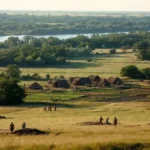
Today, the soil surrounding these ancient 4,500-year-old living zones remains highly enriched, heavily modifying local plant growth and creating lush, green carpets of vegetation that stand out in stark contrast against the surrounding gray volcanic rock. This proves that the High Arctic landscape did not develop in isolation apart from human presence; rather, it was actively sculpted and engineered by Indigenous actions from the very beginning of human settlement.
Center of Innovation: Rethinking Pikialasorsuaq
The discoveries fundamentally reframe the geopolitical role of polynyas in human prehistory. Rather than treating the open waters of Pikialasorsuaq as a marginal, terrifying boundary layer between landmasses, archaeologists now view it as a cultural engine room where early Arctic technologies were forged.
The shared technological traits observed across later Independence I, Saqqaq, and Pre-Dorset cultures likely originated from these early seafaring adaptations. Learning to navigate shifting ice edges, exploit dense open-water marine resources, and master long-distance open-sea transit allowed these ancient mariners to dominate the challenging environment of the Far North, leaving a structural footprint that continues to define the ecology of Greenland today.
Frequently Asked Questions
What makes the Kitsissut islands discovery so historic?
It provides the earliest definitive evidence of advanced open-ocean seafaring in the High Arctic, proving that Early Paleo-Inuit groups crossed 50 kilometers of open water to settle remote offshore islands nearly 4,500 years ago.
What is a polynya, and why was it important to ancient humans?
A polynya is a large area of open sea surrounded by ice that remains unfrozen year-round due to warm water currents and winds. It acts as a biological oasis, attracting massive concentrations of marine mammals, seals, walruses, and nesting seabirds, making it a prime hunting ground for ancient populations.
What kind of boats did the first Arctic inhabitants use?
While no wooden or bone boat frames survived, the 50-kilometer open-water distance proves they relied on highly sophisticated, lightweight skin-on-frame watercraft engineered to withstand open-ocean waves, freezing spray, and grinding drift ice.
What are bilobate tent rings with axial features?
These are ancient stone layouts marking the foundations of double-lobed skin tents. An axial feature is a central stone-lined walkway or corridor that bisects the interior of the dwelling, often containing box hearths for heat and cooking.
How did these ancient hunters permanently change the Arctic environment?
By bringing thousands of tonnes of hunted seals, walruses, and seabirds onto the islands for butchering, they dumped massive amounts of marine nutrients into the ground. This ancient organic waste permanently enriched the soil, creating dense pockets of lush vegetation that still thrive today.