
Table of Contents
- 1. The Tragedy of the Ice Age Prince
- 2. Arene Candide: A Sacred Cave for the Departed
- 3. The Dual Role of Red Ochre: From Medicine to Final Rituals
- 4. Mementos of Loss: The Mystery of the Fractured Pebbles
- 5. Universal Grief Across the Millennia
- 6. Frequently Asked Questions
- 6.1. Who was “the Prince” discovered in the Italian cave?
- 6.2. What kind of grave goods were buried with the Ice Age teenager?
- 6.3. Why did prehistoric humans use red ochre in burials?
- 6.4. What do the broken pebbles found in the later graves signify?
- 6.5. Where is the Arene Candide cave located?
27,000-Year-Old Ice Age Burial Proves Humans Grieved Like Us
The popular imagination often views the Ice Age as a brutal, unforgiving era dominated by a cold ethos of survival of the fittest. In this primitive rendering of history, early hunter-gatherers are frequently depicted as nomadic pragmatists who had little time, energy, or emotional capacity to mourn their dead. According to this narrative, when a member of a tribe succumbed to the elements or a predator, the survivors simply moved on, consumed entirely by their own daily struggle against extinction.
However, an extraordinary archaeological discovery in northwestern Italy completely shatters this stereotype. Deep within a coastal cave system, the ancient remains of a severely injured teenager have provided undeniable evidence that prehistoric humans experienced grief, empathy, and devotion in ways that mirror modern human emotions. This remarkable find reveals that even in the depths of the Upper Paleolithic era, human communities formed profound emotional bonds, refusing to abandon their vulnerable members in life or in death.
27,000-Year-Old Ice Age Burial Proves Humans Grieved Like Us
The Tragedy of the Ice Age Prince
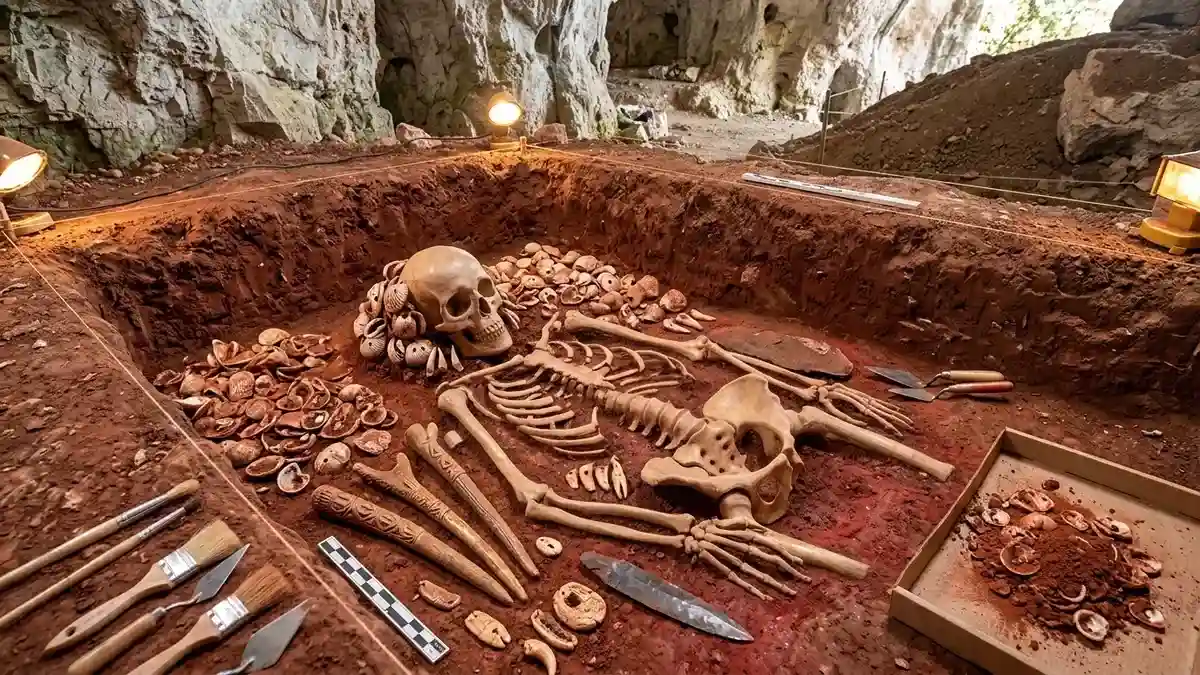
Roughly 27,500 years ago, a 15-year-old boy ventured into the wilderness of what is now Liguria, Italy. His journey took a horrific turn when he crossed paths with a massive cave bear. The encounter was catastrophic. The predatory beast launched a vicious assault, tearing through the teenager’s jaw, neck, and left shoulder. The trauma was severe, leaving portions of his jawbone and left collarbone missing.
Yet, the most profound chapter of this story lies not in the violence of the attack, but in what happened immediately afterward. The boy’s community did not abandon him to the elements. Instead, they carried his mangled body into the shelter of a nearby cave, actively tending to his catastrophic wounds. Archaeological analysis indicates that the teenager did not die instantly; rather, his companions stayed by his side, comforting him through his final days until he finally succumbed to his injuries.
When archaeologists excavated the site in May 1942, they uncovered a spectacularly preserved burial that stunned the scientific community. The youth had been laid to rest on a carefully prepared bed of rich red ochre, a natural clay pigment. He was adorned with an astonishing array of grave goods: hundreds of perforated marine shells and pierced deer canine teeth arranged neatly around his skull to form an ornate cap, exquisite mammoth ivory pendants, four intricately carved elk antler batons, and a pristine flint blade tucked securely into his right hand. Due to the sheer opulence of these funerary offerings, researchers affectionately nicknamed the young hunter-gatherer “il Principe”—the Prince.
Arene Candide: A Sacred Cave for the Departed
The theater for this ancient display of devotion was the Arene Candide cave system, a prominent archaeological site located in Finale Ligure, Italy. What makes this cavern unique is that it does not bear the typical markers of long-term domestic occupation. It was not a cozy campsite where families gathered to cook, sleep, and live out their daily routines. Instead, evidence suggests that Paleolithic communities designated this specific geological formation as a sacred sanctuary strictly reserved for the dead.
+--------------------------------------------------------------------------+
|                     ARENE CANDIDE CAVE USAGE TIMELINE                    |
+--------------------------------------------------------------------------+
|  ● 34,400 Years Ago: Earliest documented ritual use of the cave system   |
|                                                                          |
|  ● 27,500 Years Ago: Burial of "The Prince" with lavish grave goods      |
|                                                                          |
|  ● 12,500 Years Ago: Massive multi-corpse inhumations with broken pebbles|
|                                                                          |
|  ● 6th Century BCE: Final recorded ritual burials during the Neolithic   |
+--------------------------------------------------------------------------+
The human utilization of Arene Candide spans an incredible timeline, starting in the Upper Paleolithic roughly 34,400 years ago and extending all the way into the Neolithic era around the sixth century BCE. Generation after generation, distinct human groups traveled over long distances, carrying the bodies of their deceased relatives specifically to inter them within these rocky walls. This deliberate, repeated pilgrimage across thousands of years indicates a deeply entrenched cultural geography, where specific landmarks were recognized across eras as portals to honor the deceased.
The Dual Role of Red Ochre: From Medicine to Final Rituals
Central to the funerary practices at Arene Candide was the widespread implementation of red ochre. This iron-rich clay pigment was gathered, ground into a fine powder, or kept in solid chunks to be utilized in both life-saving treatments and post-mortem ceremonies.
Taphonomic evaluations of “the Prince” revealed a fascinating detail: fragments of red ochre were found embedded directly within the deep, open bone wounds inflicted by the bear. In antiquity, ochre was highly valued for its astringent properties. Because it easily binds to organic materials like skin and bone, early humans likely applied it to the teenager’s neck and shoulder as a therapeutic agent to control bleeding and prevent infection.
When those medical efforts failed, the exact same pigment was transitioned into a ritualistic tool. The community blanketed the boy’s final resting place in the brilliant red powder. This seamless crossover between emergency healthcare and funeral rites offers a moving perspective on prehistoric psychology. The very materials used to preserve life were ultimately used to sanctify death, showing a continuous cycle of care that did not terminate when a loved one drew their last breath.
Mementos of Loss: The Mystery of the Fractured Pebbles
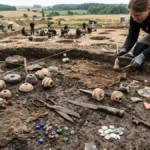
The tradition of intentional, deeply emotional mourning at Arene Candide did not fade after the burial of the Prince. Approximately 15,000 years later, a separate groups of humans utilized the exact same cavern for a massive collective burial. This later grave contained multiple individuals, all similarly resting in soil heavily saturated with red ochre.
However, this younger burial introduced a fascinating new ritualistic artifact: more than 29 oblong, flat beach pebbles, each systematically broken in half.
Through rigorous trace-evidence experiments, archaeologists confirmed that these stones were not fractured by environmental accidents or as waste products from tool manufacturing. They were intentionally split down the middle with uniform precision. One half of each pebble was heavily stained with red ochre and placed directly alongside the corpses in the grave. The matching halves, however, were completely absent from the cave site and have never been recovered.
                  [ Whole Beach Pebble Gathered ]
                                 │
                                 ▼
                 [ Stained with Sacred Red Ochre ]
                                 │
                                 ▼
                [ Intentionally Broken in Half ]
                               /   \
                              /     \
                             ▼       ▼
              [ Left in Grave ]     [ Taken by Clan ]
              *Placed with Dead*     *Kept as a Keepsake*
Anthropologists believe these missing halves served a deeply touching purpose: they were kept by the living as keepsakes. The act of breaking the stone likely served as a stark visual metaphor for a life cut short and a community fractured by loss. By taking the remaining halves with them when they departed the cave, the surviving family members carried a physical, tangible reminder of their lost companion back into the world of the living—a prehistoric equivalent to a mourning ring or a framed photograph.
Universal Grief Across the Millennia
The remarkable archaeological records preserved within Arene Candide offer a profound lesson in human evolution. They prove that our capacity to experience complex emotional trauma, process intense loss, and maintain psychological bonds with the deceased is not a modern luxury born out of comfortable civilization.
Instead, the desire to make grief tangible, survivable, and shared is woven directly into our ancient evolutionary DNA. Whether utilizing mammoth ivory, perforated shells, or fractured beach stones, our ancestors relied on symbolic expressions to navigate the painful reality of mortality. The elaborate burials of Liguria remind us that across 27,000 years of environmental upheaval and societal transformation, the human heart has always known how to weep.
Frequently Asked Questions
Who was “the Prince” discovered in the Italian cave?
“The Prince” (il Principe) is the nickname given to a 15-year-old Gravettian hunter-gatherer who died approximately 27,500 years ago. Discovered in May 1942 at the Arene Candide site in Italy, his skeleton revealed that he died after surviving a brutal bear attack. He was buried with an exceptionally wealthy array of artifacts, suggesting he held unique importance within his tribe.
What kind of grave goods were buried with the Ice Age teenager?
The teenager was buried with hundreds of marine shells and deer canine teeth that originally formed a cap around his head. Additionally, his grave contained precious mammoth ivory pendants, four decorated batons crafted from elk antlers, and a large flint blade placed directly inside his right hand.
Why did prehistoric humans use red ochre in burials?
Red ochre held both functional and symbolic value. Medicinally, it was used as an antiseptic and cauterizing agent to stop bleeding, which is why it was found inside the boy’s bear wounds. Symbolically, its blood-red coloration was widely used across Paleolithic cultures to coat graves, representing life, death, and transition.
What do the broken pebbles found in the later graves signify?
Archaeologists discovered over 29 flat beach pebbles that had been cleanly broken in half, with only one half left in the graves. Researchers believe this was an intentional mourning ritual where the broken stone symbolized a broken relationship, allowing grieving family members to take the missing half home as a keepsake to remember the deceased.
Where is the Arene Candide cave located?
The Arene Candide cave is located in Finale Ligure, within the scenic coastal region of Liguria in northwestern Italy. It is famous globally as a premier archaeological sanctuary, containing well-preserved human burials and artifacts that date from 34,400 years ago down to the 6th century BCE.