
Table of Contents
- 1. The Pazyryk Culture: Nomads of the Frozen Steppe
- 2. Piercing the Dark: How Near-Infrared Tech Revived Faded Art
- 3. Mythical Beasts and Masterful Design: The Imagery Uncovered
- 4. A Tale of Two Arms: Apprenticeship and Technique in the Iron Age
- 4.1. The Right Arm: A Master’s Touch
- 4.2. The Left Arm: The Novice’s Practice
- 5. Reconstructing the Tools and Ink of Ancient Masters
- 6. The Purpose of the Pigment: Identity Over the Afterlife
- 7. A Race Against Climate Change in the Altai Mountains
- 8. Conclusion
- 9. Frequently Asked Questions
- 9.1. 1. What unique technology was used to see the ancient tattoos?
- 9.2. 2. Who were the Pazyryk people and where did they live?
- 9.3. 3. What types of designs were found on the Siberian mummy?
- 9.4. 4. How did ancient people apply tattoos without modern machines?
- 9.5. 5. Why are climate shifts threatening these ancient archaeological sites?
New Infrared Scans of Siberian Mummy Unlock Iron Age Artistry
The frozen landscapes of the Siberian steppe have long served as a natural vault, locking away the remnants of ancient cultures from the eyes of the modern world. For over two millennia, deep within the Altai Mountains, the secrets of Iron Age nomads lay buried under layers of stone, timber, and solid ice. While early archaeological expeditions successfully retrieved the physical remains of these ancient people, the full story of their lives remained incomplete, obscured by the natural decay of human tissue over centuries.
Now, a pioneering forensic study has shattered these limitations. Utilizing high-resolution near-infrared digital imaging, researchers have pierced through the darkened, desiccated skin of a 2,500-year-old female mummy to digitally reconstruct an array of breathtakingly complex tattoos. The results provide an unprecedented look at prehistoric body modification, revealing that ancient tattooing was not merely a primitive tribal marker, but a highly sophisticated, disciplined art form requiring formal training, specialized tools, and a profound aesthetic sensibility.
New Infrared Scans of Siberian Mummy Unlock Iron Age Artistry
The Pazyryk Culture: Nomads of the Frozen Steppe
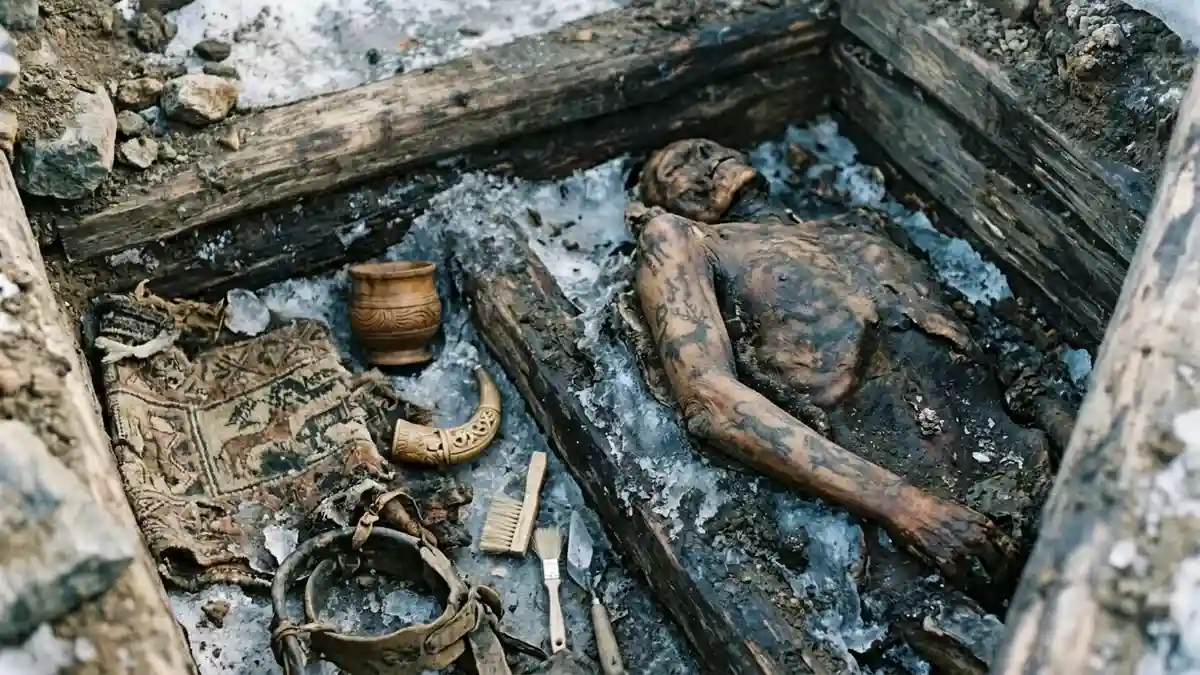
To understand the historical weight of these rediscovered tattoos, one must look to the people who wore them. The mummy belonged to the Pazyryk culture, a prominent nomadic society that flourished across the Eurasian steppe between the sixth and second centuries BCE. The Pazyryk were horse-riding warriors and pastoralists, moving through the high-altitude valleys of the Altai Mountains where Russia, China, Mongolia, and Kazakhstan meet.
While they left behind no written records, the Pazyryk communicated their wealth, beliefs, and social hierarchies through monumental architecture. They buried their elite citizens inside massive, log-lined subterranean chambers covered by heavy stone mounds known as kurgans.
Because these burial chambers were dug deep into the earth and sealed beneath heavy rock caps, rainwater seeped into the tombs and froze solid, creating localized permafrost lenses. This permanent deep-freeze halted the natural process of decomposition. It preserved organic materials that typically vanish from the archaeological record, including intricate textiles, wooden furniture, horse harnesses, and remarkably, the intact skin and muscle tissue of the deceased.
Piercing the Dark: How Near-Infrared Tech Revived Faded Art
The subject of the latest breakthrough is a woman who was approximately 50 years old at the time of her death, interred inside the prestigious Pazyryk tomb 5. When her body was initially excavated in the mid-twentieth century, scientists recognized that her skin bore traces of ancient ink. However, after 2,500 years of environmental exposure and tissue desiccation, the skin had darkened to a deep brown hue, rendering the tattoos nearly invisible to the naked human eye. For decades, historians had to rely on hand-drawn schematic sketches that captured only the vague outlines of the original designs.
To bypass this visual barrier, a research team led by Dr. Gino Caspari of the Max Planck Institute of Geoanthropology turned to advanced near-infrared (NIR) digital photography. This technology operates on a simple yet powerful physical principle:
[Visible Light] ➔ Blocked by Darkened, Aged Skin ➔ Tattoos Remain Invisible
[Near-Infrared Light] ➔ Penetrates Skin Surface ➔ Absorbed by Carbon Ink ➔ Exposes Hidden Design
While visible light is scattered or absorbed by the heavily degraded surface of the mummy’s skin, near-infrared light possesses a longer wavelength capable of penetrating the uppermost layers of human tissue. The dark carbon-based ink utilized by the ancient tattooists absorbs infrared light differently than the surrounding skin cells, creating a sharp, high-contrast digital signature.
By capturing these images with submillimeter precision, the team managed to map out the entire layout of the body art, correcting for skin folds and shrinkage caused by the centuries-long drying process.
Mythical Beasts and Masterful Design: The Imagery Uncovered
The digital reconstructions have exposed a vibrant canvas of Iron Age iconography that has stunned both historians and modern tattoo artists alike. The designs are executed in the classic Scytho-Siberian animal style, characterized by highly stylized, dynamic representations of real and mythical beasts locked in perpetual motion or combat.
On the woman’s right forearm, the near-infrared scans revealed a magnificent stag, its body gracefully contorted and surrounded by a sleek pack of stalking leopards. On the left arm, the imagery takes a more aggressive, mythological turn, portraying a ferocious griffin—a legendary beast combining the features of a lion and an eagle—locked in mortal combat with a panicked deer.
The sheer elegance of the linework, the balanced utilization of negative space, and the anatomical precision of the animal forms prove that these illustrations were not casual or haphazard markings. The complexity of the compositions indicates that tattooing within Pazyryk society was a highly specialized profession. The artisans who executed these pieces possessed a deep command of proportion, balance, and flow, adapting their designs to match the natural muscular contours of the human body.
A Tale of Two Arms: Apprenticeship and Technique in the Iron Age
One of the most fascinating revelations produced by the high-resolution mapping is the stark contrast in artistic quality between the mummy’s left and right limbs. This variance provides an intimate look at the human element behind the ancient craftsmanship.
The Right Arm: A Master’s Touch
The tattoos decorating the right forearm exhibit perfectly uniform line weights, flawless symmetry, and a highly deliberate placement of motifs. The structural consistency of the ink distribution suggests these pieces were executed by an experienced master craftsman, likely across at least two separate, highly coordinated sessions.
The Left Arm: The Novice’s Practice
In contrast, the imagery mapped across the left arm displays significantly less precision. The lines are uneven, the spacing is slightly erratic, and the overall composition lacks the fluid grace found on the opposite limb.
Archaeologists hypothesize that these left-arm designs may represent work completed much earlier in the woman’s life, or they may be the work of a novice apprentice learning the trade under a master’s supervision. This finding provides direct material evidence of a structured system of artistic apprenticeship operating within Iron Age nomadic societies.
Reconstructing the Tools and Ink of Ancient Masters
To uncover the exact technical methods used to embed these designs into the skin, the research team collaborated with Daniel Riday, a professional tattoo artist specializing in the replication of ancient historical body art using traditional, non-electric tools.
[Hand-Poking Process] ➔ Single-point or Multipoint Tool ➔ Manual Skin Puncturing ➔ Solid, Fluid Lines
By examining the microscopic spacing and indentation patterns of the ink deposits under high magnification, Riday determined that the Pazyryk artisans utilized a technique known as hand-poking. Rather than skin-stitching (a method common among some Arctic cultures where a thread soaked in ink is dragged beneath the skin), the Pazyryk tattooists manually punctured the skin repeatedly using fine-tipped needles.
The forensic analysis suggests that the artisans utilized both single-point instruments for delicate detail work and multipoint tools designed to speed up the process of shading and solid line work. While no specialized tattooing needles have been recovered from the Pazyryk kurgans to date, researchers believe this is because the tools were manufactured from organic materials like animal bone, horn, or hardwood, which could easily degrade if not caught in the immediate permafrost zones.
The pigment itself was crafted from readily available resources, primarily composed of fine soot, charcoal, or burnt plant matter mixed with a liquid binder like water or animal fat to create a fluid, durable ink. Riday further suggested that due to the extreme complexity of the animal layouts, the master artists likely stenciled or painted the outlines onto the skin using a temporary pigment before commencing the painful, permanent hand-poking process.
The Purpose of the Pigment: Identity Over the Afterlife
Why did these ancient nomads endure hours of physical discomfort to decorate their skin? While some global cultures utilized tattoos primarily for medicinal, magical, or funerary protection, the forensic evidence from tomb 5 points in a different direction.
During the post-mortem inspection, researchers discovered that a majority of the woman’s tattoos had been directly cut through, disrupted, and sewn back together during the embalming process. Pazyryk mortuary customs involved removing the internal organs and brain of elite individuals, filling the cavities with aromatic grasses, and suturing the incisions before burial.
The fact that the embalmers showed no hesitation in slicing directly through these beautiful works of art suggests that the tattoos themselves held no specific, mandatory religious role in navigating the afterlife. Instead, the body art existed primarily for the living world. The tattoos operated as a permanent visual resume, reflecting the individual’s high social status, tribal lineage, personal achievements, and membership within an elite class during her life on the Eurasian steppe.
A Race Against Climate Change in the Altai Mountains
While modern imaging technology has allowed these ancient designs to be preserved digitally, the physical tombs themselves are facing an existential crisis. The frozen kurgans of the Altai Mountains have remained intact for 2,500 years solely because of the stable sub-zero temperatures maintained within the permafrost lenses.
Unfortunately, global climate change is causing a rapid elevation in regional temperatures across Siberia. As the permafrost melts, the water inside the burial chambers liquefies, triggering rapid bacterial growth and accelerating the decay of preserved organic tissues, skin, and ancient textiles.
Scientists warn that we are currently locked in a high-stakes race against time. The deployment of non-destructive, high-tech documentation methods—like the near-infrared scanning utilized by Dr. Caspari’s team—is an urgent priority to permanently rescue and record these invaluable archives of human heritage before the physical mummies dissolve into history.
Conclusion
The high-resolution digital resurrection of the Pazyryk tattoos has provided the global scientific community with far more than a stunning visual display. It has allowed us to look past old stereotypes that view ancient nomads as unrefined barbarians, replacing that narrative with a vibrant reality of a deeply artistic, technically proficient society. By tracing the unique styles, master-apprentice dynamics, and precise tool marks locked within this 2,500-year-old ink, archaeology reminds us that the human desire for self-expression, identity, and high art is a timeless thread that binds us across the millennia.
Frequently Asked Questions
1. What unique technology was used to see the ancient tattoos?
Researchers utilized advanced, high-resolution near-infrared (NIR) digital photography. Because the mummy’s skin had darkened significantly due to 2,500 years of dehydration and aging, the tattoos were invisible to the naked human eye under standard visible light. Infrared light can penetrate the degraded upper skin layers, bouncing off the underlying carbon ink to create a highly visible, clear digital image.
2. Who were the Pazyryk people and where did they live?
The Pazyryk were a sophisticated Iron Age nomadic culture that inhabited the Eurasian steppe and the Altai Mountain region between the sixth and second centuries BCE. They are famous for their horse-riding traditions, complex metallurgy, and the construction of massive wooden burial mounds called kurgans, which frequently preserved organic materials due to localized permafrost formation.
3. What types of designs were found on the Siberian mummy?
The tattoos were executed in the traditional Scytho-Siberian animal style, featuring highly stylized representations of real and mythical creatures. The digital scans exposed an elaborate scene of a stag surrounded by stalking leopards on the woman’s right forearm, and a dramatic depiction of a mythical griffin battling a deer on her left arm.
4. How did ancient people apply tattoos without modern machines?
Forensic analysis and experimental reconstructions prove that the Pazyryk utilized a manual “hand-poking” method. Artisans punctured the skin repeatedly using fine-tipped single or multipoint needles crafted from organic materials like bone, horn, or wood. The ink was composed of a mixture of fine soot or charred plant matter bound with liquid or fat.
5. Why are climate shifts threatening these ancient archaeological sites?
The remarkable preservation of Pazyryk mummies, skin, and textiles is entirely dependent on the permanent ice layers trapped inside their stone-covered burial mounds. Due to rising global temperatures, this permafrost is thawing rapidly, causing the protective ice to melt and leading to the immediate destruction and decay of the ancient organic materials hidden inside.