
Table of Contents
- 1. Piercing the Canopy: How LiDAR Exposed a Hidden Civilization
- 2. The Architecture of Ollape: Round Houses and Geometric Friezes
- 2.1. The Engineering of Circular Dwellings
- 2.2. Sacred Artistic Adornments
- 3. The Mystery of the Clava Heads and Ancient Connections
- 3.1. Tracking a Prehistoric Link to Chavín Art
- 4. Reimagining the “Warriors of the Clouds”
- 5. Conclusion
- 6. Frequently Asked Questions
- 6.1. 1. Who were the Chachapoyas and where did they live?
- 6.2. 2. How did archeologists find a lost city hidden under a thick jungle?
- 6.3. 3. What are “clava heads” and why are they important?
- 6.4. 4. What is the historical connection between this site and the Chavín culture?
- 6.5. 5. How does this new discovery change our understanding of Peruvian history?
Lost City Discovery Gives Archeologists Fresh Look at Ancient Peru
The high-altitude cloud forests of the Peruvian Andes have long guarded the secrets of pre-Columbian civilizations. For centuries, dense, nearly impenetrable blankets of emerald vegetation and persistent mountain mists have concealed vast architectural complexes built by societies that thrived long before European contact. Among these enigmatic societies, the Chachapoyas—frequently designated by historians and early chroniclers as the “Warriors of the Clouds”—have stood out as one of the most intriguing yet poorly understood cultures of South America.
A remarkable archaeological breakthrough in northern Peru’s Amazonas region is fundamentally shifting our understanding of this ancient society. An international research initiative utilizing advanced aerospace scanning technology has exposed a massive, previously unknown urban complex hidden beneath the canopy. Unearthing more than 200 ancient stone structures and two exceptionally rare, deliberately placed ceremonial club heads, the discovery provides an unprecedented look at a highly sophisticated Andean culture, forcing historians to re-evaluate established narratives surrounding regional trade, spiritual traditions, and social complexity.
Lost City Discovery Gives Archeologists Fresh Look at Ancient Peru

Piercing the Canopy: How LiDAR Exposed a Hidden Civilization
The site of this major discovery is located within the rugged terrain of the La Jalca district at the Ollape Archaeological Site. For decades, traditional foot surveys in this sector of the Amazonas region were severely limited by the sheer hostility of the landscape and the thickness of the cloud forest growth. To bypass these physical limitations, the research team implemented a modern aerial survey campaign that effectively pulled back the jungle’s curtain.
The project was made possible through a collaborative alliance between the Kuelap Archaeology and Anthropology Research Institute (INAAK) and the Xalca Grande Archaeological Project, with critical technical support provided by the UNTRM Geomatics Research Laboratory. The team deployed drones equipped with Light Detection and Ranging (LiDAR) systems alongside high-resolution aerial mapping equipment.
LiDAR technology operates by firing hundreds of thousands of rapid laser pulses from an aircraft down toward the ground. By measuring the exact time it takes for these light beams to bounce back after striking solid objects, computer software can filter out the organic canopy of trees and brush. This process generates a highly accurate, three-dimensional digital map of the bare ground surface underneath.
When the researchers analyzed the resulting data, they did not find a small, isolated outpost. Instead, the scans revealed a sweeping, tightly interconnected network of permanent settlements terraced directly into the steep mountain slopes, mapping out an extensive urban footprint that had eluded ground-based explorers for generations.
The Architecture of Ollape: Round Houses and Geometric Friezes
The architectural footprint mapped across the Ollape complex provides striking physical proof of an advanced civic and engineering tradition. The LiDAR data and subsequent ground verification confirmed the presence of over 200 distinct pre-Hispanic stone structures.
The Engineering of Circular Dwellings
Unlike the sharp, rectangular architecture favored by the expanding Inca Empire further south, the Chachapoyas people possessed a distinct preference for circular architecture. The structures at Ollape are primarily heavy stone roundhouses built upon massive, leveled terrace foundations.

These circular designs were perfectly adapted to the wet, seismic environment of the high-altitude cloud forests. Round walls distribute structural stress more evenly than flat walls, making them highly resilient against frequent mountain earth tremors. Additionally, the aerodynamic shape allowed fierce mountain winds to pass around the homes smoothly, while specialized drainage channels built into the stone foundations directed heavy tropical rainfall away from the living spaces.
Sacred Artistic Adornments
Beyond the sheer utility of the homes, the excavations revealed that the residents of Ollape treated their architecture as a canvas for cultural and spiritual expression. Several of the circular buildings feature elaborate stone friezes—decorative bands of carved masonry embedded directly into the exterior walls.
Among these architectural flourishes, teams discovered a previously undocumented variation of a classic zigzag design. In Andean iconography, these continuous geometric patterns were rarely purely decorative; they frequently carried deep symbolic weight, representing sacred entities such as the mountain serpent, the flow of vital water sources down the peaks, or the jagged lightning bolts associated with regional weather deities. The presence of these uniform artistic details across dozens of separate homes points to a shared cultural identity and a highly organized community of skilled stonemasons.
The Mystery of the Clava Heads and Ancient Connections
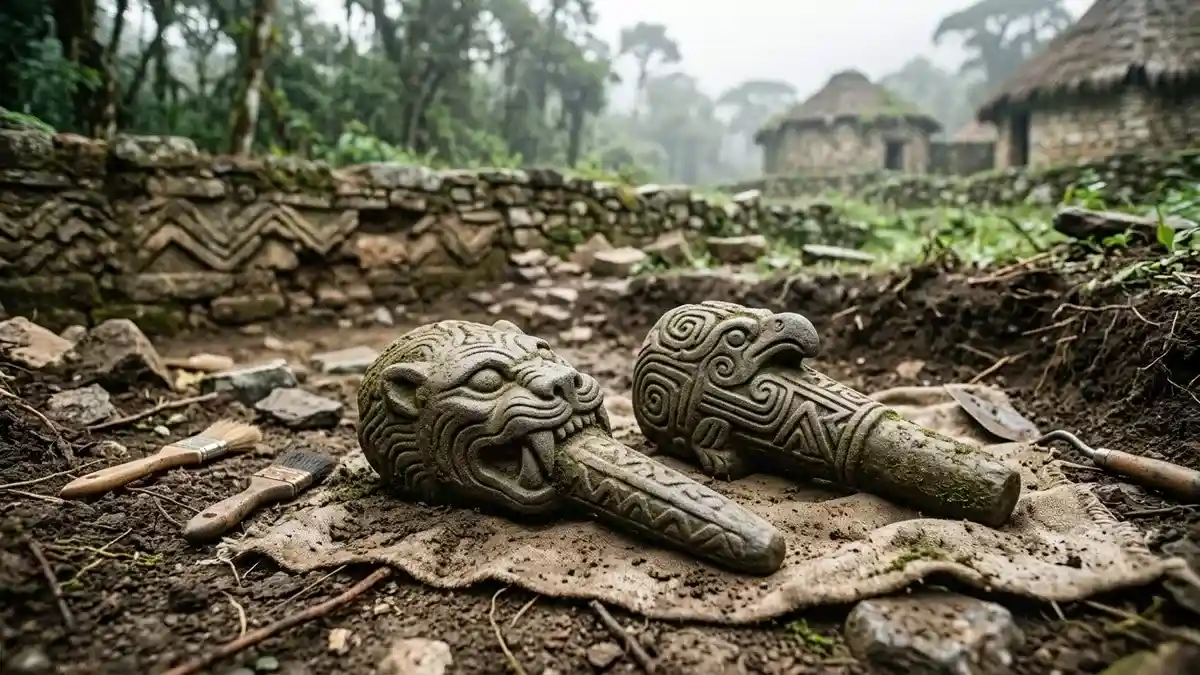
While the discovery of an entire hidden city is historically monumental, it was the recovery of two unique portable artifacts within the ruins that has generated intense academic excitement. While clearing the rubble of a substantial perimeter wall, field researchers uncovered two complete ceremonial club heads, traditionally referred to by South American archeologists as “clava heads.”
[Perimeter Wall Rubble] ➔ [Discovery of 2 Clava Heads] ➔ [Deliberate Spiritual Alignment Confirmed]
Clava heads are highly stylized, carved stone artifacts shaped like clubs or stylized animal and human faces, frequently featuring a elongated neck or pin designed to insert the object directly into stone masonry. The context of this specific find is highly significant. The orientation, placement, and condition of the two clava heads suggest they were not simply dropped, discarded, or lost during a conflict. Instead, they had been intentionally positioned inside the wall structure, serving a protective, symbolic, or spiritual purpose—potentially acting as sacred guardians to bless the perimeter of the civic complex.
Tracking a Prehistoric Link to Chavín Art
What makes these specific clava heads historically profound is their clear stylistic affinity with the artifacts of the ancient Chavín culture. The Chavín civilization was a highly influential, foundational Andean culture that flourished roughly between 900 and 200 BCE, centered at the monumental site of Chavín de Huántar hundreds of miles away.
Finding artifacts at a first-millennium Chachapoyas site that closely mirror Chavín artistic styles opens up two revolutionary historical possibilities for researchers:
Extended Artistic Preservation: The local population in the cloud forests deliberately preserved, cherished, and handed down sacred artistic traditions and religious iconography across many centuries, long after the core Chavín civilization had collapsed.
Long-Distance Ancient Contact: Early Chachapoyas communities maintained active, long-distance trade and cultural exchange networks with older Formative-period centers, trading ideas, religious beliefs, and high-status artistic styles across the rugged mountain ranges.
Reimagining the “Warriors of the Clouds”
The Chachapoyas culture flourished at extreme altitudes within the cloud forests of Peru from approximately CE 200 until their eventual conquest by the expanding Inca Empire around 1500 CE. Historically, the global public has associated this civilization with a few famous, isolated epicenters:
The Fortress of Kuelap: A massive, walled city perched atop a mountain ridge, featuring towering stone walls and hundreds of interior roundhouses.
The Sarcophagi of Carajía: Unique, clay funeral capsules perched precariously on sheer cliff faces, housing the mummies of elite elders.
Laguna de las Momias (Mummy Lake): A remote cliffside burial site that preserved hundreds of intact mummies and valuable historical artifacts.
For centuries, much of what was known about the daily lives, political structures, and ritual systems of the Chachapoyas was derived almost entirely from the biased written records left behind by Inca conquerors and Spanish chroniclers. These external accounts frequently oversimplified Chachapoyas society, painting them primarily as a loose collection of aggressive, independent mountain warriors.
The newly exposed Ollape complex challenges these old textbook narratives by demonstrating a much greater territorial size, a denser population footprint, and a significantly higher level of internal social complexity than previously recorded. The unique layout of the ritual centers and the distinct style of the stone artifacts suggest that the Chachapoyas world was culturally diverse, practicing localized rituals and religious ceremonies that differed from those observed at Kuelap.
Conclusion
The ongoing excavations at the Ollape site are providing the global historical community with far more than a simple collection of stone walls and ancient tools. By using modern aerospace technology to pierce the dense cloud forest canopy, archaeological science has brought an entire forgotten city back into the light. As field teams continue to carefully clear the stone foundations and map out the full extent of this ceremonial complex, they are reconstructing a vibrant narrative of a deeply artistic, spiritually complex, and highly organized society that successfully mastered one of the most challenging environments on Earth.
Frequently Asked Questions
1. Who were the Chachapoyas and where did they live?
The Chachapoyas, often called the “Warriors of the Clouds,” were an advanced pre-Hispanic civilization that flourished from around CE 200 to 1500. They lived at extreme altitudes within the humid, mountainous cloud forests of the Amazonas region in northern Peru, developing unique architectural and artistic traditions perfectly adapted to the rugged terrain.
2. How did archeologists find a lost city hidden under a thick jungle?
The discovery was made possible by utilizing LiDAR (Light Detection and Ranging) technology mounted on drones. By firing rapid laser pulses down through the dense forest canopy and mapping the reflections, researchers constructed a precise 3D digital model of the ground surface, exposing over 200 hidden structures that were invisible from the air and ground.
3. What are “clava heads” and why are they important?
Clava heads are ancient, stylized stone carvings shaped like ceremonial clubs or symbolic faces. The discovery of two clava heads at the Ollape site is highly significant because their deliberate placement inside a perimeter wall suggests they carried deep spiritual value, possibly serving as symbolic guardians for the urban complex.
4. What is the historical connection between this site and the Chavín culture?
The newly discovered clava heads display clear stylistic similarities to artifacts from the ancient Chavín culture (c. 900–200 BCE). Because the Chavín civilization predated the height of the Chachapoyas, this stylistic link indicates either long-distance cultural trade or the preservation of sacred artistic traditions across centuries.
5. How does this new discovery change our understanding of Peruvian history?
Previously, Chachapoyas society was known primarily through the accounts of Inca and Spanish chroniclers, who often framed them simply as fragmented mountain tribes. The immense size, architectural complexity, and unique ritual artifacts found at the Ollape site prove that the civilization possessed a highly organized social structure and diverse cultural practices that varied significantly across the region.