
Table of Contents
- 1. The Scale of the Treasure: 5,000 Everyday Coins
- 1.1. The Bulk of the Hoard: “Boratynki” Copper Coins
- 2. The Hidden Silver and an 18th-Century Burial Date
- 3. Safekeeping in Volatile Times
- 4. Frequently Asked Questions
- 4.1. What are “boratynki” coins?
- 4.2. When exactly was this coin treasure buried?
- 4.3. How much money was the hoard worth in the 17th century?
- 4.4. Were there any human remains or containers found with the coins?
- 4.5. Where can the public see the newly discovered coin hoard?
Large 17th-Century Coin Hoard Unearthed in Eastern Poland
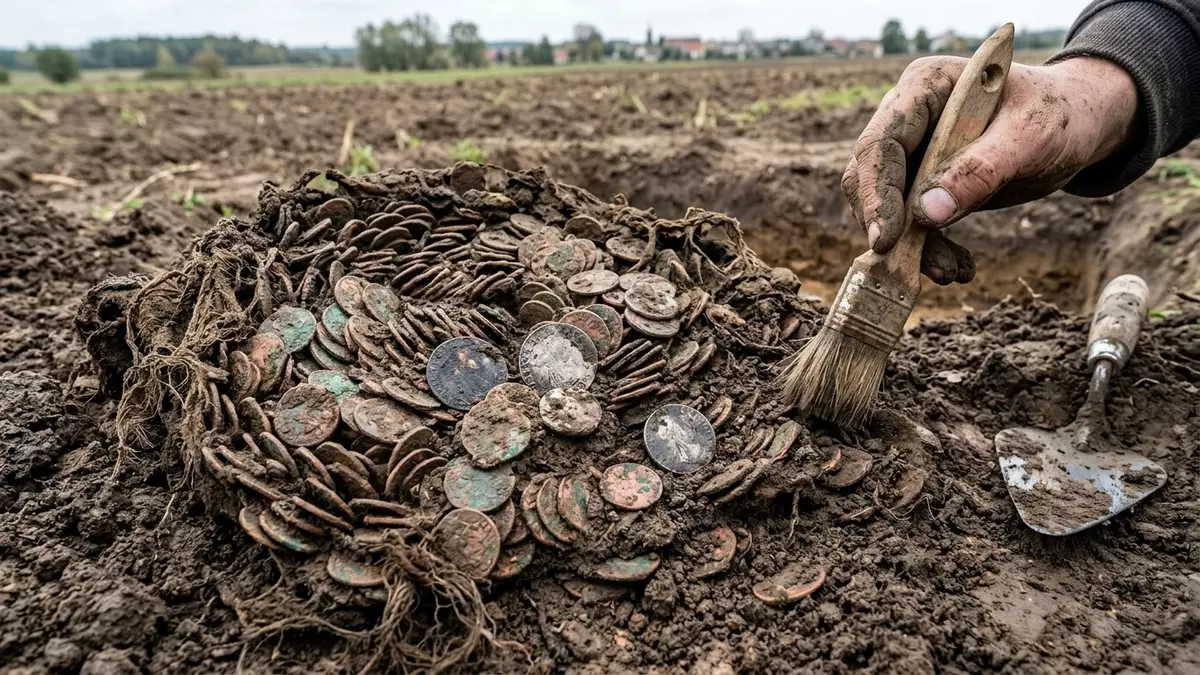
A massive treasure cache consisting of thousands of mid-17th-century coins has been discovered near the village of Zewierszczów in the Lublin Voivodeship of eastern Poland. Found by a licensed metal detectorist, the hoard provides an incredibly rare and detailed look into the everyday economic life and monetary circulation of the region during a deeply volatile period in European history.
The discovery was made by Grzegorz Panek, an experienced member of the Hrubieszów Historical–Exploration Association “GROSSUS.” Panek, who holds official conservation permits to search for historical artifacts, was investigating a powerful signal from his detector when he uncovered a small cluster of copper coins near the soil’s surface. What initially looked like a few scattered pieces quickly turned into a major archaeological event as thousands of coins began pouring out of the earth.
Large 17th-Century Coin Hoard Unearthed in Eastern Poland
The Scale of the Treasure: 5,000 Everyday Coins
Upon realizing the magnitude of the find, Panek immediately halted his excavation and contacted provincial heritage authorities. The following day, archaeologists from the state conservator’s office in Zamość and curators from the Hrubieszów Museum arrived to formally secure the site.
Due to centuries of intensive agricultural plowing and natural soil erosion, no structural remains or chest features survived to mark the spot. Instead, the vast collection of coins lay concentrated in the disturbed topsoil. In total, the recovered hoard is estimated to contain roughly 5,000 individual specimens.
The Bulk of the Hoard: “Boratynki” Copper Coins
A preliminary analysis conducted by numismatic experts reveals that the overwhelming majority of the copper coins date between 1650 and 1657, tracing back to the turbulent reign of King Jan II Kazimierz Vasa.
These small-denomination copper coins are widely known to history buffs as “boratynki.” They were named after Tito Livio Burattini, the infamous master of the royal mint who introduced the mass production of these low-value coins to stabilize the state’s crippled finances after devastating wartime occupations. While an individual “boratynka” held very little purchasing power in its day and remains common among collectors today, discovering an intact, concentrated mass of 5,000 pieces gives researchers an unparalleled dataset to analyze the inflation and economic reality of early modern Poland.
The Hidden Silver and an 18th-Century Burial Date
While copper dominated the find, the individual who buried the wealth also tucked away a distinct sub-cache of higher-value currency. Hidden among the copper pieces were 29 premium silver coins.
This silver selection included:
Six-grosz coins minted under King Jan II Kazimierz.
Later silver specimens minted during the reign of King John III Sobieski.
Foreign and regional silver currencies struck under rulers such as Frederick William of Brandenburg, Leopold I, Christian of Wolosek, and Joachim VIII.

[Copper Base Layer: 1650–1657] + [Silver Premium Coins: 1660–1705] ──> Concealed Early 18th Century
The minting dates of the silver coins span from 1660 to 1705. Because the youngest silver coins were struck at the dawn of the 18th century, archaeologists have concluded that the entire hoard was likely concealed right around the year 1705. This timeline is further supported by the discovery of microscopic, decayed remnants of canvas fabric clinging to the coins—the physical remains of the original cloth bag used to hold the treasure when it was lowered into the ground.
Safekeeping in Volatile Times
The transition between the late 17th and early 18th centuries was an incredibly dangerous era for eastern Europe. Buffeted by civil strife, shifting alliances, and destructive conflicts like the Great Northern War, the local populations of Poland faced constant threats of military looting and financial ruin.
| Coin Type | Dominant Material | General Minting Era | Historical Context |
| Boratynki | Copper | 1650–1657 | Mass-produced, everyday pocket change minted to rescue state finances. |
| Grosz & Thalers | Silver | 1660–1705 | Elite, high-value regional and foreign currency saved for true wealth preservation. |
The Zewierszczów hoard serves as a direct, tangible reflection of this pervasive anxiety. Burying money beneath the earth was the primary security method of the age. The fact that this substantial fortune remained untouched for over 320 years tells its own silent tragedy: whoever buried this bag of wealth for safekeeping was likely swept up in the chaos of the era, never returning to reclaim their life savings.
The entire treasure cache has been transferred to the conservation laboratories of the Hrubieszów Museum. Over the coming months, specialists will clean, stabilize, and log each coin to prepare the collection for a major public exhibition, restoring a piece of regional heritage back to the community.
Frequently Asked Questions
What are “boratynki” coins?
“Boratynki” are small-denomination copper coins minted in massive quantities during the 17th century in the Kingdom of Poland and the Grand Duchy of Lithuania. They were introduced by a royal official named Tito Livio Burattini to serve as everyday, low-value currency during a period of intense financial crisis.
When exactly was this coin treasure buried?
While the bulk of the copper coins date back to the 1650s, the inclusion of silver coins minted as late as 1705 indicates that the treasure bag was likely buried at the very beginning of the 18th century, potentially during the geopolitical disruptions of the Great Northern War.
How much money was the hoard worth in the 17th century?
An individual copper boratynka was worth very little, representing the pocket change used by everyday peasants to buy bread or minor goods. However, a bulk collection of 5,000 copper pieces combined with 29 high-value silver coins represented a substantial, consolidated sum of savings for an individual or family trying to protect their assets from war.
Were there any human remains or containers found with the coins?
No human remains or structural boxes were found at the site due to centuries of agricultural plowing that churned up the earth. However, archaeologists did discover microscopic traces of decayed canvas fabric mixed with the soil, which points to the coins originally being buried inside a basic cloth bag.
Where can the public see the newly discovered coin hoard?
The entire hoard has been safely relocated to the Hrubieszów Museum in Poland. It is currently undergoing specialized chemical conservation and cataloging by numismatic experts, with museum officials planning to place the collection on permanent public display once the preservation process is complete.