
Table of Contents
- 1. Unveiling the Grave of an Elite Iron Age Warrior
- 2. High Luxury and the Mediterranean Trade Connection
- 3. The Chariot Burial Paradox
- 4. Redrawing the Map of Celtic Power
- 5. Frequently Asked Questions
- 5.1. What makes the Bad Camberg burial so important to European archaeology?
- 5.2. How do scientists know it was a warrior’s grave if no bones survived?
- 5.3. What is an Etruscan beaked jug, and how did it get to Germany?
- 5.4. How rare are chariot burials in this part of Germany?
- 5.5. What will happen to the hidden artifacts still trapped inside the soil blocks?
2,500-Year-Old Celtic Chariot Burial With Gold and Etruscan Treasures Discovered in Germany
In a spectacular archaeological breakthrough, a routine survey ahead of a solar energy project in central Germany has exposed the ultra-wealthy grave of a Celtic warrior elite who lived roughly 2,500 years ago. Uncovered near the town of Bad Camberg in the state of Hessen, the undisturbed burial provides some of the most definitive proof ever found of a powerful, localized ruling class dominating the region during the early La Tène period of the Iron Age.
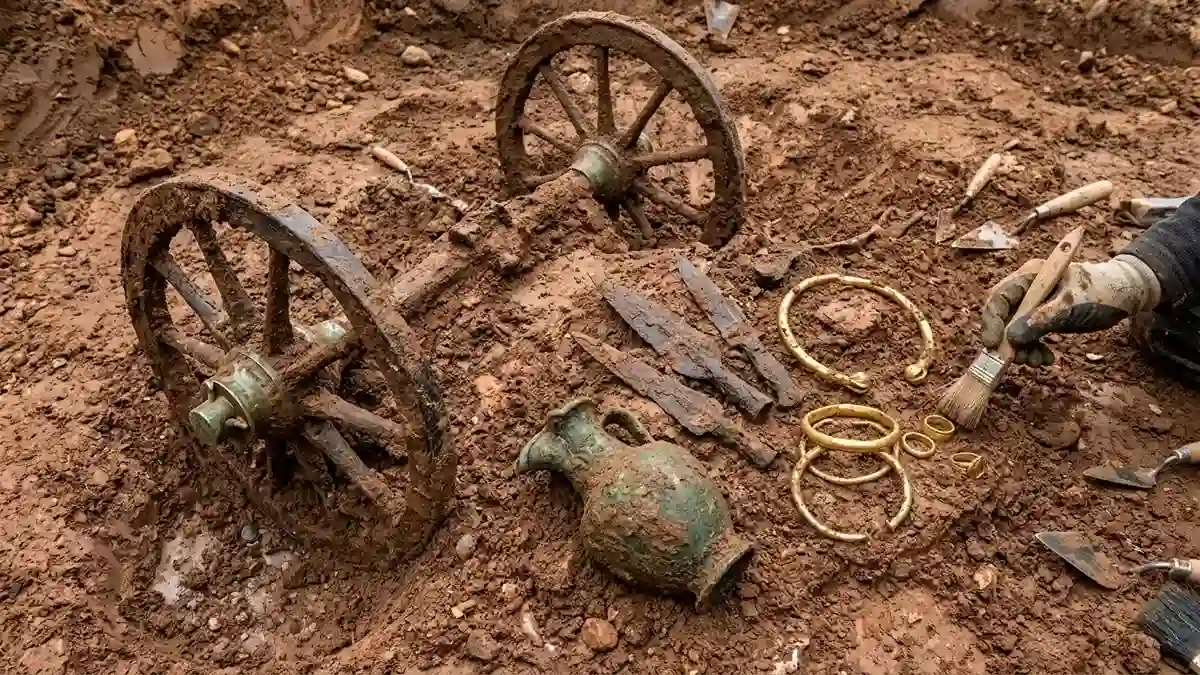
The remarkable discovery was made by an excavation team from the archaeological firm SPAU GmbH. Working under a tight two-week timeline to ensure construction on the solar park could proceed without delay, researchers successfully salvaged an array of gold jewelry, advanced weaponry, a physical two-wheeled combat chariot, and luxury Mediterranean imports.
2,500-Year-Old Celtic Chariot Burial With Gold and Etruscan Treasures Discovered in Germany
Unveiling the Grave of an Elite Iron Age Warrior
Due to the highly acidic nature of the local soil, the physical skeleton and teeth of the deceased completely dissolved over the millennia. Despite the absence of human remains, the highly specific collection of accompanying artifacts has allowed archaeologists to confidently profile the grave’s occupant as an elite, high-status male warrior from the 5th century BCE.

The first artifact pulled from the earth was a heavy iron spearhead, which immediately alerted teams to the significance of the plot. As the excavation deepened, a hoard of precious metals was revealed. Archaeologists recovered an array of solid gold jewelry, including dedicated rings designed for the warrior’s fingers, arms, and neck. Finding precious gold work of this caliber is an exceptionally rare occurrence for Celtic burials of this specific timeframe.
High Luxury and the Mediterranean Trade Connection
Beyond regional wealth, the burial highlights the incredibly far-reaching trade networks that connected the tribal societies of prehistoric Germany to the classical civilizations of the Mediterranean world.
Among the most stunning luxury goods recovered from the grave was an authentic Etruscan beaked jug. Forged hundreds of miles away in what is now Tuscany, Italy, bronze vessels of this caliber were considered the absolute pinnacle of prestige and luxury across Iron Age Europe.
| Grave Artifact | Original Geographic Origin | Socio-Economic Purpose |
| Gold Rings & Torcs | Central Germany (Local) | Broadcasted immense personal wealth and high ruling status. |
| Iron Spearheads & Knife | Central Germany (Local) | Defined the individual’s social role as a defender and warrior. |
| Bronze Beaked Jug | Tuscany, Italy (Etruscan) | Luxury wine-serving vessel highlighting trans-Alpine trade. |
| Two-Wheeled Chariot | Central Germany (Local) | Elite military vehicle used for status displays and warfare. |
The presence of the Etruscan jug proves that the ruling class of Hessen maintained sophisticated, long-distance diplomatic and commercial relationships with Mediterranean merchants. Similar high-status vessels have previously been documented at Glauberg, one of Germany’s most famous and celebrated Celtic power centers.
The Chariot Burial Paradox
While the gold and imported bronze stunned researchers, the most surprising revelation was the presence of a full, two-wheeled Celtic chariot buried directly beneath the warrior.
While the wooden components of the vehicle had naturally rotted away, the durable iron and bronze fittings remained perfectly arranged in the soil. Archaeologists successfully isolated and mapped out preserved wheel hub fittings, specialized axle caps, and structural iron wheel-rim fragments.

[Chariot Wheel Placement] ──> Iron Rims ──> Bronze Axle Caps ──> High-Status Identification
Chariot burials are incredibly rare within the state of Hessen. While a small handful of vehicle graves have been mapped in past decades, archaeologists state that none match the sheer manufacturing quality and pristine preservation of the metal fittings discovered at the Bad Camberg site.
Redrawing the Map of Celtic Power
The Bad Camberg warrior dates back to the exact same cultural epoch as the world-famous “Glauberg Prince”—a richly adorned Celtic ruler whose monumental grave completely transformed the modern understanding of early Iron Age social hierarchies. While the Bad Camberg site contains slightly fewer luxury imports than the massive Glauberg complex, both individuals clearly belonged to an exclusive, interrelated layer of high aristocracy.
For decades, historians suspected that a localized Celtic elite must have lived around Bad Camberg, but physical evidence remained frustratingly scarce. This discovery provides the definitive, smoking-gun proof that a highly organized, affluent, and internationally connected ruling class was fully established in the region during the 5th century BCE.
Advanced scientific analysis of the site is still highly active. Because the excavation team had to work rapidly to clear the solar park site, several large, fragile blocks of earth were removed entirely intact. Laboratory specialists are currently utilizing advanced X-ray and CT scanning technology to look inside these unexcavated soil blocks, which have already revealed additional, hidden metal artifacts that have yet to be fully exposed to the modern world.
Frequently Asked Questions
What makes the Bad Camberg burial so important to European archaeology?
The Bad Camberg burial provides definitive physical proof of a localized Celtic ruling class in a region where evidence of high-ranking Iron Age elites was previously very limited. It also showcases a rare, high-quality chariot burial and confirms that local tribal leaders had access to exotic luxury goods imported from the Mediterranean.
How do scientists know it was a warrior’s grave if no bones survived?
Due to acidic soil conditions, the human skeleton completely dissolved. However, archaeologists can confidently identify the occupant as an elite male warrior based on the layout and composition of the artifacts—specifically the combination of heavy combat weapons (spearheads and a tactical knife) alongside elite items like a war chariot and male-gendered gold jewelry.
What is an Etruscan beaked jug, and how did it get to Germany?
An Etruscan beaked jug is a highly crafted, luxury bronze vessel used for pouring wine, manufactured by the Etruscan civilization in ancient Italy (modern-day Tuscany). Its presence in central Germany proves that Celtic elites utilized extensive, trans-Alpine trade networks to acquire status symbols from the Mediterranean world.
How rare are chariot burials in this part of Germany?
Chariot burials are exceptionally rare in the state of Hessen. Only a few scattered examples have ever been documented by archaeologists, and researchers note that none of the previous discoveries match the exceptional quality of the iron and bronze vehicle fittings found at Bad Camberg.
What will happen to the hidden artifacts still trapped inside the soil blocks?
Archaeologists purposefully removed several fragile sections of the grave in solid blocks of earth to protect them from the elements. These blocks are currently being examined in a laboratory setting using noninvasive CT scans and X-rays, allowing specialists to carefully map and excavate hidden artifacts without damaging them.