
Table of Contents
- 1. The Enigma of the Rising Star Cave
- 2. Unlocking Secrets with Paleoproteomics
- 3. Upending Past Assumptions About Gender and Size
- 4. Cultural Separation or Genetic Anomaly?
- 4.1. 1. Intentional, Sex-Segregated Burials
- 4.2. 2. A Rare Genetic Mutation
- 5. A Shocking Evolutionary Link
- 6. A New Era for Archeology
- 7. Frequently Asked Questions
- 7.1. How did scientists determine that the Homo naledi skeletons were all female?
- 7.2. Why were some of these skeletons originally thought to be male?
- 7.3. Is it possible that males are present in the cave but weren’t detected?
- 7.4. What does an all-female skeleton group suggest about Homo naledi behavior?
- 7.5. How old are the Homo naledi fossils found in the South African cave?
All-Female Cave Discovery Stuns Scientists, Altering Human History
Deep within a labyrinthine cave system in South Africa, an ancient mystery has just taken a bizarre turn. For over a decade, a primitive, small-brained human relative known as Homo naledi has captivated the scientific world, challenging our basic definitions of what it means to be human. Now, a revolutionary genetic analysis of their remains has yielded a result that no one saw coming: every single skeleton recovered from the site appears to be female.
This unprecedented finding represents the first time in the history of paleoanthropology that an entire fossil collection of a hominin species has been identified as belonging exclusively to one sex. Published in the journal Cell, the study has sparked intense debate among experts, offering startling new insights into prehistoric behavior while raising profound questions about how these ancient relatives lived, died, and treated their dead.
All-Female Cave Discovery Stuns Scientists, Altering Human History

The Enigma of the Rising Star Cave
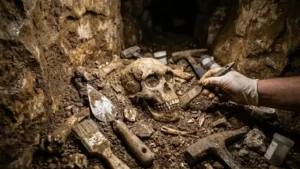
The story of Homo naledi began in 2013 when a team of researchers led by Lee Berger, a National Geographic explorer-in-residence, squeezed through the brutally narrow cracks of the Rising Star cave system inside South Africa’s Cradle of Humankind. What they stumbled upon was a goldmine of ancient bones—nearly two dozen partial and complete skeletons belonging to an entirely new species that walked the Earth roughly 300,000 years ago.
From the beginning, Homo naledi defied conventional evolutionary patterns. The creatures possessed a strange mosaic of anatomical traits:
Primitive features: They had tiny brains, roughly the size of an orange, and an upper body structure reminiscent of tree-climbing ape-like ancestors like “Lucy” (Australopithecus afarensis).
Modern human features: Their hands, feet, wrists, and lower limbs were remarkably similar to our own, built for efficient upright walking and complex tool manipulation.

As the years passed, the species grew even more enigmatic. In 2023, the research team uncovered signs that these small-brained hominins may have controlled and utilized fire inside the pitch-black chambers. By 2025, the team advanced an even more controversial claim: that Homo naledi intentionally traveled deep into the dangerous, dark cave system to bury their dead. Because deliberate burial practices were long thought to be a sophisticated cultural milestone unique to large-brained species like Neanderthals and modern humans (Homo sapiens), the idea was met with heavy skepticism.
However, this latest discovery regarding the sex of the skeletons may provide the missing piece of the puzzle, fundamentally altering how scientists view the site.
Unlocking Secrets with Paleoproteomics
To determine the sex of the ancient skeletons, an international team of scientists turned to a cutting-edge scientific discipline: paleoproteomics.
In the hot, volatile climates of Africa, ancient DNA degrades rapidly, making traditional genetic sequencing nearly impossible for fossils that are hundreds of thousands of years old. Fortunately, proteins are far more durable than DNA and can survive inside the protective matrix of fossilized tooth enamel for millions of years.
The research team examined 20 distinct teeth collected from various Homo naledi individuals within the cave. They focused specifically on the amelogenin (AMEL) genes, which are responsible for producing the proteins that form tooth enamel. Because these genes are tied to sex chromosomes, they leave distinct biochemical signatures:
The AMELX variant is linked to the X chromosome and is produced by both biological males and biological females.
The AMELY variant is tied exclusively to the Y chromosome, meaning it is only present in biological males.
Using a highly precise, minimally destructive extraction technique, lead author Palesa Madupe, a researcher at the Max Planck Institute for Evolutionary Anthropology, and her colleagues mapped the protein profiles of the teeth. The results were clear: every single sample contained abundant amounts of the female-associated AMELX protein, while the male-associated AMELY protein was entirely absent.
Even the iconic, nearly complete skeletons code-named “Neo” and “DH1″—which scientists had long assumed were males due to their larger physical size—were revealed to be biologically female.
Upending Past Assumptions About Gender and Size
This biological revelation solves a long-standing paradox that had puzzled scientists analyzing Homo naledi anatomy. In most hominin lineages, including our own, males are generally larger than females on average, a biological concept known as sexual dimorphism. When the Rising Star skeletons were initially categorized in 2015, researchers divided the bones into “large” and “small” groups, operating under the assumption that they were looking at a standard mix of men and women.
However, a subsequent study in 2024 pointed out a glaring anomaly: the physical variation among the teeth of these supposedly diverse individuals was incredibly narrow. The dental data was so uniform that researchers noted it was highly likely the collection was heavily skewed toward one sex.
The new proteomic data confirms this suspicion. Homo naledi did not lack sexual dimorphism; rather, the entire sample pool was uniform because it only contained females.
Cultural Separation or Genetic Anomaly?
Anthropologists are now left to grapple with what an all-female cave site means for our understanding of ancient hominin behavior. Currently, two competing theories dominate the discussion.
1. Intentional, Sex-Segregated Burials
The most tantalizing explanation is that the Rising Star cave system was a specialized cultural site. If Homo naledi was capable of complex mortuary practices, it is entirely possible that their society practiced sex- or gender-segregated burials. Many historical and modern human cultures have designated specific resting places based on sex, status, or role within the community. If true, this implies a level of abstract social organization and cultural nuance that no one thought a creature with an orange-sized brain could possess.
2. A Rare Genetic Mutation
Alternatively, the lack of male protein markers could point to a genetic quirk rather than a cultural practice. In rare instances among modern humans and certain extinct Neanderthal populations, a genetic mutation can occur where the AMELY gene is deleted from the Y chromosome. If a male lacks this gene, his tooth enamel proteins will look identical to those of a female under proteomic testing.
However, project researchers point out that for this to explain the Rising Star cave, an entire isolated population would need to carry this rare deletion uniformly—an occurrence that would be profoundly unusual but equally fascinating.
A Shocking Evolutionary Link
The tooth enamel study yielded a second, entirely unexpected breakthrough. When mapping the protein profiles, scientists discovered that Homo naledi shared a distinct genetic variant related to collagen production with Paranthropus robustus, an entirely different, massive-jawed human relative that lived in South Africa between 1 million and 2 million years ago.
This specific collagen variant is completely absent in modern humans, Neanderthals, and Denisovans. Because Homo naledi and Paranthropus robustus occupied the same geographic region, this shared trait hints at a deep evolutionary connection or a common ancestor that has yet to be properly mapped. To fully solve this piece of the evolutionary puzzle, scientists will need to gather more proteomic data from other African hominins, such as Homo erectus and Australopithecus africanus.
A New Era for Archeology
Beyond the shocking historical implications, this study proves that paleoproteomics is a game-changer for the future of archaeology. Because the process requires only a microscopic scraping of tooth enamel, it allows scientists to extract priceless genetic data without damaging rare, fragile fossils.
Whether the all-female composition of the Rising Star cave points to a complex social ritual or a massive genetic anomaly, it has permanently shattered old assumptions. Homo naledi continues to prove that human evolution was not a straight, predictable line, but a diverse and beautifully complex web.
Frequently Asked Questions
How did scientists determine that the Homo naledi skeletons were all female?
Scientists utilized a non-destructive process called paleoproteomics to analyze ancient proteins preserved inside the fossilized tooth enamel of 20 individuals. They searched for sex-specific protein markers tied to the AMELX (female and male) and AMELY (male only) genes. Every tested skeleton possessed the female marker, while the male marker was entirely missing.
Why were some of these skeletons originally thought to be male?
When the fossils were first described in 2015, researchers assumed the larger, more robust skeletons belonged to males, as physical size differences between sexes are common in human relatives. The new protein testing revealed that even the largest skeletons in the cave were biologically female.
Is it possible that males are present in the cave but weren’t detected?
Yes, there is a small chance that a rare genetic mutation called an AMELY gene deletion was present in the population. If the males lacked this specific gene, their protein profiles would look identical to females during testing. However, experts note that a systematic deletion across an entire population would be highly extraordinary.
What does an all-female skeleton group suggest about Homo naledi behavior?
If the results accurately reflect an exclusively female group, it strongly supports the theory that Homo naledi practiced intentional burial rituals. It suggests they may have had culturally dictated, sex-segregated burial grounds, a behavior showcasing unexpected social complexity for a creature with a small brain.
How old are the Homo naledi fossils found in the South African cave?
The Homo naledi remains discovered in the Rising Star cave system are estimated to be approximately 300,000 years old, placing them in the Pleistocene epoch alongside early ancestors of modern humans.