
Table of Contents
- 1. The Pathological Profile: Head Binding and Brain Surgery
- 1.1. Artificial Cranial Deformation
- 1.2. Attempted Trepanation
- 1.3. Dental Health
- 2. From Bolivian Funerary Towers to Swiss Vaults
- 3. Rehumanizing Anonymous Museum Artifacts
- 4. Frequently Asked Questions
- 4.1. Who did the mummified head actually belong to?
- 4.2. Why is the skull shaped like an elongated cone?
- 4.3. What is trepanation and did this man survive it?
- 4.4. How did the head naturally mummify?
- 4.5. Is the mummified head currently on display?
350-Year-Old Mummified Head in Swiss Museum Traced to Bolivia’s Aymara People
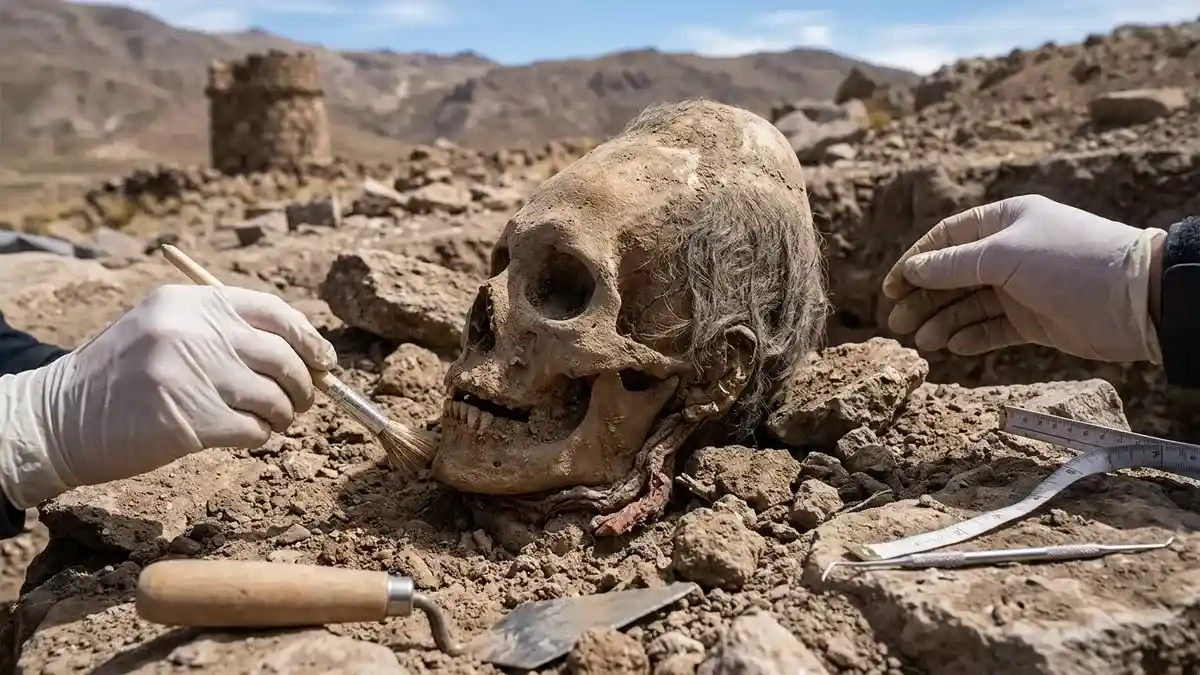
For over a century, a remarkably preserved mummified head rested quietly inside a Swiss museum vault under a false identity. The remains—consisting of a preserved face, cranium, jaw, and upper neck tissue—were long labeled as belonging to an ancient Inca man. However, a comprehensive multi-disciplinary study has shattered this long-held assumption, restoring the artifact’s true cultural identity and uncovering a dramatic personal history of ancient surgery, childhood head-shaping, and colonial exploitation.
Published in the International Journal of Osteoarchaeology, the research was spearheaded by an international team led by the Cantonal Museum of Archaeology and History in Lausanne, Switzerland. Using advanced, non-destructive scanning technologies alongside meticulous archival tracking, the team proved that the individual was not Inca at all. Instead, he belonged to the Aymara people, an Indigenous society native to the unforgiving, high-altitude landscapes of the Bolivian Highlands.

350-Year-Old Mummified Head in Swiss Museum Traced to Bolivia’s Aymara People
The Pathological Profile: Head Binding and Brain Surgery
To study the fragile, 350-year-old remains without causing physical damage, scientists subjected the specimen—cataloged formally as individual “Y-001″—to high-resolution Computed Tomography (CT) scans. The digital cross-sections exposed a lifetime of distinct cultural practices and health conditions written directly into the bone.
Artificial Cranial Deformation
The most striking physical feature of the skull is its severe, conical elongation along the front-to-back axis. This shape was achieved through artificial cranial modification during the man’s infancy. In Aymara culture, parents used tight textile bindings wrapped around a baby’s malleable skull for several years. This process permanently elongated the head, serving as a powerful visual marker of ethnic identity and social status within the highland communities.
Attempted Trepanation
The CT scans also revealed a distinct groove scored into the protective bone of the cranium, indicating an attempted trepanation—an ancient surgical procedure where parts of the skull were cut or drilled away. Interestingly, this specific incision never fully penetrated the dense inner layers of the skull bone. Because there are no signs of medical necessity or deep trauma, researchers speculate that this specific surgery may have been a symbolic or ritualistic operation rather than a lifesaving medical intervention.
Dental Health
The digital dental reconstruction showed that the man suffered from a severe, painful dental abscess tucked inside his upper jaw, providing an intimate, humanizing look at his everyday physical burdens.

From Bolivian Funerary Towers to Swiss Vaults
The study also focused heavily on solving the historical mystery of how the Aymara man’s head traveled from South America to Central Europe.
[Natural Mummification in Chullpa Tower] ──► 19th-Century Looting by Louis Kuffré ──► 1914 Donation to Lausanne Museum
Archival records reveal that during the late 19th century, a Swiss collector named Louis Kuffré traveled through Bolivia. This was an era when European explorers routinely looted Indigenous burial grounds to supply western museums with exotic anatomical specimens. Kuffré acquired the head and shipped it back to Switzerland, where it was formally donated to the Museum of Lausanne in 1914.
The original donation paperwork featured a brief note identifying the head as “Inca.” However, its specific skeletal characteristics, combined with the exact geographic region where Kuffré traveled, point exclusively to an Aymara origin.

Anthropologists believe the head was stolen from a chullpa—a monumental stone funerary tower common across the Bolivian Highlands. In these high-altitude stone structures, the naturally freezing, dry mountain air and rapid evaporation create a perfect environment for natural mummification, preserving skin, hair, and soft tissue without the use of artificial embalming chemicals.
Rehumanizing Anonymous Museum Artifacts
The investigation looks past pure biological data, directly tackling the modern ethical dilemmas surrounding colonial-era human collections. Over the past decade, international museums have faced growing pressure to re-evaluate how they acquired human remains, especially those taken through exploitative or colonial expeditions.
“The goal of this project is to restore a sense of identity, dignity, and cultural heritage to an individual who was reduced to an anonymous museum specimen for more than a century,” the research team explained.
Currently, individual Y-001 is being kept in a highly secure, climate-controlled storage facility to prevent the organic tissues from degrading, and he is strictly barred from public exhibition. While the Cantonal Museum has not yet received an official repatriation claim from the Bolivian government or modern Aymara leadership, museum authorities have explicitly stated that they welcome open discussions regarding his eventual return home.
Frequently Asked Questions
Who did the mummified head actually belong to?
While long misidentified as an Inca man, modern scientific testing proved that the mummified head belonged to a member of the Aymara people, an Indigenous ethnic group native to the high-altitude Altiplano region of the Bolivian Highlands.
Why is the skull shaped like an elongated cone?
The unique shape is the result of artificial cranial deformation practiced during childhood. As an infant, the individual’s head was tightly bound with fabrics or boards for several years, permanently shaping the growing bone as a symbol of social and cultural identity.
What is trepanation and did this man survive it?
Trepanation is an ancient surgical technique that involves scraping, cutting, or drilling a hole directly into the skull. In this individual’s case, the surgical cut was superficial and never broke through the inner skull wall, suggesting it may have been performed as a symbolic or religious ritual.
How did the head naturally mummify?
The head was likely placed inside a chullpa, an ancient stone funerary tower built across the cold, dry, and windy Bolivian Highlands. The high-altitude climate naturally dried out the body tissues before decomposition could occur, creating a natural mummy without artificial chemicals.
Is the mummified head currently on display?
No. Out of respect for the individual and modern ethical curation standards, the remains are stored in a private, climate-controlled research facility in Switzerland and are completely closed to the general public.