
Table of Contents
- 1. Anatomy of a Masterpiece: The Gisr el-Mudir Statue
- 1.1. The Innovation: A Revolutionary Artistic Hybrid
- 2. Tracking the Origin: The School of Irukaptah
- 2.1. A Striking Connection to the Brooklyn Museum
- 3. Redefining the Creative Boundaries of the Old Kingdom
- 3.1. Pushing High Relief Back 2,000 Years
- 4. Clues from an Unmarked Tomb: The Mystery of ‘Messi’
- 5. Frequently Asked Questions
- 5.1. Where was this unique family statue discovered?
- 5.2. What makes this specific Egyptian statue completely unique?
- 5.3. How did archaeologists determine the age of the statue?
- 5.4. What is the symbolic meaning behind the daughter holding a goose?
- 5.5. Who is “Messi” in relation to this archaeological discovery?
Unique Ancient Egyptian Statue Overturns Long-Held Art Theories
A remarkable archaeological discovery in the ancient necropolis of Saqqara is forcing historians to completely rewrite the textbook on Old Kingdom Egyptian art. Excavations at the historic site of Gisr el-Mudir have brought to light an extraordinary limestone family statue that shatters long-held assumptions regarding the rigid conservatism of ancient Egyptian sculptors.
The masterwork, detailed in a comprehensive study published in The Journal of Egyptian Archaeology by world-renowned Egyptologist Dr. Zahi Hawass and his colleague Dr. Sarah Abdoh, challenges decades of academic consensus. For generations, scholars believed that Old Kingdom artists were bound by absolute structural rules that left zero room for creative experimentation. This newly revealed artifact proves that ancient masters were far more flexible, innovative, and artistically daring than previously imagined.
Unique Ancient Egyptian Statue Overturns Long-Held Art Theories
Anatomy of a Masterpiece: The Gisr el-Mudir Statue
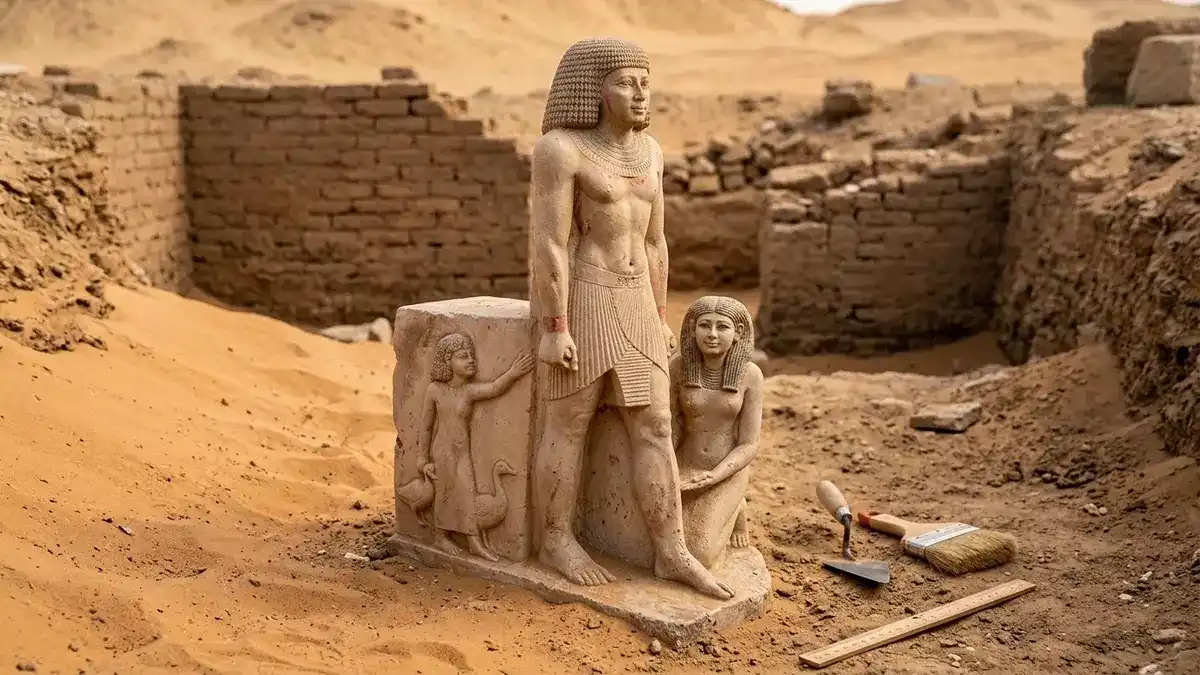
At first glance, the sculpture appears to follow the classic artistic templates established during the dawn of the pharaonic golden age. Carved from a single block of fine limestone, the central figure is a high-ranking Egyptian nobleman. He is depicted in the traditional “left-foot-forward” marching stance—a highly deliberate pose used by Old Kingdom sculptors to symbolize vitality, physical strength, and a readiness to cross over into the afterlife.
The nobleman is rendered with striking anatomical precision, showcasing a deeply modeled torso, a finely pleated ceremonial kilt, and a short, meticulously detailed lappet wig. Kneeling affectionately at his right leg is his wife. In keeping with the strict hierarchical proportions of the era, her smaller scale emphasizes her supportive domestic role. She is depicted wearing a classic, form-fitting sheath dress, a broad decorative collar, and a neat, shoulder-length wig.
The Innovation: A Revolutionary Artistic Hybrid
While the figures of the husband and wife perfectly align with traditional three-dimensional execution, the true artistic revolution occurs on the left side of the sculpture. Positioned directly behind the left leg of the nobleman is the couple’s young daughter.
Unlike her parents, who are sculpted entirely in the round, the daughter is carved entirely in flat bas-relief directly onto the stone support structure. With one hand, she reaches forward to tenderly grasp her father’s leg, while her other hand holds a goose.

This unexpected blending of two completely distinct artistic genres—fully three-dimensional statuary and flat, two-dimensional relief carving—within a single, integrated family monument is completely unprecedented in Old Kingdom art history.
Tracking the Origin: The School of Irukaptah
The circumstances surrounding the statue’s recovery initially presented a significant challenge for researchers. Found without its original archaeological context, the monument had evidently been dragged from its primary tomb chamber and cast aside in the desert sands by ancient grave robbers hunting for gold and jewelry.
Without accompanying inscriptions or a intact tomb environment, scientists had to rely on advanced stylistic analysis to determine exactly when this masterpiece was created.

A Striking Connection to the Brooklyn Museum
To pinpoint the statue’s historical era, researchers cross-referenced its physical attributes with securely dated monuments found throughout the Saqqara region. They discovered an undeniable stylistic match: a famous limestone statue of a prominent official named Irukaptah, currently preserved in the Brooklyn Museum.
The two sculptures share a series of highly specific characteristics:
Identical Proportions: The exact height, width, and mathematical ratios of the human figures align perfectly.
Costume Execution: The unique pleating style of the kilt and the specific carving pattern of the lappet wigs are practically indistinguishable.
Shared Provenance: Both monuments originated within the vast burial grounds of Saqqara.
These extraordinary similarities have led Egyptologists to conclude that the Gisr el-Mudir statue securely dates back to the Fifth Dynasty of Egypt (approx. 2494–2345 BCE). Furthermore, the evidence strongly suggests that both pieces were produced by the exact same master sculptor or the same elite regional “artistic school” operating in Saqqara nearly 4,300 years ago.
Redefining the Creative Boundaries of the Old Kingdom
The broader implications of this find have sent shockwaves through the field of Egyptology. For well over a century, the Old Kingdom was viewed as an era of absolute conformity, where artists followed a strict, unyielding canon that left no room for individual expression or stylistic deviation. The Gisr el-Mudir statue definitively refutes that narrative.
Pushing High Relief Back 2,000 Years
In an exclusive communication with Archaeology News Online Magazine, Dr. Zahi Hawass highlighted the immense historical importance of the relief carving technique utilized for the daughter. Historically, the seamless integration of high relief elements into free-standing sculpture was considered a much later development in Egyptian art history, most commonly associated with the Greek-influenced Ptolemaic period nearly two millennia later.
“The integration of relief and three-dimensional carving makes this statue the only known example of its kind from the Old Kingdom,” Dr. Hawass noted. “This unique masterpiece of innovation proves that ancient artists possessed the technical skill and creative vision to blend these mediums more than 4,300 years ago.”
Clues from an Unmarked Tomb: The Mystery of ‘Messi’
During the excavation process, Dr. Hawass uncovered the statue hidden just beneath the desert sand line. Nearby, the team discovered a stone false door—the symbolic threshold used by spirits to travel between the physical world and the afterlife. This particular door bore a single inscribed name: “Messi.”
While the statue’s home tomb lacked extensive autobiographical inscriptions, the scene of the daughter holding a goose provides vital context. In ancient Egyptian iconography, geese were highly valued luxury food sources. Depicting a child carrying a live goose was a scene directly mirrored from daily life, serving a dual spiritual purpose:
Eternal Sustenance: It acted as a permanent, magical guarantee of fresh food provisions for the parents in the afterlife.
Family Reunification: The intimate physical contact between the family members symbolically declared that the family unit would successfully reunite and remain intact for all eternity.
This landmark discovery cements Saqqara’s historical reputation not just as a grand royal cemetery, but as a major incubator for avant-garde art and structural innovation during the Old Kingdom. By proving that ancient Egyptian artists could fluidly manipulate tradition to engineer completely new visual concepts, the family statue of Gisr el-Mudir stands as a timeless testament to human ingenuity.
Frequently Asked Questions
Where was this unique family statue discovered?
The statue was discovered during archaeological excavations at Gisr el-Mudir, an ancient stone structure located within the expansive desert necropolis of Saqqara, Egypt. Saqqara served as the primary burial ground for the ancient capital city of Memphis.
What makes this specific Egyptian statue completely unique?
The statue is the only known example from the Old Kingdom that combines fully three-dimensional, free-standing sculpture with two-dimensional bas-relief work in a single block of stone. The husband and wife are carved completely in the round, while their young daughter is rendered entirely in relief on the support pillar behind them.
How did archaeologists determine the age of the statue?
Because the statue was discarded by ancient tomb raiders and found out of its original archaeological context, researchers utilized stylistic analysis. By comparing its specific proportions, kilt pleating, and wig styles to a known statue of Irukaptah housed in the Brooklyn Museum, experts matched it to the Fifth Dynasty of Egypt (around 4,300 years ago).
What is the symbolic meaning behind the daughter holding a goose?
In ancient Egyptian funerary belief, the goose represents a vital food offering. Carving the daughter holding a goose served a magical, religious function to ensure that her parents would have an endless supply of fresh provisions in the afterlife. The way she holds onto her father’s leg also symbolizes eternal family unity.
Who is “Messi” in relation to this archaeological discovery?
“Messi” is an ancient Egyptian name found inscribed on a stone false door discovered in close proximity to the family statue. While the tomb itself lacked extensive wall inscriptions, this name provides a potential link to the owner or a family member associated with the burial site.