
Table of Contents
- 1. The Molecular Time Capsules of the Alpine Lakes
- 2. Prehistoric Chewing Gum: Snapshots of Ancient Identity and Diet
- 2.1. Reconstructing the Neolithic Menu
- 2.2. Why Chew Tar?
- 3. From Tools to Table: The Daily Utility of Birch Tar
- 3.1. The Superglue of the Stone Age
- 3.2. Mending and Reheating
- 4. Conclusion: The Ingenuity of Europe’s First Farmers
- 5. Frequently Asked Questions
- 5.1. How did ancient people make birch bark tar without modern equipment?
- 5.2. Why did the birch tar preserve DNA when the human bones at the site rotted?
- 5.3. What did the presence of conifer resin inside the tar signify?
- 5.4. Can scientists tell what diseases these ancient farmers suffered from using the tar?
- 5.5. What is a “chaîne opératoire” in archaeology?
Ancient Birch Tar Reveals How Europe’s First Farmers Chewed, Cooked, and Crafted 6,000 Years Ago
Long before the invention of writing or the forging of metal tools, the early agricultural communities of Neolithic Europe relied heavily on an incredible, sticky black substance: birch bark tar. Produced by heating birch bark under low-oxygen conditions, this material stands as one of humanity’s earliest synthetic inventions.
While archaeologists have long recognized its role as a prehistoric superglue, a groundbreaking study published in Proceedings of the Royal Society B: Biological Sciences reveals that this sticky resin was far more versatile. By analyzing 6,000-year-old tar samples recovered from lakeside settlements around the Alps, an international research team has unlocked a stunning molecular archive. Trapped within these black lumps is a vivid record of how Europe’s first farmers lived, ate, worked, and even managed their health.
Ancient Birch Tar Reveals How Europe’s First Farmers Chewed, Cooked, and Crafted 6,000 Years Ago
The Molecular Time Capsules of the Alpine Lakes
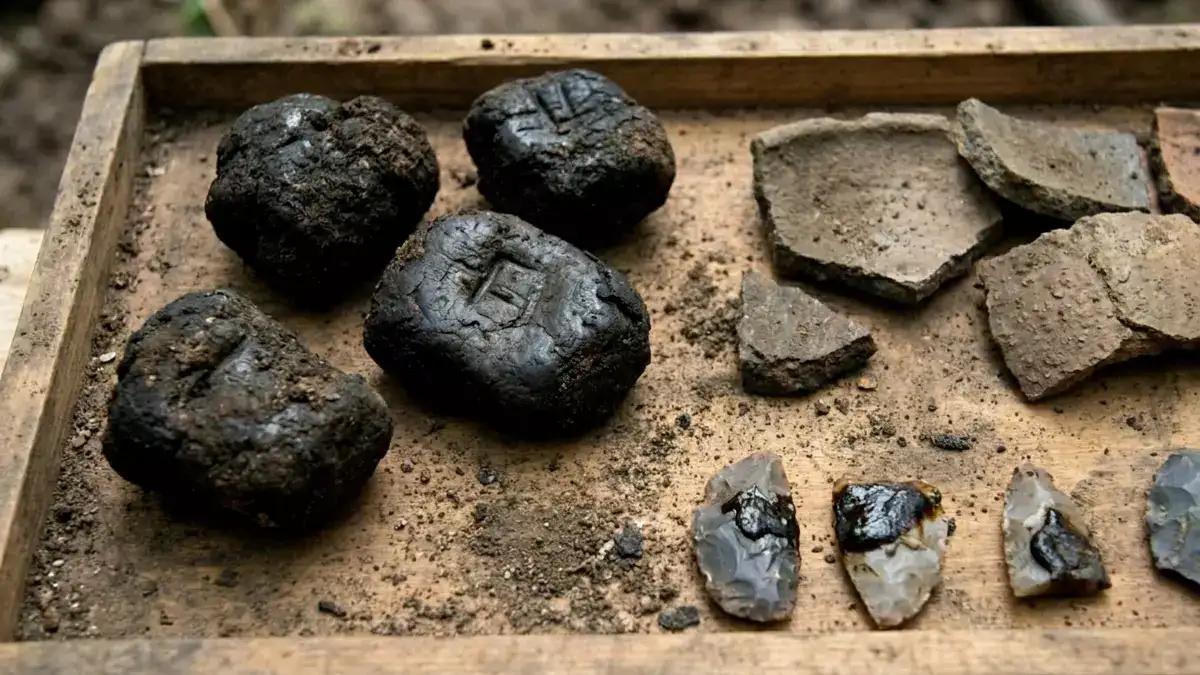
The study focused on 30 distinct pieces of birch tar excavated from nine prehistoric waterlogged lakeside sites stretching across the Alpine region. Some specimens were recovered as loose, forgotten lumps, while others were meticulously scraped as dark residue clinging to broken pottery shards and stone flint blades.
 10th-Century Bronze Cross Found in Germany Reveals Early Christian Influence on Slavic Tribes
+------------------------+----------------------------------------------------+
| Artifact Attribute     | Research and Biomolecular Details                  |
+------------------------+----------------------------------------------------+
| Material Identity      | Birch Bark Tar (Humanity's earliest synthetic glue)|
| Chronological Age      | Approximately 6,000 years old (Neolithic Era)      |
| Geographic Origin      | Alpine region lake settlements (Central Europe)    |
| Analytical Workflow    | Organic residue chemistry + Ancient DNA sequencing |
| Trapped Biomolecules   | Human DNA, oral microbiomes, plant and diet traces |
+------------------------+----------------------------------------------------+
To extract the hidden data, scientists combined high-resolution organic residue chemistry with advanced ancient DNA (aDNA) sequencing. Because the Alpine settlements were located in wet, marshy lake environments, traditional skeletal remains and human bones from these sites had long since decayed.
However, the dense, waterproof, and chemically stable matrix of the birch tar acted as an accidental preservative. It perfectly sealed out destructive oxygen and bacteria, locking sensitive biomolecules into an airtight stasis for sixty centuries.
Prehistoric Chewing Gum: Snapshots of Ancient Identity and Diet
Among the most fascinating discoveries were several loose tar lumps that bore clear, unmistakable impressions of ancient human teeth. Neolithic men and women were actively chewing this sticky substance, leaving behind a profound genetic signature.

                    BIOMOLECULAR CACHE INSIDE THE TAR

  [ Human aDNA ]   ==========> Confirmed both male and female chewers.
  [ Oral Microbiome] ========> Preserved ancient mouth bacteria and pathogens.
  [ Plant Genomics ] ========> Traced recent meals (Barley, Wheat, Peas, Hazelnuts).
  [ Resin Additives ] =======> Revealed mixing of Conifer sap to adjust texture.
The genetic sequencing of the saliva trapped inside the teeth marks successfully recovered full profiles of both male and female chewers. Alongside human DNA, researchers mapped the ancient oral microbiome—the community of bacteria living inside the prehistoric mouth. This provides an unprecedented baseline for studying how the human immune system and oral diseases have evolved over millennia.
Reconstructing the Neolithic Menu
Even more remarkable was the extraction of plant and food genomics from the chewed wads. The tar held microscopic remnants of what the chewers had consumed right before popping the resin into their mouths. Scientists successfully identified the DNA of:
Grains: Cultivated barley and wheat.
Legumes: Early domestic peas.
Wild Foraged Goods: Hazelnuts and beech mast.

Why Chew Tar?
Anthropologists hypothesize that people chewed the tar for several practical and medicinal reasons. Mechanically, chewing was the easiest way to use body heat to soften the stone-hard, cooled tar blocks, making the adhesive pliable and ready for workshop application.
Clinically, because birch tar naturally contains high concentrations of antiseptic and anti-inflammatory compounds like betulin, it likely doubled as a prehistoric medicine. Chewing it would soothe toothaches, treat gum infections, or act as a basic form of dental hygiene. To adjust the elasticity or sticky strength of the chew, some individuals even blended in sticky conifer tree resin.
From Tools to Table: The Daily Utility of Birch Tar
Beyond its role as a prehistoric chewing gum, the chemical residue mapping proved that birch tar was the backbone of Neolithic domestic technology.
                      NEOLITHIC APPLICATIONS OF TAR

   [ Pottery Repair ]  ====> Applied to cracks in cooking pots to seal leaks.
   [ Tool Hafting ]    ====> Glued flint blades securely into wooden handles.
   [ Food Storage ]    ====> Painted inside vessels to waterproof containers.
   [ Recycling Loop ]  ====> Repeatedly reheated and scraped for secondary use.
The Superglue of the Stone Age
On several recovered flint blades, scientists identified distinct bands of tar residue exactly where the stone edge met its original wooden handle. This confirms its widespread use in hafting—the technical process of bonding a stone point to an organic shaft or grip to create durable knives, axes, and spears.
Mending and Reheating
The tar also served as a valuable home repair kit. When valuable ceramic cooking pots cracked, Neolithic farmers did not discard them. Instead, they smeared molten birch tar along the fractures, creating an instant, waterproof seal that extended the lifespan of the cookware.
Furthermore, some pottery samples displayed clear chemical markers of repeated heating sequences. This indicates a complex “recycling loop” where tar was systematically melted down, used, scraped away, and remelted across various cooking and food storage applications.
Conclusion: The Ingenuity of Europe’s First Farmers
The pioneering analysis of the Alpine birch tar permanently shifts our understanding of the Neolithic period. It proves that Europe’s early farming societies were not merely struggling to survive; they were highly innovative chemical engineers. They successfully manipulated native forestry resources to invent a multi-purpose substance that functioned simultaneously as an industrial adhesive, a domestic repair compound, a culinary sealant, and a targeted medicine. By looking closer at these humble, sticky black lumps, modern science has uncovered an eloquent, deeply human portrait of resourcefulness and ingenuity that echoes clearly across 6,000 years of history.
Frequently Asked Questions
How did ancient people make birch bark tar without modern equipment?
Neolithic craftspeople utilized a clever, low-oxygen heating process. They packed tightly rolled strips of birch bark into a ceramic vessel, sealed it to block out air, and buried it beneath a hot campfire. The indirect heat baked the bark, causing a thick, dark tar to slowly distill and collect at the bottom of the container.
Why did the birch tar preserve DNA when the human bones at the site rotted?
The lakeside settlements were highly acidic and waterlogged, an environment that rapidly dissolves calcium and destroys skeletal structures. Birch tar, however, is completely waterproof, hydrophobic (repels water), and rich in natural antimicrobial chemicals, creating a sterile, sealed matrix that shielded trapped DNA from environmental decay.
What did the presence of conifer resin inside the tar signify?
The inclusion of conifer resin proves that Neolithic farmers were actively customizing their materials. By blending sticky, flexible conifer sap into the more rigid birch tar, ancient artisans could carefully alter the texture, melting point, and overall adhesive strength of the glue to match specific tasks.
Can scientists tell what diseases these ancient farmers suffered from using the tar?
Yes. By sequencing the ancient oral microbial DNA trapped within the tooth impressions, researchers can identify specific prehistoric bacteria and pathogens, providing direct clues about the dental hygiene, gum diseases, and systemic respiratory infections circulating through the population.
What is a “chaîne opératoire” in archaeology?
A chaîne opératoire (operational chain) is a conceptual framework used by archaeologists to map out the entire life cycle of an artifact. It traces every step of an object’s existence, including raw material gathering, manufacturing steps, active daily use, secondary recycling modifications, and its final discard into the archaeological record.