
Table of Contents
- 1. Decoding the Engineering of Roman Cage Cups
- 2. Hidden Signatures: The Code of Late Antiquity Workshops
- 2.1. From Solo Geniuses to Collaborative Production Lines
- 2.2. Clues Left Behind in Tool Marks and Fragments
- 3. The Human Experience Behind the Ancient Grinding Wheel
- 4. A More Interconnected Roman Empire
- 5. Frequently Asked Questions
- 5.1. What are Roman cage cups, or diatreta?
- 5.2. How did ancient craftsmen make these cups?
- 5.3. What was the purpose of the hidden symbols on the glass?
- 5.4. Does this discovery mean these vessels were made by a team?
- 5.5. Why is a practical understanding of glassblowing important for this research?
Hidden Makers’ Marks Uncovered on Ancient Roman Glass Masterpieces
A routine observation inside a quiet museum gallery has fundamentally transformed how historians and archaeologists view some of the Roman Empire’s most spectacular luxury artifacts. This surprising breakthrough occurred when Hallie Meredith, an art historian and practical glassblower from Washington State University, was analyzing a private collection of rare Roman vessels at the Metropolitan Museum of Art. While examining an incredibly intricate type of carved glass known as a cage cup, or diatretum, she spotted a series of subtle anomalies on the reverse side of the vessel. What previous generations of researchers had brushed off as meaningless, superficial ornamentation suddenly emerged as a deliberate, repeating sequence.
These luxury glass objects, crafted between the fourth and sixth centuries CE, have long been celebrated as the absolute pinnacle of ancient glassmaking. Traditionally, historians assumed these breathtaking pieces were the life’s work of isolated, legendary master artisans working in absolute solitude. However, this fresh architectural look at the glass tells a completely different story. It reveals a highly collaborative, sophisticated network of ancient workshops that utilized their own secret visual language—effectively introducing the concept of commercial branding long before the modern era.
Hidden Makers’ Marks Uncovered on Ancient Roman Glass Masterpieces

Decoding the Engineering of Roman Cage Cups
To appreciate the significance of this discovery, one must first understand the staggering amount of labor and technical mastery required to produce late Roman diatreta. These vessels were not merely blown into shape; they were meticulously sculpted through an agonizingly slow reductive process.
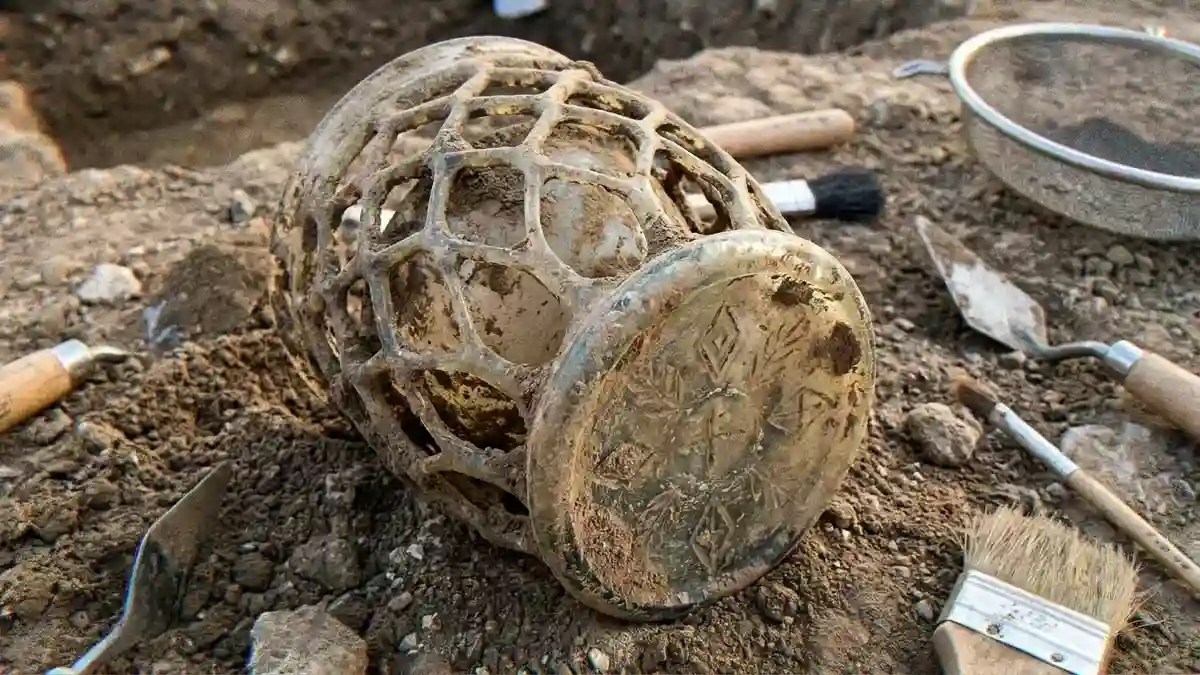
Artisans began with a remarkably thick, solid blank of molten glass. Specialized carvers then spent months grinding away the material, meticulously hollowing out an inner bowl while simultaneously fashioning an outer, openwork lattice. This delicate exterior cage remained attached to the primary inner vessel exclusively through a network of impossibly thin, web-like glass bridges. A single microscopic miscalculation or excessive application of physical pressure at any point during the months-long carving phase would instantly shatter the entire masterpiece.
+--------------------------------------------------------+
|              ROMAN CAGE CUP (DIATRETUM)                |
|                                                        |
|   [Outer Inscription / Greeting]  <-- "BIBE VIVAS..."   |
|   [Geometric Openwork Lattice]    <-- Intricate Cage    |
|         ||            ||          <-- Micro-Bridges     |
|   [Inner Glass Holding Bowl]      <-- Central Vessel    |
|                                                        |
|   *Hidden Bottom Symbols: Diamonds, Leaves, Crosses*   |
+--------------------------------------------------------+
Historically, academic research surrounding these artifacts focused heavily on translating the grand Greek or Latin inscriptions running along the rims—which frequently featured festive phrases like BIBE VIVAS (“Drink, may you live!”). However, the abstract geometric shapes placed directly alongside or beneath these letters—such as tiny diamonds, highly stylized leaves, and cross-like configurations—were consistently ignored. For generations, catalogs cataloged these marks as generic “stop-marks,” intended merely to fill empty space or signal the termination of a sentence.
Hidden Signatures: The Code of Late Antiquity Workshops
By looking past the dominant text and focusing directly on these geometric designs, researchers have unveiled an entirely new layer of historical data. Meredith’s comparative research, highlighted in major publications like World Archaeology and the Journal of Glass Studies, tracked identical and near-identical abstract shapes across several surviving diatreta housed in separate global collections.
This systematic distribution strongly indicates that these symbols were not random decorative flourishes added on a whim. Instead, they served as highly organized makers’ marks—the ancient equivalent of a studio logo or a corporate trademark. The presence of these standardized markings establishes that Roman glass workshops were actively branding their premium products, ensuring wealthy buyers across the empire could instantly recognize and verify the specific origin of their elite luxury goods.
From Solo Geniuses to Collaborative Production Lines
This paradigm shift completely dismantles the romantic historical myth of the solitary, eccentric Roman artist. The physical evidence embedded in the glass points directly toward a highly structured, team-oriented manufacturing environment.
The creation of a single cage cup required an extensive division of labor, demanding seamless coordination among multiple specialized workers, including:
The Glassblowers: Craftsmen who gathered and formed the massive, flawless glass blanks.
The Master Engravers: Technicians skilled in executing deep, high-stakes structural relief cuts.
The Detail Polishers: Specialists tasked with smoothing out microscopic tool marks inside the impossibly tight spaces between the inner bowl and the outer lattice.
The makers’ mark acted as a unifying seal, representing the collective output of the entire studio rather than celebrating the ego of a singular craftsman.
Clues Left Behind in Tool Marks and Fragments
To reconstruct this ancient industrial landscape, researchers examined more than just pristine museum showpieces. The definitive proof of a collaborative network came from analyzing the physical realities of the workshop floor: microscopic tool marks left by specialized grinding wheels, half-finished objects abandoned mid-production, and broken fragments that showed clear signs of historic repair or recycling.
This forensic approach to archaeology reveals an interconnected craft sector where techniques, equipment, and stylistic choices were constantly shared across regional industries. The geometric symbols served as an internal code, allowing distinct teams of workers within a sprawling workshop—or even across allied workshops in different provinces—to seamlessly communicate structural guidelines, quality benchmarks, and production batches.
The Human Experience Behind the Ancient Grinding Wheel
What makes this breakthrough particularly compelling is how it incorporates the lived experience of the ancient laborers themselves. Combining historical analysis with practical, real-world experience in glassblowing provides a rare, visceral understanding of the intense physical toll required by this craft.
Ancient glass production was an exhausting, hazardous, and deeply stressful endeavor. Workers spent grueling hours exposed to extreme furnace heat, toxic dust, and the constant, high-stakes pressure of ruining a priceless luxury item with a single slip of a hand tool. By examining the irregular spellings, blended alphabets, and unconventional layouts that frequently populate these objects, modern researchers are gaining a profound appreciation for the human element behind the art.
Many of these artisans operated in highly complex, multilingual environments across the shifting borders of the late Roman Empire. To better map this intricate web of human interaction, a brand-new digital database is currently being developed in collaboration with computer science teams. This tool will catalog, track, and analyze thousands of late Roman inscriptions and workshop marks simultaneously, shedding much-needed light on the migratory patterns, literacy levels, and cultural identities of the working-class scribes and craftsmen who built the material wealth of the ancient world.
A More Interconnected Roman Empire
The uncovering of these hidden workshop signatures permanently changes our view of late Roman industry. Far from being a period of stagnant decline, the fourth through sixth centuries CE clearly hosted a vibrant, sophisticated, and highly creative manufacturing ecosystem. These ancient craftworkers possessed their own advanced communication networks, corporate structures, and professional identities. By decoding the secret language carved into the bases of these masterworks, modern science has finally allowed these long-forgotten Roman artisans to sign their names to history.
Frequently Asked Questions
What are Roman cage cups, or diatreta?
Diatreta are extraordinarily complex luxury glass vessels produced during the late Roman Empire. They consist of a delicate, thin inner drinking bowl suspended inside an intricate, openwork outer decorative cage or lattice, connected only by microscopic glass bridges.
How did ancient craftsmen make these cups?
Rather than being formed in a single mold or blown into shape, cage cups were painstakingly carved from a single, exceptionally thick blank of solid glass. Artisans used specialized rotary wheels and hand tools to slowly grind away the excess material over several months.
What was the purpose of the hidden symbols on the glass?
Long dismissed by modern scholars as meaningless decorative “stop-marks” used to fill blank space, the abstract diamonds, leaves, and cross-like symbols are now recognized as makers’ marks. They functioned as workshop logos, representing a sophisticated system of ancient commercial branding.
Does this discovery mean these vessels were made by a team?
Yes. The presence of standardized workshop marks across multiple distinct vessels proves that these pieces were the result of a highly collaborative group effort involving blowers, specialized engravers, and detail polishers, rather than the work of a single solitary artist.
Why is a practical understanding of glassblowing important for this research?
Having firsthand experience with the physical properties of molten and cold glass allows modern researchers to identify subtle tool marks, structural stress points, and production errors. This practical insight helps reconstruct the authentic labor conditions, training methods, and physical challenges faced by ancient Roman artisans.