
Table of Contents
- 1. The Metal Detectorist’s Luck: How the Discovery Unfolded
- 2. Decoding the Wardrobe of a High-Status Norse Woman
- 2.1. The Jewelry Collection
- 2.2. Exceptional Preservation
- 3. The Mystery of the Scallop Shells and Bird Bones
- 3.1. The Protective Mask
- 3.2. The Avian Symbology
- 4. A Multigenerational Family Cemetery
- 5. What Science Will Reveal Next
- 6. Frequently Asked Questions
- 6.1. Why are oval brooches significant in Viking burials?
- 6.2. Has the scallop shell ritual been seen in other Viking graves?
- 6.3. What do bird bones symbolize in ancient Norse culture?
- 6.4. How did the researchers preserve the grave from destruction?
- 6.5. Will the public be able to see these artifacts?
Viking Grave Discovery Reveals Bizarre Ancient Burial Ritual
A routine scan with a metal detector in central Norway has yielded one of the most astonishing archaeological discoveries in recent memory. What began as a hobbyist’s lucky find has evolved into a full-scale excavation, unearthing the incredibly preserved remains of a high-status Viking woman.
While the discovery of Viking-era graves is always significant, this particular site at Val in Bjugn has left researchers stunned. Beneath the soil lay evidence of a bizarre, previously undocumented mortuary practice that challenges our current understanding of Norse spiritual beliefs. The find offers a rare, intimate look into the complex rituals of rural Norway during the 9th century.
Viking Grave Discovery Reveals Bizarre Ancient Burial Ritual
The Metal Detectorist’s Luck: How the Discovery Unfolded
The remarkable discovery began with Roy Søreng, a local metal detector enthusiast exploring a field in Bjugn. His equipment registered a strong signal, leading him to unearth a beautifully preserved oval brooch. Recognizing the historical significance of the bronze artifact—a piece of jewelry deeply tied to 9th-century Norse women’s attire—Søreng immediately halted his search and contacted local authorities.
His responsible actions brought experts from the NTNU Science Museum and the Trøndelag County Council to the scene. Archaeologists quickly determined that the brooch was not an isolated lost object but rather the marker of an intact, untouched burial site.
Because the field was actively used for agriculture, the grave was facing imminent destruction from routine seasonal plowing. Recognizing the urgency, Norway’s Ministry of Cultural Heritage stepped in with emergency funding to launch a swift rescue excavation, allowing scientists to extract the fragile remains before they were lost to history.
Decoding the Wardrobe of a High-Status Norse Woman
As the excavation team carefully peeled back the layers of earth, they revealed a skeleton adorned in classic, wealthy Viking style. The artifacts found with the body indicate that this individual was a free woman of considerable status, likely a matriarch or an influential figure on a prominent local farmstead.
The Jewelry Collection
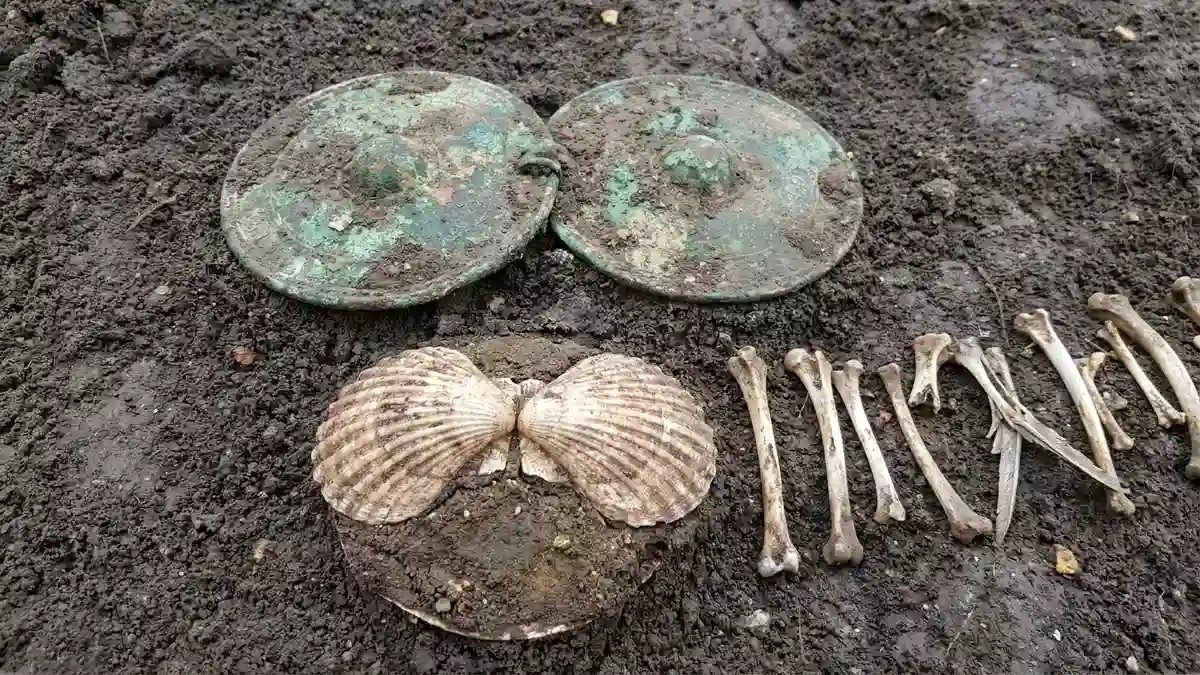
The woman was buried in a traditional apron dress, secured by a pair of elaborate bronze oval brooches positioned at her chest. These specific ornaments were symbols of identity and social standing among Norse women. Additionally, a smaller ring brooch, used to fasten her undergarment, was recovered nearby.
Exceptional Preservation
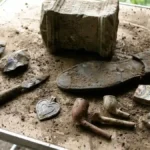
What makes this find incredibly rare is the condition of the organic material. In many Viking-age burials, acidic soil completely destroys human remains, leaving behind only metal artifacts. At Bjugn, however, the skeletal structure remained largely intact, offering an unprecedented opportunity for osteological analysis and deep scientific study.
The Mystery of the Scallop Shells and Bird Bones
While the jewelry confirmed the woman’s era and social standing, it was the arrangement of items around her face and body that left archaeologists completely baffled. The burial features two highly unusual, symbolic elements that have never been documented in any other Viking grave in Norway.
The Protective Mask
Placed directly over the woman’s mouth were two large scallop shells. They were arranged intentionally: the curved sides faced outward, while the straight edges met cleanly in the middle, forming a deliberate protective shield over her lips.
[ Scallop Shell ]  <- Curved side facing outward
       ||          <- Straight edges meeting over the mouth
[ Scallop Shell ]  <- Curved side facing outward
Archaeologists are currently debating the purpose of this ritual. Was it meant to prevent the spirit from escaping, protect the deceased from evil forces in the afterlife, or silence her for eternity? Without written records from the period, the exact meaning remains elusive.
The Avian Symbology
Adding to the enigma, researchers discovered a sequence of small bird bones meticulously arranged along the entire length of the grave. Upon closer inspection, specialists noted that these were predominantly wing bones. The deliberate inclusion of flight-related anatomy suggests a symbolic connection to transition, spiritual journeys, or perhaps a localized religious deity.
A Multigenerational Family Cemetery
The plot thickens when looking at the wider context of the Bjugn site. Earlier excavations in the exact same field revealed another exceptionally well-preserved skeleton dating back to the 8th century, roughly a generation or two before the woman with the scallop shells was laid to rest.
| Burial Site | Estimated Timeline | Key Findings |
| Burial 1 (Earlier Find) | 8th Century | Well-preserved skeleton, early Norse artifacts |
| Burial 2 (Current Find) | 9th Century (Viking Age) | Wealthy female, oval brooches, scallop shells, bird bones |
The close proximity of these two high-status graves strongly implies that this specific plot of land served as a sacred communal or family cemetery for multiple generations. The site was clearly revered by the local community, acting as a permanent resting place for its most prominent citizens.
What Science Will Reveal Next
Now that the rescue excavation is complete, the focus shifts from the field to the laboratory. Experts are leveraging cutting-edge scientific techniques to extract every possible detail from the recovered remains.
DNA Testing: Genetic analysis is currently underway to determine if the 8th-century skeleton and the 9th-century woman were biologically related, which would confirm the multi-generational family estate hypothesis.
Isotope Analysis: By analyzing the chemical signatures trapped in the woman’s teeth, scientists can determine her diet and find out whether she grew up locally in Bjugn or traveled from a distant region.
Pathology and Aging: Anthropologists will examine the bone structure to assess her age at death, overall health, and whether she suffered from any chronic illnesses or trauma.
Artifact Stabilization: Conservators are working against the clock to clean, treat, and stabilize the bronze brooches and fragile organic materials to prepare them for future public display.
This discovery highlights how much we still have to learn about the spiritual diversity of the Viking world. Rather than a uniform set of beliefs, it appears that localized traditions, family customs, and unique symbolic rituals played a massive role in how ancient Norse communities said goodbye to their loved ones.
Frequently Asked Questions
Why are oval brooches significant in Viking burials?
Oval brooches, often called “tortoise brooches,” are key indicators of gender and social status in Viking Age archaeology. They were worn almost exclusively by free Norse women to fasten the straps of their hangerfrok (apron dresses). The quality, material, and intricate detailing of these brooches directly reflected the wearer’s wealth and standing in the community.
Has the scallop shell ritual been seen in other Viking graves?
No, this specific ritual is currently unique to the Bjugn discovery. While shells have occasionally been found in maritime or coastal graves, placing matching scallop shells directly over the mouth of the deceased as a protective cover is entirely undocumented in Norwegian Viking history.
What do bird bones symbolize in ancient Norse culture?
In Norse mythology, birds are deeply connected to the divine and the spiritual realm. Odin was famously accompanied by two ravens, and Freya possessed a cloak of falcon feathers. The use of wing bones in this grave could symbolize spiritual flight, transition to the afterlife, or a specific offering to a deity.
How did the researchers preserve the grave from destruction?
Because the site was located in an active agricultural field, regular plowing posed an immediate threat to the shallow grave. The Ministry of Cultural Heritage provided emergency rescue funding, allowing archaeologists to conduct an immediate, rapid excavation to safely remove the skeleton and artifacts before any damage could occur.
Will the public be able to see these artifacts?
Yes. Once the conservation team at the NTNU University Museum finishes stabilizing, cleaning, and analyzing the bronze brooches, human remains, and delicate shells, the artifacts are expected to be featured in future museum exhibitions dedicated to Norway’s Viking heritage.