
Table of Contents
- 1. Engineering the Pre-Pyramid Era
- 2. Construction Secrets and Ancient Scavenging
- 3. A Multimillennial Burial Landscape
- 3.1. Predynastic Subsurface Cemetery
- 3.2. Late Period Reconfiguration
- 4. Conclusion
- 5. Frequently Asked Questions
- 5.1. How do these tombs connect to the origins of pyramid architecture?
- 5.2. What are the Naqada II and Naqada III periods?
- 5.3. Why are the oxide lines on the stones significant?
- 5.4. Who was King Den, and why is he mentioned?
- 5.5. What is black-topped pottery?
5,000-Year-Old Tombs in Minya Reveal Roots of Pyramid Architecture
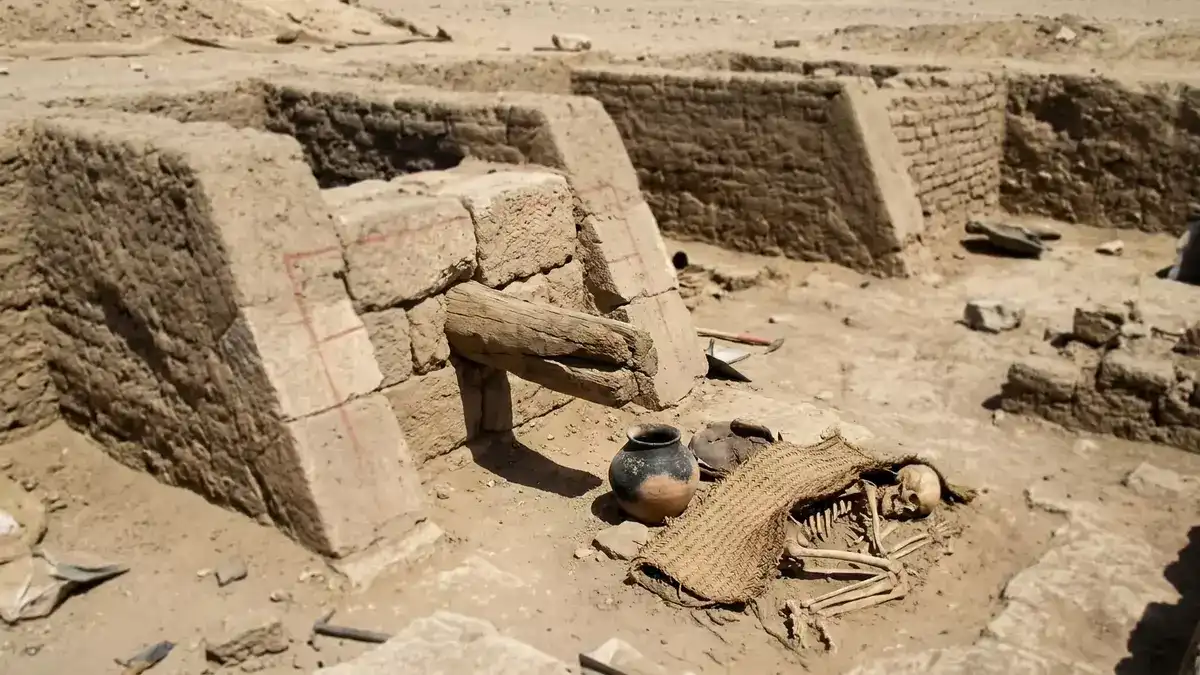
A remarkable archaeological discovery along the Nile River is shedding new light on the architectural evolution of ancient Egypt. Excavating at the site of Jabal al-Tayr in the Minya Governorate, an Egyptian scientific mission from the Supreme Council of Antiquities has uncovered two highly significant Early Dynastic tombs. These structures provide vital physical evidence of engineering developments that occurred centuries before the first iconic pyramids were built.
The expansive burial ground, situated on the strategic eastern bank of the Nile, reveals a highly layered history of human occupation. Artifacts and burials recovered at the site span thousands of years, demonstrating continuous sacred use from the prehistoric Predynastic period straight through to the Late Period of ancient Egypt.
5,000-Year-Old Tombs in Minya Reveal Roots of Pyramid Architecture
Engineering the Pre-Pyramid Era
The core of the discovery centers on two tombs dating back more than 5,000 years to Egypt’s First Dynasty. Initial structural evaluations have revealed striking architectural similarities between these newly found regional tombs and the royal tomb of King Den at Abydos—one of the most prominent rulers of early unified Egypt. This architectural mirroring indicates that specialized engineering plans and spiritual concepts were actively shared across different administrative regions during the foundational era of the Egyptian state.
The first tomb provides clear insight into early experimental engineering. The mudbrick and stone walls are built with an intentional inward slope—meaning the walls are noticeably thicker at the base and become gradually thinner as they rise toward the ceiling.
                       [Inward-Sloping Wall Evolution]
  _________________________________________________________________________
 | First Dynasty Tombs: | Thicker base, tapered top to prevent soil collapse|
 | Step Pyramids:       | Tiered, sloped mastabas stacked vertically        |
 | True Pyramids:       | Uniform, sharp inclined casing stones             |
 |______________________|___________________________________________________|
This structural tapering was a sophisticated early method designed to distribute weight more efficiently and counter the lateral pressure of surrounding desert sands. This identical structural logic was later adapted, scaled up, and perfected by royal architects to build the monumentally stable step pyramids and true pyramids of the Old Kingdom.
Construction Secrets and Ancient Scavenging
Despite suffering structural damage from historic stone-robbing networks, the first tomb managed to retain pristine micro-details regarding ancient building techniques:
Oxide Layout Lines: Archaeologists identified visible traces of oxide lines drawn onto stone surfaces, offering rare physical evidence of how ancient masons measured, marked, and cut building blocks over 5,000 years ago.
Internal Timber Scaffolding: Massive structural wooden beams were integrated directly into the walls. While some long beams extended across the entire length of the masonry, other shorter timbers were strategically placed as independent reinforcing anchors.
Directly south of this structure lies the second tomb, which shares an almost identical floor plan. Fortunately, this southern tomb completely escaped the attention of ancient stone scavengers and tomb raiders. Because its original layout remained entirely undisturbed, specialists are using its pristine state of preservation to document the precise structural features that were partially lost in the first tomb.

A Multimillennial Burial Landscape
The excavations at Jabal al-Tayr confirm that the high-status First Dynasty tombs were constructed within an already established sacred space, which remained active for millennia.
Predynastic Subsurface Cemetery
The team exposed an older cemetery layer containing several prehistoric individuals. In keeping with the cultural traditions of the pre-unification era, these individuals were laid to rest in a tightly crouched, fetal position and wrapped carefully in woven plant mats.
Buried alongside these skeletons were highly recognizable black-topped ceramic vessels. These diagnostic pottery styles date the burials precisely to the Naqada II and Naqada III periods, tracing the community’s roots to the centuries leading up to Egypt’s political unification.
Late Period Reconfiguration
At the other end of the chronological spectrum, the team identified individual and collective graves belonging to the Late Period of ancient Egypt. Some of these late-era graves still contained the fragile remnants of decorated wooden coffins.
| Historical Period | Burial Style | Primary Artifacts / Features |
| Predynastic (Naqada II/III) | Crouched body positions | Plant-fiber mats, black-topped pottery |
| Early Dynastic (1st Dynasty) | Subterranean tombs | Sloped walls, timber framing, oxide guides |
| Late Period | Individual & collective plots | Ornamental wooden coffins |
This extensive timeline proves that the regional population viewed Jabal al-Tayr as an exceptionally sacred ancestral landscape, consistently returning to bury their dead here across vastly different historical epochs.
As field operations continue on the eastern banks of the Nile, researchers anticipate that further clearing of the site will solve remaining questions about the early economic and social organization of Egypt’s foundational builders.
Conclusion
The discoveries at Jabal al-Tayr rewrite important chapters of early Egyptian architectural history, demonstrating that the structural innovations that made the pyramids possible were being developed and utilized much earlier and more widely than previously believed. By preserving structural traditions, changing religious practices, and everyday construction marks across thousands of years, this Minya necropolis stands as a vital library documenting the birth of monumental Egyptian architecture.
Frequently Asked Questions
How do these tombs connect to the origins of pyramid architecture?
The First Dynasty tombs feature specialized, inward-sloping walls that are wider at the bottom than the top. This early engineering approach improved wall stability against shifting sands. This exact structural principle was later expanded by architects to build the world’s first large-scale stone step pyramids and true pyramids.
What are the Naqada II and Naqada III periods?
These are distinct chronological phases of the Egyptian Predynastic period, dating roughly between 3500 BCE and 3000 BCE. These eras represent the cultural and technological dawn of Egypt, characterized by advanced pottery styles, expanding trade networks, and social stratification just prior to the unification of the First Dynasty.
Why are the oxide lines on the stones significant?
Oxide lines served as original construction blueprints drawn directly onto raw materials. Finding these lines provides researchers with rare, direct evidence of how ancient stonecutters measured, calibrated, and cut masonry blocks over 5,000 years ago.
Who was King Den, and why is he mentioned?
King Den was an influential pharaoh of Egypt’s First Dynasty, known for bringing stability, introducing administrative reforms, and expanding architectural traditions. The structural similarities between the newly discovered Minya tombs and King Den’s royal tomb at Abydos prove that early architectural concepts were standardized across different regions of Egypt.
What is black-topped pottery?
Black-topped pottery is a iconic style of prehistoric Egyptian ceramic where the upper rim of a clay vessel is turned black by being placed upside down in organic ash during firing, while the lower body burns to a reddish-brown color. It serves as an incredibly accurate chronological marker for dating Predynastic archaeological layers.