
Table of Contents
- 1. The Geography of Stone Age Acoustics
- 1.1. Intentional Modification Over Dietary Gathering
- 2. Blasting Across the Landscape: The Acoustic Tests
- 2.1. Unprecedented Sound Pressure Levels
- 2.2. Coordinating Complex Industrial Networks
- 3. Beyond Function: The Discovery of Prehistoric Music
- 3.1. Tonal Range and Pitch Manipulation
- 4. Sizing Up the Perfect Frequency
- 5. Conclusion: The Dynamic Rhythms of Stone Age Life
- 6. Frequently Asked Questions
- 6.1. How old are the shell trumpets found in Catalonia?
- 6.2. What species of shell was used to create these instruments?
- 6.3. How did prehistoric people modify the shells into horns?
- 6.4. How far could the sound of these ancient trumpets travel?
- 6.5. Were these tools used exclusively for long-distance signaling?
Neolithic Shell Trumpets Found in Spain Reveal Ancient Sound Tech
Long before the invention of metal horns or digital sirens, prehistoric communities in southwestern Europe utilized advanced acoustic technology to project messages across steep valleys and sprawling agricultural landscapes. A comprehensive study of Stone Age archaeological sites in Catalonia, Spain, has revealed how prehistoric societies modified massive marine snail shells into exceptionally powerful sound-producing tools.
Dating back approximately 6,000 years to the late fifth and early fourth millennia BCE, these modified artifacts are now recognized as some of the most acoustically potent signaling devices ever documented from the prehistoric world. By testing these ancient instruments, an international research team has uncovered crucial details regarding early long-distance communication systems, communal industrial coordination, and the expressive musical lives of early farming communities.
Neolithic Shell Trumpets Found in Spain Reveal Ancient Sound Tech
The Geography of Stone Age Acoustics
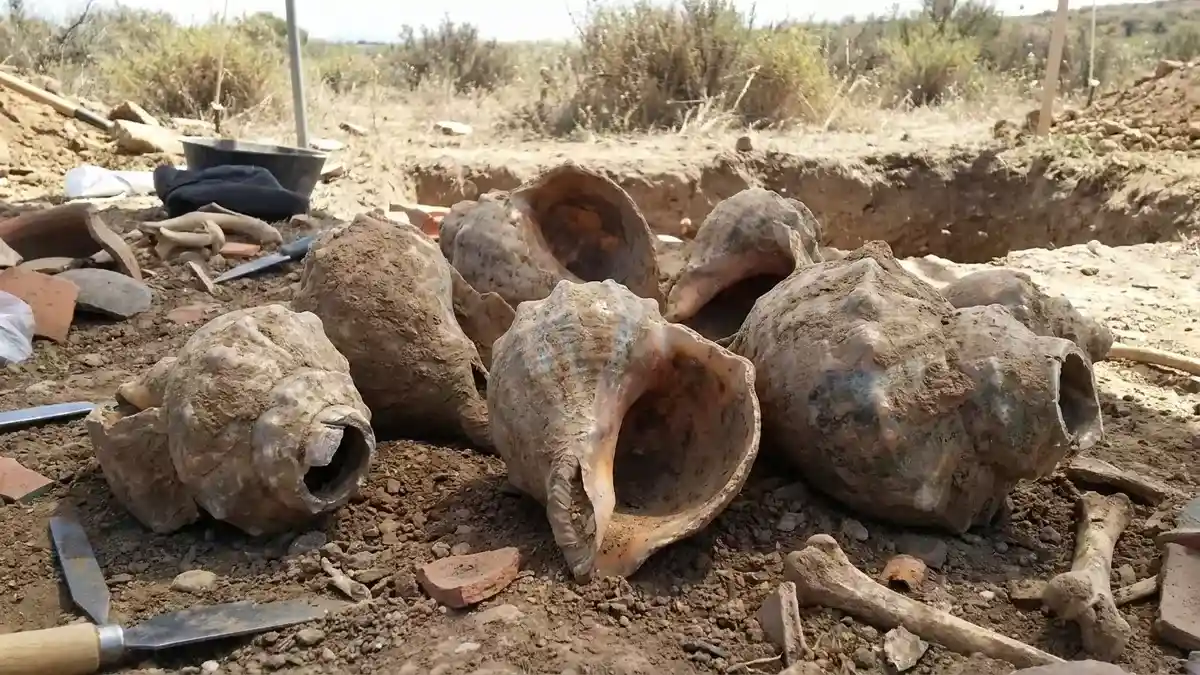
The specialized marine artifacts were recovered from a series of highly active Neolithic sites clustered within a geographically distinct zone in northeastern Iberia. More than a dozen of these unique specimens have been unearthed across a relatively compact territory stretching from the low-lying Llobregat River basin across the Penedès inland depression and out to the fertile Barcelona plains.

Intentional Modification Over Dietary Gathering
A key revelation of the research is that these massive sea snails—specifically belonging to the predatory marine species Charonia lampas (commonly known as the Triton’s trumpet)—were never harvested as a food source. Microscopic analysis of the shell surfaces reveals distinct patterns of marine wear and internal smoothing, proving that the shells were collected along the coast long after the soft-bodied mollusks had naturally died.
Once transported inland, these heavy shells underwent precise structural alterations. The pointed tip, or apex, of each spiral shell was intentionally sawed off or systematically chipped away. This deliberate modification created a smooth, open blowhole that perfectly fits human lips, transforming a heavy natural object into a fully functioning, high-powered wind instrument.

Blasting Across the Landscape: The Acoustic Tests
To uncover the exact capabilities of this ancient technology, researchers from the University of Barcelona gathered the finest surviving artifacts from regional collections. Out of the broader assemblage, eight exceptionally well-preserved shell trumpets were selected for comprehensive acoustic testing.
Unprecedented Sound Pressure Levels
When modern experimental musicians blew into the ancient instruments, the results astonished the research team. The unmodified chambers acted as natural amplifiers, producing thunderous, booming tones capable of cutting through dense woodland and echoing across rugged hillsides.
In formal acoustic terms, the sound pressure levels generated by these 6,000-year-old horns surpassed those of any other known non-electronic signaling tool discovered from the European Neolithic. The penetrating frequency of the horns was explicitly suited for navigating natural acoustic obstacles, making them perfect safety and warning devices for sprawling, decentralized populations.

Coordinating Complex Industrial Networks
The heavy concentration of these acoustic tools in specific Catalonian regions aligns perfectly with what historians know about the economic landscape of the late Stone Age. The horns were found primarily in high-density population clusters and strategic industrial sectors, such as:
Mas d’en Boixos: A vital agricultural and settlement hub.
Cal Pere Pastor: A heavily occupied domestic base.
The Gavà Mines: A complex underground mining network where prehistoric laborers excavated variscite, a highly prized green gemstone used to manufacture luxury personal ornaments traded across western Europe.
In busy farming valleys and dark, sprawling mining complexes where direct line-of-sight visibility was restricted by topography or thick vegetation, the piercing blast of a Charonia lampas horn could cut through ambient noise. These instruments likely functioned as community timekeepers, signaling the start or end of shifts, announcing trade arrivals, or mobilizing regional defenses during crises.
Beyond Function: The Discovery of Prehistoric Music
While the sheer acoustic volume of the Catalonian shell trumpets highlights their utility as industrial or military signaling devices, the research demonstrates that their creators valued them for aesthetic and artistic reasons as well.
Tonal Range and Pitch Manipulation
The experimental testing revealed that the instruments are not limited to a single monotonous drone. Highly skilled players can successfully produce up to three distinct, stable musical notes. Furthermore, by using advanced physical playing techniques—such as hand-stopping (inserting a hand into the large open aperture, or lip, of the shell) or subtle lip-bending—ancient musicians could dynamically alter the internal air column.
[Open Blowhole Blast] ───> Baseline Fundamental Frequency (High Volume)
[Hand-Stopping Shift] ───> Subtle Pitch Variance / Melodic Modulation (Lower Volume)
While these advanced playing styles reduce the overall volume of the blast, they exponentially increase the expressive, melodic potential of the tool. This strongly implies that the horns played a starring role in sacred rituals, spiritual dances, and tribal celebrations, allowing prehistoric artists to weave intricate sonic narratives.
Sizing Up the Perfect Frequency
A fascinating question raised by the University of Barcelona study centers on whether Neolithic craftsmen possessed an intuitive understanding of physics and acoustic engineering when selecting their raw materials.
The fundamental pitch of any natural horn is inextricably linked to its physical length and internal volume. Interestingly, the Catalonian shell trumpets display a highly specific size clustering, consistently producing fundamental frequencies situated between 400 and 470 Hz. This specific frequency band sits higher on the musical scale than shell trumpets recovered from other global contexts.
This structural consistency suggests that Stone Age selectors intentionally bypassed excessively large or overly tiny shells. Instead, they actively sought out medium-sized specimens that offered the ultimate balance: light enough to carry across rugged mountain passes, durable enough for daily physical abuse, and tuned perfectly to a piercing pitch that naturally commands human attention.
Conclusion: The Dynamic Rhythms of Stone Age Life
The multi-disciplinary investigation into Catalonia’s ancient shell trumpets changes our perspective on Neolithic sensory landscapes. Far from living in a world of quiet isolation, these early societies engineered a sophisticated network of auditory communication that united farmlands, mountain ridges, and industrial mining centers. Whether functioning as a vital safety siren, an economic coordinator, or a sacred vehicle for musical art, these ancient marine horns served as a foundational pillar in the social structure of early European civilization.
Frequently Asked Questions
How old are the shell trumpets found in Catalonia?
The shell trumpets date back roughly 6,000 years, placing their active use in the late fifth and early fourth millennia BCE during the European Neolithic period.
What species of shell was used to create these instruments?
Ancient communities systematically selected the shells of Charonia lampas, a large predatory sea snail commonly known as the Triton’s trumpet, which is native to the Mediterranean Sea and Atlantic Ocean.
How did prehistoric people modify the shells into horns?
Craftsmen carefully severed or ground down the pointed apex (the top spire) of the dry shell. This created a precise, circular opening that allowed a human player to vibrate their lips directly into the internal chambers.
How far could the sound of these ancient trumpets travel?
While exact distances depend heavily on local wind patterns and topography, acoustic testing proved these instruments produced higher sound pressure levels than any other known Neolithic device, allowing their tones to cut through valleys and dense forests far beyond the range of a human voice.
Were these tools used exclusively for long-distance signaling?
No. While they were incredibly effective for coordinating miners and farmers, experimental testing showed the shells could produce up to three stable notes. By using techniques like hand-stopping, ancient musicians could play melodies, indicating the horns were also used for music and spiritual ceremonies.