
Table of Contents
- 1. Redating a Cold Case: The Hort d’en Grimau Discovery
- 2. The Phoenician Connection and Changing Trade Networks
- 3. Built for Labor: The Life of a High-Value Worker
- 3.1. Pathologies of a Working Life
- 3.2. Stabling and a Specialized Diet
- 4. Mystery of the Homeland: Born Local or Imported?
- 5. A Unique Ritual: Women and Equids in Early Iberia
- 6. Conclusion: Redefining European Chronology
- 7. Frequently Asked Questions
- 7.1. Why is this specific mule discovery considered so important?
- 7.2. How do scientists know the animal was a mule and not a small horse?
- 7.3. Who brought donkeys to the Iberian Peninsula?
- 7.4. What kind of life did this ancient mule lead?
- 7.5. Why was the mule buried alongside a human woman?
Oldest Mule in Western Europe Found in an Iron Age Iberian Burial
Archaeologists have made a stunning discovery in northeastern Spain that completely rewrites the history of animal breeding and agricultural technology in ancient Europe. Researchers working at the Iron Age site of Hort d’en Grimau, located in the Penedès region of Catalonia, have identified the skeletal remains of what is now confirmed to be the earliest known mule in both the western Mediterranean and continental Europe.
The breakthrough study, published in the Journal of Archaeological Science: Reports, pushes back the timeline for deliberate equid hybridization—the intentional crossbreeding of horses and donkeys—on the European continent by several centuries. Beyond its biological significance, this ancient work animal sheds new light on the immense reach of early maritime trade networks and the sophisticated farming communities of ancient Iberia long before the rise of the Roman Empire.
Oldest Mule in Western Europe Found in an Iron Age Iberian Burial
Redating a Cold Case: The Hort d’en Grimau Discovery
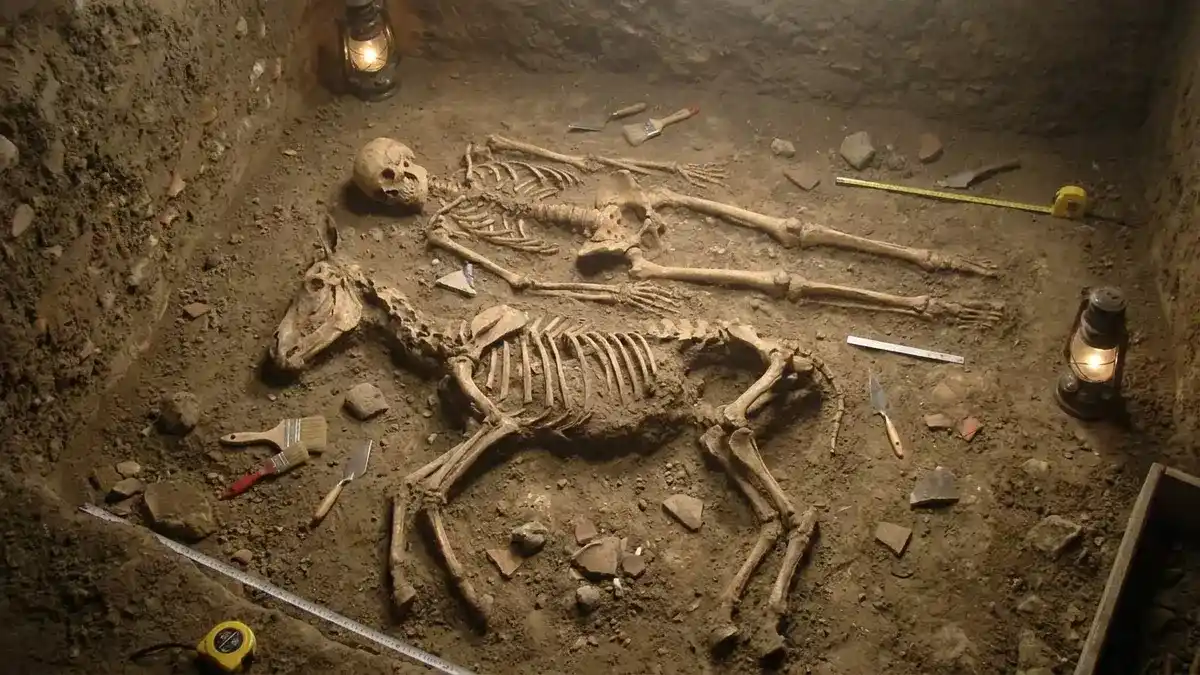
The skeletal material at the heart of this discovery was not found recently; it was originally excavated in 1986 from an underground pit, which historians believe served as a agricultural storage silo before being repurposed as a final resting place. Inside this subterranean chamber lay the remarkably well-preserved remains of a small equid interred directly alongside the partially burned bones of a human female.
For decades, the true identity of the animal remained obscure. However, using a battery of cutting-edge modern scientific techniques, an international research team re-analyzed the historic collection curated in Vilafranca del Penedès. By combining four distinct fields of modern archaeology, they finally unlocked the specimen’s secrets:
Ancient DNA (aDNA) Sequencing: Confirmed the animal’s exact genetic lineage, proving it was a female hybrid born to a horse mare and a male domestic donkey.
High-Precision Radiocarbon Dating: Securely placed the burial between the 8th and 6th centuries BCE, a crucial transition period in European history known as the Early Iron Age.
Detailed Zooarchaeology: Mapped a structural mosaic of skeletal traits, noting that the skull and limbs blended physical characteristics from both parent species.
Stable Isotope Analysis: Analyzed the chemical signatures locked inside the animal’s teeth to determine its exact lifetime diet and geographic origin.

The Phoenician Connection and Changing Trade Networks
The timing of this ancient mule’s life is directly linked to a period of intense global expansion. The 8th to 6th centuries BCE marked the peak of Phoenician maritime exploration and colonization along the coastlines of the Iberian Peninsula.
Hailing from the Levant (modern-day Lebanon, Syria, and Israel), the Phoenicians established highly efficient trading factories and coastal colonies. They brought with them a wealth of foreign luxury goods, novel manufacturing technologies, and entirely new domestic animals—most notably, the domestic donkey.
Because mules are biologically sterile hybrids requiring the deliberate pairing of a female horse and a male donkey, their presence in Iron Age Catalonia implies a rapid transfer of sophisticated livestock knowledge. The delicate art of equid crossbreeding had been practiced for over a millennium in the Near East, but this find confirms that this specialized knowledge reached western Europe much earlier than historians previously assumed.
Built for Labor: The Life of a High-Value Worker
The scientific team didn’t just identify what the animal was—they reconstructed how it lived, worked, and was cared for by its human masters.
Pathologies of a Working Life
An intense examination of the mule’s skull revealed clear, age-related wear and tear, particularly concentrated along the jaws and dental structures. The team noted specific buccal enamel overgrowths, sharp cusps, and distinct concave wear patterns on the molars. These dental anomalies are consistent with an animal that was regularly managed, broken to a bit or halter, and ridden or used for heavy draft work throughout its adult life.
Stabling and a Specialized Diet
The results of the stable carbon and nitrogen isotope testing provided an unexpected twist regarding how this animal was valued. The chemical values revealed that the mule consumed a specialized diet rich in cultivated agricultural cereals rather than wild, open-pasture grasses.
This indicates intentional foddering—meaning humans purposefully harvested grain to feed this specific animal. It strongly suggests that the mule was kept in a stable and maintained on high-energy, premium feed, reflecting its status as an invaluable economic asset to the local community. Mules possess superior endurance, stronger hooves, and a capacity to carry heavier loads than either horses or donkeys, making them the ultimate multi-terrain draft animals for rugged environments.
Mystery of the Homeland: Born Local or Imported?
One of the most compelling questions still facing researchers is whether this historic mule was bred locally in the hills of Penedès or imported across the sea as a fully grown luxury commodity.
Possibility A: Local Breeding
[Local Iberian Mare]  x  [Imported Phoenician Donkey]  =  Locally Born Hybrid Mule

Possibility B: Maritime Import
[Hybridized in North Africa/Levant]  -->  [Shipped via Phoenician Vessel]  -->  [Arrives in Iberia]
If it was bred locally, it proves that Iberian farmers were actively experimenting with imported Phoenician donkeys to transform their domestic livestock lines. If it was imported, it highlights a complex, long-distance trade network capable of shipping live, heavy working stock across the Mediterranean. Ongoing genetic and isotopic research is currently underway, comparing the Iberian specimen’s profile to ancient animal populations in North Africa and the Levant to pinpoint its true birthplace.
A Unique Ritual: Women and Equids in Early Iberia
The human element of the Hort d’en Grimau discovery adds a fascinating layer of cultural and religious complexity. The association of a woman buried alongside a valuable working equid represents a highly specific, local funerary tradition unique to the Early Iron Age of northeastern Iberia.
This practice stands in stark contrast to the later cultural shifts seen during the Second Iron Age. In later centuries, horse remains are found almost exclusively inside male cremation graves, heavily laden with martial symbolism, weapons, and elitist warrior status. The earlier tradition of interring women with equids, though uncommon, suggests a distinct social structure or religious practice that may have been influenced or preserved through centuries of close contact with Phoenician trading communities.
Conclusion: Redefining European Chronology
The identification of the Hort d’en Grimau specimen forces a massive revision of European agricultural timelines. For over a century, conventional history dictated that wide-scale mule breeding and hybrid animal management were innovations introduced to western Europe by the expanding Roman Republic. This discovery completely shatters that narrative, proving that specialized equid hybridization was already smoothly integrated into the economic and ritual fabric of the Iberian Peninsula hundreds of years before the first Roman legions ever set foot in Spain.
Frequently Asked Questions
Why is this specific mule discovery considered so important?
It is officially the oldest confirmed mule skeleton ever discovered in continental Europe and the western Mediterranean. The find pushes back the known timeline for advanced hybrid animal breeding in Europe by several centuries.
How do scientists know the animal was a mule and not a small horse?
Researchers used ancient DNA (aDNA) extraction to confirm its genetic status as a hybrid. They paired this with zooarchaeological analysis of the teeth and bones, which displayed a physical mixture of both horse and donkey skeletal features.
Who brought donkeys to the Iberian Peninsula?
Domestic donkeys were introduced to the region by the Phoenicians during the Early Iron Age. The Phoenicians established extensive coastal trade networks that brought new technologies, eastern goods, and unique livestock into native Iberian communities.
What kind of life did this ancient mule lead?
Skeletal analysis shows the mule lived a long, active life as a valued working animal. Distinct wear patterns on its jaws indicate it was ridden or harnessed, while isotope analysis reveals it was fed a premium diet of cultivated grains and likely kept in a stable.
Why was the mule buried alongside a human woman?
During the Early Iron Age in northeastern Iberia, a distinct, localized cultural practice occasionally involved burying women with equids. This unique ritual disappeared in later centuries, when horse burials became exclusively associated with high-status male warriors.