
Table of Contents
- 1. Unlocking Ancient Childhood Through Artifacts
- 2. The Spiritual Geography of the Human Head
- 3. Timing the Ritual: A Milestone Before Gender
- 3.1. 1. Infancy (3 to 12 Months)
- 3.2. 2. Early Childhood (1 to 4 Years)
- 4. Sacred Blood and Priestly Interventions
- 5. The Lifelong Journey of Bodily Transformation
- 6. Conclusion
- 7. Frequently Asked Questions (FAQ)
- 7.1. 1. Why did the ancient Maya consider ears to be spiritually significant?
- 7.2. 2. At what exact age did Maya children have their ears pierced?
- 7.3. 3. Did commoner children participate in ear stretching as well?
- 7.4. 4. How did the Maya actually stretch their ears over time?
- 7.5. 5. Was ear piercing related to a child’s gender?
Ancient Maya Childhood: How Ear Piercing Formed the Essence of Personhood
When we visualize the ancient Maya civilization, our minds often drift to towering limestone pyramids, complex hieroglyphic calendars, or divine kings adorned in brilliant jade. Yet, beneath the grand tapestry of geopolitical warfare and cosmic ritualism lay a deeply intimate, domestic world. A groundbreaking study has recently brought this world to light, revealing that one of the most vital milestones in an ancient Maya life occurred during infancy: the ritual piercing and subsequent stretching of the ears.
Far from being a mere aesthetic choice or a simple display of wealth, ear ornamentation was a foundational rite of passage. New research indicates that this physical transformation was central to the very construction of identity, spirituality, and social personhood in Maya society.
Ancient Maya Childhood How Ear Piercing Formed the Essence of Personhood
Unlocking Ancient Childhood Through Artifacts
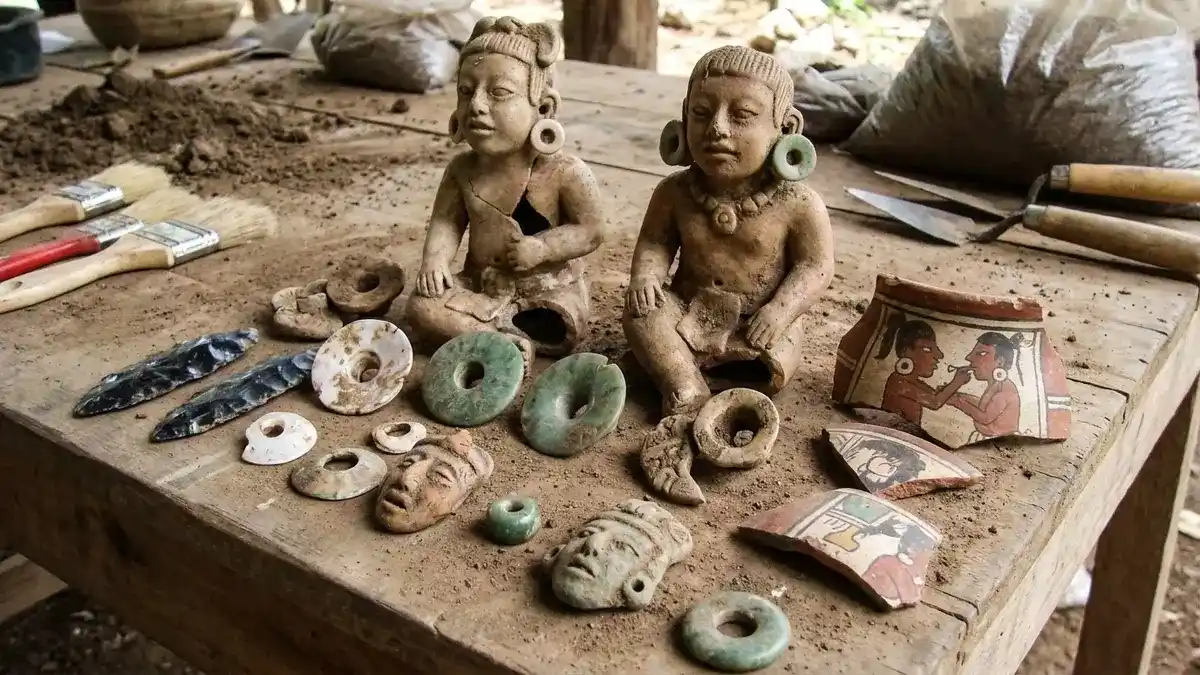
Reconstructing the lives of children in archaeological contexts is notoriously difficult. Children leave smaller material footprints, and their stories are frequently overshadowed by the deeds of adult elites. To bridge this gap, a comprehensive study analyzed 83 artistic representations of Maya children spanning over two millennia, from the Preclassic period around 800 BCE to the Postclassic period ending near 1500 CE.

These rare depictions were meticulously gathered from a variety of surviving mediums:
Hand-modeled ceramic figurines
Vibrant, painted scenes on elite polychrome pottery
Intricate stone reliefs and monumental carvings

Because children are relatively rare subjects in monumental Maya art, this sample of 83 images represents an incredibly precious repository of data. It provides modern historians with a vivid, unfiltered lens into how the ancient Maya conceptualized, categorized, and celebrated the earliest stages of human life.
The Spiritual Geography of the Human Head
To understand why the Maya focused so heavily on the ears, researchers cross-referenced archaeological iconography with the rich ethnographic records of modern Maya communities, such as the Ch’ol and Tzotzil.

In the traditional Maya worldview, the human soul is not a singular entity. Instead, it is a complex composite of multiple spiritual forces, the majority of which reside within the head. These soul components, which govern a person’s identity, consciousness, and mental clarity, are deeply intertwined with the concept of ik’—a sacred term translating to wind, breath, or life force.
   [Sacred Breath / Wind (ik’)]
               │
               ▼
     [Ear Ornaments / Spools] ──► Linked to Mental Clarity & Social Integrity
               ▲
               │
   [Soul Components in the Head]
Within this symbolic framework, ear ornaments acted as spiritual conduits directly tied to ik’. Piercing a child’s ears was not just a cosmetic enhancement; it was a profound metaphysical act. It anchored the child’s life force, safeguarded their mental faculties, and signaled their readiness to enter the social contract of the community.
This spiritual connection is beautifully mirrored in Classic-period iconography of wind deities. These celestial beings are almost universally depicted wearing specialized earspools marked with glyphs and symbols representing wind and sacred breath.
Timing the Ritual: A Milestone Before Gender
The study yielded fascinating insights into the chronological timeline of a Maya child’s bodily transformation. The analysis of the iconographic data revealed a structured progression:
1. Infancy (3 to 12 Months)
While some rare depictions show infants as young as three to four months old with pierced ears, it was not the standard practice. However, between the ages of four months and one year, the appearance of ear ornaments in art increases noticeably.
2. Early Childhood (1 to 4 Years)
This window represents the cultural peak for the ritual. The vast majority of children depicted within this age bracket wear fully formed ear ornaments.
Intriguingly, children received these ear adornments long before they were depicted wearing gender-specific clothing or other age-linked societal markers. This suggests that achieving spiritual and social personhood via ear piercing was deemed more urgent than defining a child’s economic or gendered role within the community. It was the absolute baseline of becoming human.
Sacred Blood and Priestly Interventions
In neighboring Mesoamerican cultures, such as the Aztecs, historical codices explicitly state that infant ear piercing was a highly formalized event conducted by specialized ritual practitioners. For the Maya, identifying the exact individuals who performed these procedures has been historically challenging due to a lack of written step-by-step manuals.
However, drawing parallels to other known Maya traditions offers compelling answers. Because the act of piercing flesh inevitably involved bloodletting, it likely carried immense sacrificial weight.
Archaeological Parallel: In elite Maya society, holy bloodletting ceremonies—where rulers pierced their own tongues or genitals to communicate with ancestors—were strictly orchestrated by high priests.
Given the shared sacrificial nature of drawing blood from the head, it is highly probable that a child’s initial ear piercing was a sanctified event overseen by religious figures or shamans, elevating the procedure from a domestic chore to a cosmic presentation.
The Lifelong Journey of Bodily Transformation
The initial piercing in infancy was merely the prologue to a lifelong process of modification. A hallmark of Maya identity was ear stretching, a practice where individuals gradually expanded the diameter of their earlobe piercings over several decades.
While the exact materials used to gradually widen the lobes remain unrecorded, experimental archaeology suggests a slow, methodical increase in the physical size and weight of the inserted jewelry. This practice created a striking visual hierarchy that reflected a person’s socio-economic status:
| Social Stratum | Ear Ornament Materials | Archaeological Preservation |
| The Elite & Nobility | Imperial jade, precious marine shells, finely slipped specular ceramics | Excellent; frequently discovered intact in royal tomb excavations. |
| The Commoners | Carved wood, fired clay, woven fiber cords | Poor; these organic materials readily decayed in the humid tropical soil. |
As the earlobes stretched further over time, the size of the ornament a person could support became an undeniable, walking testament to their endurance, age, and societal standing.
Conclusion
The revelation that ear piercing was a pivotal childhood rite reshapes our understanding of the ancient Maya. It proves that the magnificent ornaments found in royal tombs were not merely status symbols acquired in adulthood, but the culmination of a sacred journey that began in the arms of a caregiver. By transforming the physical body of an infant, the Maya successfully breathed social spirit, safety, and cultural identity into the next generation.
Frequently Asked Questions (FAQ)
1. Why did the ancient Maya consider ears to be spiritually significant?
The Maya believed that vital components of the human soul, closely tied to consciousness and ik’ (breath or wind), were concentrated in the head. The ears were viewed as crucial pathways for these energies. Piercing them helped secure the soul and maintain mental clarity.
2. At what exact age did Maya children have their ears pierced?
The ritual typically took place between 1 and 4 years of age. While it could occasionally happen as early as three months, the iconographic evidence shows that the vast majority of children were adorned with ear jewelry by their fourth year.
3. Did commoner children participate in ear stretching as well?
Yes, ear stretching was a widespread cultural practice across all levels of Maya society. However, while elites wore heavy, prestigious materials like jade and rare seashells, commoners utilized readily available, perishable items like wood, clay, and twisted cords.
4. How did the Maya actually stretch their ears over time?
Though explicit historical guides do not exist, evidence indicates it was a gradual process. The Maya slowly increased the size, gauge, and weight of their ear inserts over many years, allowing the skin of the earlobe to safely expand over time.
5. Was ear piercing related to a child’s gender?
No. The study discovered that ear piercing occurred before children were given gender-specific clothing or other gendered markers. It was a universal rite of passage aimed at establishing basic human personhood, regardless of whether the child was a boy or a girl.