
Table of Contents
- 1. The Secrets of Goat Mound: Discovery in Kozareva Mogila
- 2. Reconstruction of a Prehistoric Nightmare: The Nature of the Injuries
- 2.1. Catastrophic Cranial Damage
- 2.2. Widespread Bodily Trauma
- 3. Scientific Detective Work: Identifying the Apex Predator
- 4. Healing Against All Odds
- 5. The Prehistoric Healthcare System: Bioarchaeology of Care
- 5.1. Total Dependence on the Community
- 5.2. Compassion Over Productivity
- 6. A Complicated Farewell: Fear and Ambiguity in Death
- 7. Frequently Asked Questions
- 7.1. Were there actually wild lions living in Europe 6,000 years ago?
- 7.2. How did scientists prove a lion caused the injuries rather than a human weapon?
- 7.3. What is the “bioarchaeology of care”?
- 7.4. How could someone survive an open skull fracture without modern antibiotics?
- 7.5. Why was the young man buried without any grave goods?
6,000-Year-Old Human Skeleton Reveals Miraculous Ancient Lion Attack Survival
A groundbreaking archaeological discovery in eastern Bulgaria has offered an unprecedented look into prehistoric human resilience and compassion. Researchers excavating a Copper Age cemetery have uncovered the skeletal remains of a young man who survived a horrific, violent encounter with a lion more than 6,000 years ago.
Not only did this ancient teenager endure an attack that would be fatal in almost any era, but bone analysis confirms he lived for months afterward. This remarkable survival story provides rare, tangible evidence of community healthcare and empathy in the deep human past.
6,000-Year-Old Human Skeleton Reveals Miraculous Ancient Lion Attack Survival
The Secrets of Goat Mound: Discovery in Kozareva Mogila
The extraordinary remains were unearthed near the Black Sea coast at a famous archaeological site known as Kozareva Mogila, which translates to “Goat Mound.” Dating back to the fifth millennium BCE, this location hosts a necropolis from the Late Eneolithic, or Copper Age—a transformative period in European prehistory characterized by early metallurgy and complex social structures.
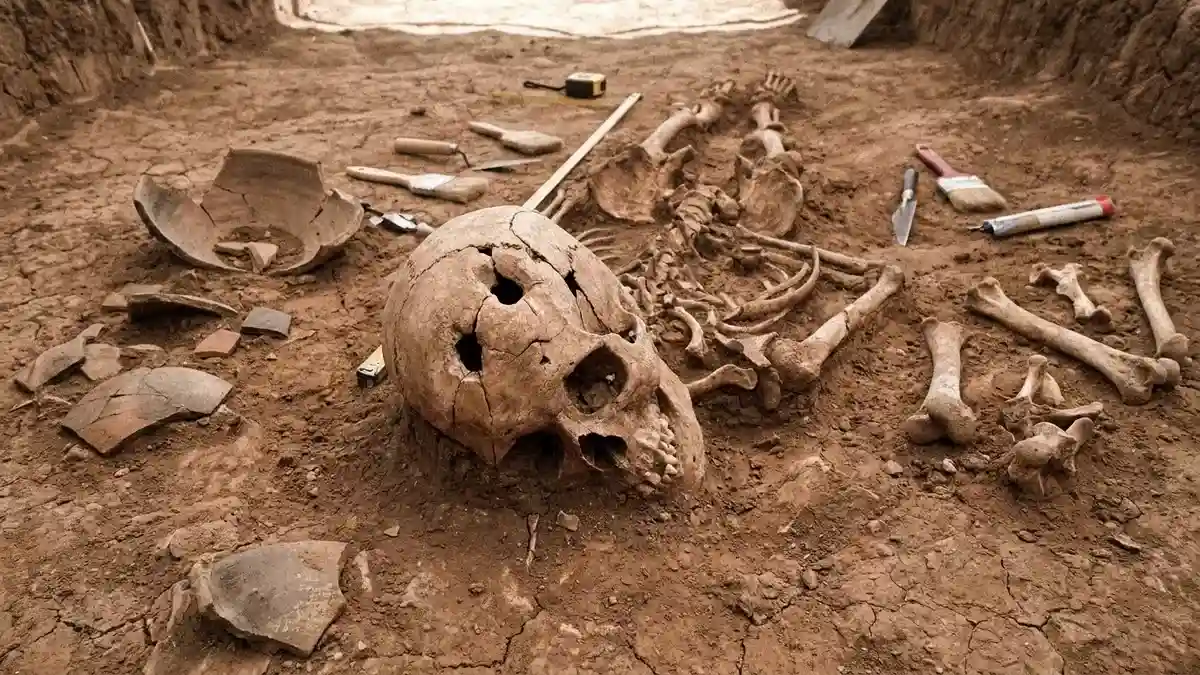
Among the many graves excavated at the site, Grave 59 immediately stood out to researchers. The burial contained a remarkably tall male adolescent or young adult, estimated to have stood between 5 feet 7 inches and 5 feet 9 inches (171 to 177 cm). Unlike the standard burials of the culture, this young man was laid to rest in a crouched position on his side within an unusually deep grave. Strikingly, he was buried completely devoid of grave goods, pottery, or personal ornaments, hinting at a complicated social status at the time of his death.
Reconstruction of a Prehistoric Nightmare: The Nature of the Injuries
When physical anthropologists and forensic experts examined the skeleton, they discovered a harrowing pattern of trauma. The young man’s bones bore the distinct marks of a desperate struggle for survival against a massive predator.
Catastrophic Cranial Damage
The most severe trauma was located on the skull. The young man suffered multiple crushing and puncture wounds across his head. Most notably, a large perforation penetrated directly through his cranial cavity, an injury so severe it would have completely exposed his brain. Forensic casting revealed distinct pits on both the left and right parietal bones, mapping out the precise locations where powerful jaws clamped down on his head.

Widespread Bodily Trauma
The violence was not restricted to the skull. The analysis identified extensive trauma across the rest of the skeleton, including the shoulder, arm, and legs. The alignment of these bone lesions indicates severe muscle tearing, tendon damage, and deep flesh wounds where the attacker repeatedly clawed and bit the victim as he was dragged down.
Scientific Detective Work: Identifying the Apex Predator
To determine exactly what caused these horrific injuries, the research team utilized advanced forensic techniques and comparative archaeozoology.
Ruling Out Human Violence: The unique structural shapes of the fractures quickly ruled out interpersonal warfare, execution, or weapons.
Excluding Ritual Practices: The jagged, destructive nature of the skull wounds did not align with prehistoric trepanation—an ancient surgical practice of drilling holes in the skull, which typically leaves clean, deliberate edges.
Matching the Bite Marks: Researchers created high-precision molds of the bone punctures and compared them against extensive skeletal reference collections of carnivore teeth.

The depth, spacing, and immense pressure required to fracture the bone perfectly matched the dental anatomy of a lion (Panthera leo). While smaller predators like leopards and lynxes inhabited the prehistoric Balkans, their jaws were anatomically incapable of leaving such massive, crushing markers. This study confirms that European lions were not just a myth, but an active, terrifying reality for Copper Age communities.
Healing Against All Odds
What elevates this discovery from a tragic wildlife encounter to a historic marvel is the undeniable evidence of healing. Forensic analysis of the skull revealed that a loose fragment of splintered bone had actually fused back onto the inner surface of the cranium.
Every major wound across the young man’s body showed significant advanced bone remodeling. New, healthy bone growth had successfully formed around the edges of the catastrophic skull fractures. Furthermore, the skeletal analysis showed absolutely no signs of active bone infection (osteomyelitis) at the time of his passing.
The data indicates that the young man did not die during the attack, nor did he succumb to immediate blood loss or sepsis. Instead, he defied the medical limitations of the fifth millennium BCE to survive for several months after the trauma occurred.
The Prehistoric Healthcare System: Bioarchaeology of Care
The survival of a severely traumatized individual for months provides profound insights into the social fabric of Copper Age Europe. This discovery serves as a textbook example of what anthropologists call the “bioarchaeology of care.”
Total Dependence on the Community
The extent of the young man’s injuries means he would have been instantly and permanently disabled. The open head wound and internal cranial pressure likely caused severe neurological deficits, potentially resulting in seizures, cognitive changes, or partial paralysis. Meanwhile, the trauma to his limbs would have severely restricted his mobility.
Compassion Over Productivity
In a harsh prehistoric environment where daily survival depended heavily on physical labor, hunting, and farming, a severely disabled individual could no longer contribute traditionally to the group’s productivity. Yet, the community chose to invest immense time, energy, and resources into his survival.
To keep him alive for months with an exposed brain and mangled limbs, his peers must have provided round-the-clock assistance. They would have needed to clean his wounds, manage his pain, shelter him from the elements, and physically feed and hydrate him. This reveals a deeply empathetic culture that valued human life far beyond its economic or practical utility.
A Complicated Farewell: Fear and Ambiguity in Death
While the community demonstrated deep compassion during his final months of life, his burial arrangements suggest that his social standing changed dramatically after the attack.
The absolute lack of grave goods—an anomaly for a community that traditionally buried its dead with ceramic vessels or copper tools—combined with the deliberate effort required to dig an exceptionally deep grave, points to a complex societal reaction. Researchers hypothesize that the young man’s heavily scarred face, missing chunks of his skull, and altered personality due to brain trauma may have generated a sense of fear, awe, or spiritual ambiguity among his peers. He may have been viewed as someone touched by the supernatural, resulting in a burial designed to isolate or permanently contain his spirit.
Ultimately, these ancient bones offer an enduring testament to human nature. Even 6,000 years ago, faced with the terrifying reality of apex predators, humanity’s defining trait was not just our vulnerability to nature, but our profound capacity for love, nursing, and community care.
Frequently Asked Questions
Were there actually wild lions living in Europe 6,000 years ago?
Yes. European lions (Panthera leo) were native to the Balkan Peninsula, Greece, and parts of Eastern Europe during the Stone and Copper Ages. They eventually went extinct in the region around the 1st century CE due to overhunting and habitat loss caused by expanding human civilizations.
How did scientists prove a lion caused the injuries rather than a human weapon?
Archaeologists used high-precision molds of the bone punctures to analyze the exact size, depth, and spacing of the wounds. These metrics were compared against known human weapon markings and animal tooth shapes. The injuries perfectly matched the jaw dimensions and biting force of a large male lion, ruling out tools or smaller predators.
What is the “bioarchaeology of care”?
The bioarchaeology of care is an anthropological framework used to study healthcare and disability in ancient societies. By analyzing severe skeletal trauma and calculating how long an individual survived post-injury, scientists can deduce the level of medical attention, nursing, and emotional support a community provided to its vulnerable members.
How could someone survive an open skull fracture without modern antibiotics?
While modern medicine makes survival much higher, ancient humans relied on robust immune systems, sterile environments away from modern superbugs, and natural treatments. The community likely used medicinal plants, clean water rinses, or natural antiseptics (like honey or specific herbs) to keep the wound clean, preventing fatal brain infections for months.
Why was the young man buried without any grave goods?
The lack of grave goods and the unusual depth of his grave suggest a complex social response to his trauma. Neurological changes from his brain injury or his severe physical disfigurement may have made his community view him with fear, reverence, or superstition, leading to an unconventional burial meant to separate him from the rest of the deceased.