
Table of Contents
- 1. The Relocation of Hitler’s Rocket Program
- 1.1. The Shadow of Blizna
- 2. Excavating the Impact Crater
- 2.1. Pieces of a Forgotten Missile
- 2.2. The Unexploded Practice Warhead
- 3. Dual Legacies: Space Exploration and Human Cost
- 4. Honoring the Underground Intelligence
- 5. Frequently Asked Questions
- 5.1. Why did the German military test V-2 rockets in Poland?
- 5.2. What specific parts of the rocket were found in the crater?
- 5.3. Why didn’t the rocket explode when it hit the ground?
- 5.4. How did the V-2 rocket impact the post-war world?
- 5.5. What role did the Polish resistance play at the Blizna site?
World War II V-2 Rocket Fragments Unearthed at Nazi Missile Test Site in Poland
An extraordinary historical recovery in southeastern Poland has brought the harrowing realities of World War II rocketry back to the surface. During a collaborative field survey near the Blizna Historical Park, military history enthusiasts unearthed buried fragments of a German V-2 ballistic missile.
The discovery, made in Poland’s Ropczyce-Sędziszów County, reveals critical tangible remnants of Nazi Germany’s late-war “Wonder Weapon” (Wunderwaffe) testing operations. It highlights a vital nexus of wartime technological evolution, massive human suffering, and the brave espionage efforts of the Polish underground resistance.
World War II V-2 Rocket Fragments Unearthed at Nazi Missile Test Site in Poland
The Relocation of Hitler’s Rocket Program
The V-2 rocket—officially designated by the German military state as the Aggregat-4 (A-4)—was developed under the supervision of aerospace scientist Wernher von Braun. Initially, the core of the research and manufacturing operation was based at the Peenemünde Army Research Center on Germany’s Baltic coast.

The Shadow of Blizna
In August 1943, the British Royal Air Force launched Operation Hydra, a massive bombing raid that severely crippled the facilities at Peenemünde. Recognizing the vulnerability of their coastal research center, Nazi leadership scrambled to relocate their rocket testing program deep inland.
They selected the heavily forested area around Blizna, Poland, converting it into a top-secret military zone known as Heidelager. Between late 1943 and mid-1944, this site became the primary launchpad for trial V-2 rockets, making it an incredibly dangerous, heavily fortified epicenter of early aerospace engineering.

Excavating the Impact Crater
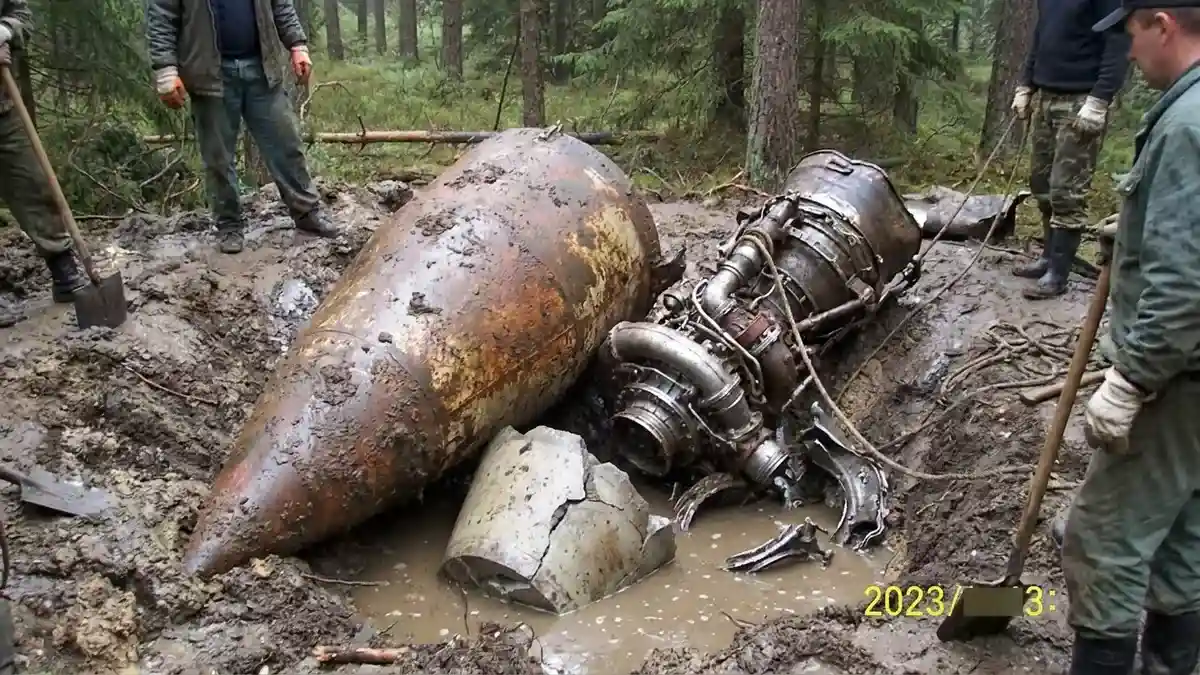
The recent breakthrough was achieved by a dedicated joint task force consisting of the Podkarpackie Military Enthusiasts Association, two separate metal detectorist networks, regional forestry services, and local municipal authorities. The excavation team targeted an old, isolated impact crater left behind by a test launch that failed to execute a normal flight path over eighty years ago.
Pieces of a Forgotten Missile
Digging deep into the waterlogged soil of the crater, researchers exposed heavily intact machinery components that had managed to evade scavengers and scrap collection for decades.
The Ballistic Cone: The team recovered a nearly complete nose cone assembly, which is globally recognized as one of the most iconic aesthetic and structural elements of the V-2 airframe.
The Fuel Injectors and Components: Intact fuel injection systems were pulled from the mud, offering clues about the liquid-propellant mixing sequences used by the German rocket engineers.
The Engine Turbopump: Critical internal components of the highly sophisticated turbopump assembly were salvaged. In an intact A-4 rocket, this complex steam-driven pump was responsible for forcing thousands of pounds of liquid oxygen and alcohol into the combustion chamber every minute.

The Unexploded Practice Warhead
Remarkably, the team also reached the main warhead compartment buried deep beneath the impact line. On impact, the severe force of the crash had driven the rocket’s second-stage structural frame directly into the main fuselage body.
The reason these components survived in such pristine structural condition is due to a single factor: because this launch was an internal test flight, the missile was equipped with a non-explosive concrete practice warhead. The absence of a live high-explosive payload prevented the entire rocket from vaporizing itself upon slamming into the Polish soil, leaving its heavy engine components intact for future historians.
Dual Legacies: Space Exploration and Human Cost
The V-2 rocket occupies a highly polarized and dark position in modern history. Technologically, it was a staggering achievement, standing as the very first human-made object to cross the Kármán line and enter the fringes of outer space. Following the collapse of Nazi Germany, captured V-2 hardware and scientists—including Wernher von Braun himself—were brought to the United States and the Soviet Union via operations like Project Paperclip, forming the literal engineering foundations of the Cold War Space Race and the subsequent Apollo moon landings.
┌────────────────────────────────────────────────────────┐
│               THE INVERSION OF V-2 HARDWARE            │
│                                                        │
│  [Wartime Destruction] ─────────────► [Post-War Space] │
│          │                                   │         │
│          ▼                                   ▼         │
│  • 3,000+ fired at civilian cities   • Transferred via Paperclip│
│  • Killed thousands of civilians      • Powered early NASA tech │
│  • Built using forced labor camps    • Precursor to modern ICBMs│
└────────────────────────────────────────────────────────┘
However, this technological milestone was built entirely on a foundation of absolute horror. Over 3,000 V-2 rockets were launched operationally against civilian targets like London and Antwerp, killing thousands of innocent people.
Worse still, the manufacturing process inside underground factories like Mittelwerk relied entirely on the brutal exploitation of concentration camp prisoners and forced laborers. Historians estimate that far more people died building the V-2 under horrific slave labor conditions than were actually killed by the weapon’s impact on its targets.
Honoring the Underground Intelligence
The artifacts recovered from the Ropczyce-Sędziszów excavation are currently being transferred to the Blizna Historical Park. Once stabilized, the components will join an exhibition dedicated to the history of the V-1 and V-2 programs, as well as the heroic actions of the Polish Home Army (Armia Krajowa).
During the war, Polish underground operatives maintained a constant, highly dangerous watch on the Blizna testing grounds. At immense personal risk, these local resistance fighters tracked rocket paths, gathered fallen debris from misfired tests, and successfully smuggled vital technical intelligence reports back to the Western Allies. The newly recovered fragments stand as a permanent physical monument to their bravery and a reminder of the complex, dual-edged sword of early rocket science.
Frequently Asked Questions
Why did the German military test V-2 rockets in Poland?
Initially, V-2 testing was concentrated at Peenemünde on the German coast. However, after a devastating Allied bombing raid in August 1943 severely damaged the facility, Nazi high command relocated testing activities deep into the dense forests of Blizna, Poland, to protect the secret project from aerial surveillance.
What specific parts of the rocket were found in the crater?
The excavation successfully recovered a nearly complete ballistic nose cone, major internal pieces of the liquid-propellant turbopump, fuel injector components, the warhead assembly, and compressed remnants of the rocket’s secondary internal stage.
Why didn’t the rocket explode when it hit the ground?
Because this specific launch was an engineering test flight rather than an operational attack, the rocket was fitted with a concrete practice warhead rather than a live high-explosive payload. This absence of an explosion preserved the heavy internal metal components from being blown to pieces.
How did the V-2 rocket impact the post-war world?
The V-2 was the direct ancestor of modern space exploration and intercontinental ballistic missiles (ICBMs). After World War II, both American and Soviet space programs captured V-2 hardware and recruited its lead scientists to kickstart their respective space races.
What role did the Polish resistance play at the Blizna site?
The Polish Home Army operated a highly sophisticated intelligence network around Blizna. At great risk to their lives, they monitored Nazi missile launches, salvaged crashed rocket components before German retrieval teams could reach them, and passed crucial technical data to Allied intelligence.