
Table of Contents
- 1. The Copper Engine of Hala Sultan Tekke
- 2. Sealed by Fate: The 14th-Century BCE Vaults
- 3. Global Treasures: Mapping the Bronze Age Supply Chain
- 3.1. The Aegean & Greece
- 3.2. India, Afghanistan, & Egypt
- 3.3. The Baltic & Sardinia
- 4. The Biological Profile of the Elite
- 5. Frequently Asked Questions
- 5.1. What makes the recent discoveries at Hala Sultan Tekke so important?
- 5.2. How did Hala Sultan Tekke become so wealthy?
- 5.3. How did the artifacts inside the tombs survive so well?
- 5.4. What exotic trade items were found inside the burial chambers?
- 5.5. What did the skeletal analysis reveal about the people buried there?
Wealth of the Copper Kings: Elite Bronze Age Tombs Uncovered in Cyprus
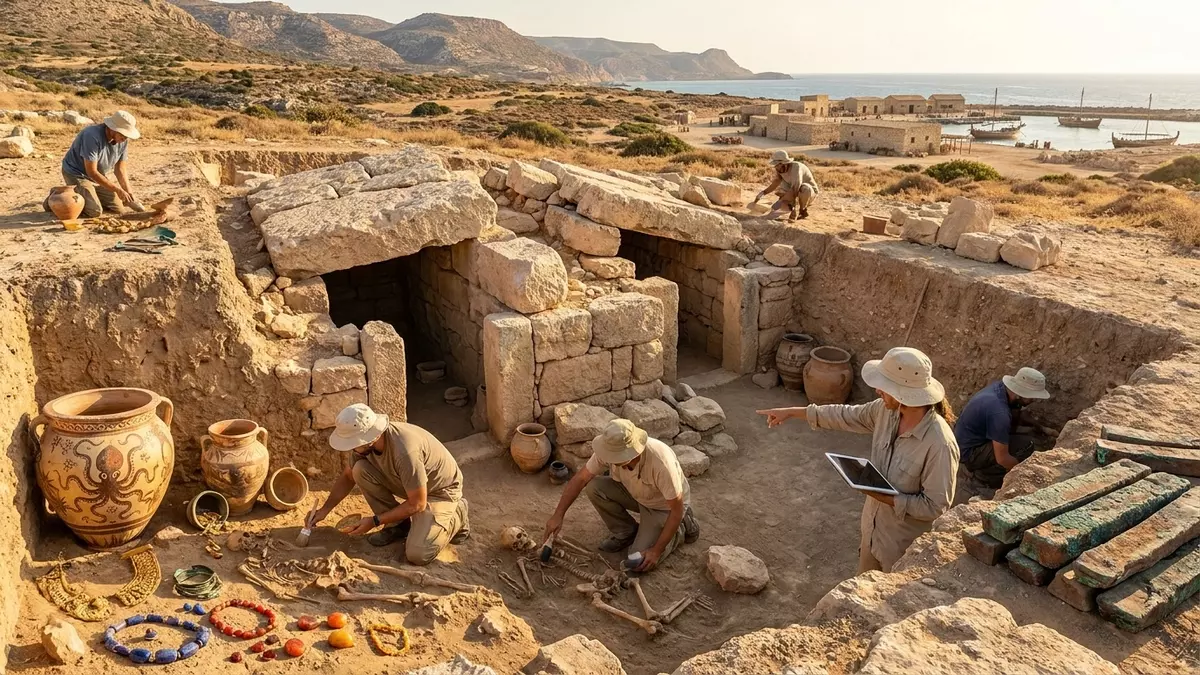
A high-tech excavation on the southern coast of Cyprus has brought to light two spectacular Late Bronze Age chamber tombs packed with international treasures. The discoveries at the ancient harbor city of Hala Sultan Tekke (also known as Dromolaxia-Vyzakia) expose the incredible wealth of an elite class of merchant-metallurgists who sat at the absolute center of a global trade network stretching from the Baltic Sea to the deserts of India and Afghanistan over 3,300 years ago.
Wealth of the Copper Kings Elite Bronze Age Tombs Uncovered in Cyprus
The Copper Engine of Hala Sultan Tekke
Hala Sultan Tekke was a sprawling, 25-hectare urban powerhouse that dominated Mediterranean trade from roughly 1650 BCE until its violent destruction around 1150 BCE. The city’s immense political and economic power was fueled by one critical resource: copper.
Excavations across the urban footprint have exposed a massive, industrial metalworking landscape choked with ancient slag heaps, smelting furnaces, raw ore fragments, and heavy clay crucibles.
By mining raw copper from the nearby Troodos Mountains and refining it into standard transportable “oxhide ingots,” the city’s merchant families transformed their protected harbor into the most vital maritime crossroads of the Late Bronze Age.
Sealed by Fate: The 14th-Century BCE Vaults
During the summer field season, a multi-national research team targeted an extra-urban cemetery known as Area A. Guided by advanced geophysical subsurface surveys, teams uncovered eroded structural footings, a saline-poisoned ancient well, and two grand 14th-century BCE chamber tombs.
In antiquity, the heavy stone roofs of both tombs collapsed under their own weight. While this catastrophic cave-in crushed some of the pottery inside, it turned out to be a blessing for modern science. The fallen limestone debris completely sealed the interior layers under meters of protective rock, shielding the treasures from both ancient grave robbers and modern agricultural plowing.
       [ THE CHAMBER TOMB STRATIGRAPHY ]

              ========= SURFACE =========
                         │
                         ▼ (Topsoil & Erosion Layers)
              ====== COLLAPSED ROOF =====
              (Massive fallen limestone blocks)
                         │
                         ▼ (Undisturbed Funerary Matrix)
              [ Phase 3: Late Burials ]
              [ Phase 2: Middle Burials ]
              [ Phase 1: Earliest Ancestors ]
              (Bones gently swept to sides for later generations)
The pristine stratigraphy proved that these tombs were used continuously across multiple generations. As new members of the elite families died, the skeletons and grave goods of their earlier ancestors were gently and respectfully swept to the side walls of the chamber to make room for the newly deceased—highlighting deep family lineages and long ancestral memory within the city’s upper class.
Global Treasures: Mapping the Bronze Age Supply Chain
The volume and geographic diversity of the luxury goods recovered from the sealed mud layers are staggering. The tombs functioned as a miniature museum of the ancient world’s global economy, yielding rare materials traded across vast geographical boundaries:
The Aegean & Greece
The tombs were packed with fine imported tableware, including massive, intricately painted Minoan octopus kraters from Crete and luxury ceramics originating from the Mycenaean power centers of Tiryns and Berbati on the Greek mainland.
India, Afghanistan, & Egypt
Artisans decorated the dead with brilliant blue beads crafted from lapis lazuli hauled from deep mines in the remote mountains of Afghanistan, alongside deep red carnelian gems imported from western India. The bodies were accompanied by delicate carved ivory pieces and cosmetic jars sculpted from Egyptian calcite.
The Baltic & Sardinia
Most surprisingly, researchers recovered amber beads and an incredibly rare, carved amber scarab that traveled down long-distance overland trails from the Baltic Sea. Furthermore, the discovery of Nuragic pottery from Sardinia confirms a massive maritime trade route where Cypriot copper ingots moved west into the western Mediterranean in exchange for western luxury ceramics and raw silver moving east.
+-------------------------------------------------------------------------+
|                HALA SULTAN TEKKE GLOBAL SUPPLY NETWORK                  |
+-------------------+--------------------+--------------------------------+
| Commodity / Good  | Geographic Source  | Trade Vector & Economic Role   |
+-------------------+--------------------+--------------------------------+
| Oxhide Copper     | Troodos Mountains, | Primary export; backed the     |
| Ingots            | Cyprus             | global Bronze Age economy      |
+-------------------+--------------------+--------------------------------+
| Octopus Kraters   | Crete / Aegean     | High-status elite dining and   |
| & Mycenaean Pots  | Islands            | prestige display vessels       |
+-------------------+--------------------+--------------------------------+
| Lapis Lazuli &    | Afghanistan &      | Exotic luxury gems strung into |
| Carnelian Beads   | Western India      | elaborate funerary necklaces   |
+-------------------+--------------------+--------------------------------+
| Amber Scarabs &   | Baltic Sea Regions | Ultra-rare northern resin used |
| Baltic Ornaments  |                    | for high-elite jewelry items   |
+-------------------+--------------------+--------------------------------+
The Biological Profile of the Elite
A comprehensive bioarchaeological investigation of the skeletal remains inside the vaults revealed a community defined by high stress and early mortality, despite their immense material wealth.
The tombs held individuals of all developmental ages, ranging from fragile newborns and young children to mature adults. Fascinatingly, almost none of the recovered skeletons represented individuals who lived past the age of forty—an expected demographic footprint for Bronze Age populations navigating infectious disease, childbirth hazards, and intense environmental pressures.
To paint a clearer picture of these copper barons, geneticists are running advanced ancient DNA (aDNA) sequencing on the bones. This upcoming data will map out the precise biological relationships between the co-buried individuals, determining if the separate tombs represented distinct, competing merchant clans, or if Hala Sultan Tekke was home to a diverse, multi-ethnic population of foreign traders who settled down on the sunny coast of Cyprus to seek their fortune.
Frequently Asked Questions
What makes the recent discoveries at Hala Sultan Tekke so important?
The discovery of two unlooted 14th-century BCE chamber tombs provides an undisturbed look at Late Bronze Age elite society, revealing an unprecedented collection of luxury imports from across Europe, Asia, and Africa.
How did Hala Sultan Tekke become so wealthy?
The city was a massive industrial hub for copper production. Workers mined raw copper from the Troodos Mountains, smelted it into transportable “oxhide ingots,” and exported it across the Mediterranean from their protected harbor.
How did the artifacts inside the tombs survive so well?
In ancient times, the heavy stone roofs of the chambers collapsed. This fallen stone debris sealed the interior burial layers away from ancient grave-looters and modern plowing, keeping the archaeological context perfectly intact.
What exotic trade items were found inside the burial chambers?
Archaeologists recovered Minoan octopus jars from Crete, Baltic amber jewelry, Indian carnelian gems, Afghan lapis lazuli beads, Egyptian ivory carvings, and unique Nuragic pottery from the distant island of Sardinia.
What did the skeletal analysis reveal about the people buried there?
The bones represent individuals of all ages, from infants to adults. However, it was rare for anyone to live past forty, reflecting the low life expectancy and high mortality rates typical of the Late Bronze Age.