
Table of Contents
- 1. The Eilsleben Outpost: Agriculture’s Northern Frontier
- 2. The Roe Deer Mask: A Bridge of Belief Systems
- 3. Technology Transfer on the Borderlands
- 4. Contact Without Mixing: A Shared Landscape
- 5. Frequently Asked Questions
- 5.1. What makes the Eilsleben deer headdress discovery so unique?
- 5.2. Who were the Linear Pottery (LBK) culture?
- 5.3. How did the farmers use hunter-gatherer technology?
- 5.4. Did the farmers and hunter-gatherers intermarry on a large scale?
- 5.5. Why did the Eilsleben settlement have defensive walls?
Ancient Shamanic Mask Unveils Hidden Dynamic Between Europe’s First Farmers and Hunter-Gatherers
The discovery of a 7,500-year-old roe deer skull headdress at an Early Neolithic settlement in Germany has fundamentally altered our understanding of the cultural frontier between Europe’s first agriculturalists and indigenous foraging groups. Unearthed in Eilsleben, Saxony-Anhalt, this rare symbolic artifact proves that these two distinct populations did not merely tolerate each other from a distance; they shared deeply spiritual and technological ideas along a dynamic cultural borderland.
Ancient Shamanic Mask Unveils Hidden Dynamic Between Europe’s First Farmers and Hunter-Gatherers
The Eilsleben Outpost: Agriculture’s Northern Frontier
Dating back to roughly 5375 BCE, Eilsleben was a sprawling, 20-acre settlement established by the Linear Pottery culture (known as the LBK from the German Linearbandkeramik). Settled within a fertile loess region, this village marked the northernmost edge of early agricultural expansion into Central Europe.
Decades of excavations combined with modern geomagnetic imagery have mapped out a classic LBK footprint, including neat rows of timber longhouses, storage pits, and enclosing ditches.

However, Eilsleben was far from a peaceful, homogenous farming community. The site features unusual mortuary deposits, including at least nine formal burials alongside isolated human skulls and intentionally arranged body parts placed within settlement ditches, hinting at complex rituals or defensive stress.
The Roe Deer Mask: A Bridge of Belief Systems
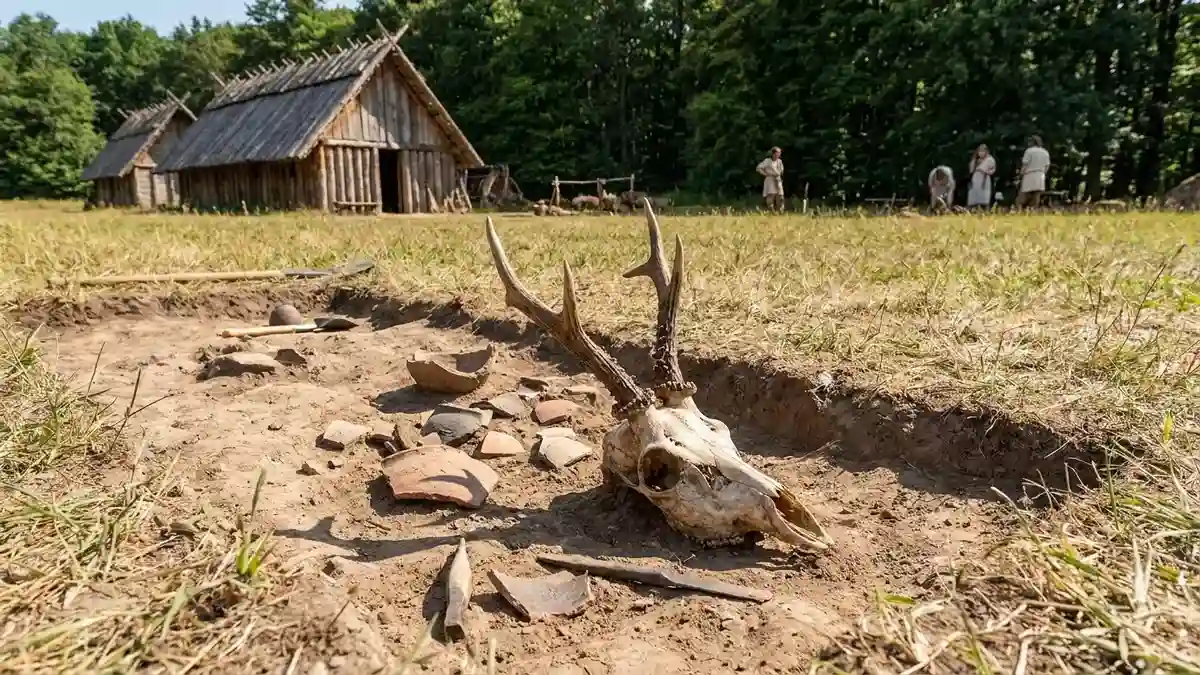
During recent excavations, archaeologists exposed an undisturbed, shallow depression packed with house debris, plant remains, and burnt daub (clay used for building walls). Sealed within this layer was the project’s most spectacular find: a roe deer skull with antlers carefully modified to be worn as a headdress or ritual mask.
This artifact is completely alien to typical farming traditions. Instead, it is a hallmark of Mesolithic shamanic culture. Similar antler headdresses are famously tied to ancient hunter-gatherer spiritual practices across Europe, such as the legendary 9,000-year-old shaman burial at Bad Dürrenberg.
Finding such a potent, highly charged hunter-gatherer ritual object buried inside a permanent farming village proves that the interaction between these societies went far deeper than the simple bartering of animal pelts or flint blades. It reveals an active, respectful exchange of profound cosmological and symbolic concepts.
Technology Transfer on the Borderlands
The material evidence at Eilsleben points toward an industrial blend, showing that the farmers eagerly adopted the wilderness survival skills of their foraging neighbors. Traditional LBK farmers rarely utilized antler as a primary raw material for heavy tool production, favoring domesticated bone and polished stone instead.
 20 Interesting Books About Archaeology
Yet, the workshops at Eilsleben tell a completely different story:
+-------------------------------------------------------------------------+
|                  EILSLEBEN INDUSTRIAL HYBRID TOOLKIT                    |
+------------------------------------+------------------------------------+
| Artifact Group                     | Cultural & Technological Origin    |
+------------------------------------+------------------------------------+
| T-Shaped Antler Axes / Hoes        | Mesolithic design adapted for      |
|                                    | Neolithic land modification        |
| Antler Punches & Pressure Flakers  | Hunter-gatherer bone-working kits  |
| Transverse Flint Arrowheads        | Specialized forest hunting tech    |
+------------------------------------+------------------------------------+
The discovery of extensive antler production waste and manufacturing debris proves these tools were crafted directly on-site. The village artisans were actively manufacturing T-shaped antler axes, delicate punches, and sharp, transverse flint arrowheads—technologies specifically engineered by hunter-gatherers to master the dense primeval forests.
The farmers did not abandon their agrarian roots; their core lifestyle remained centered around livestock herding and grain cultivation, but they dynamically absorbed localized forager techniques to adapt to their challenging northern frontier.
Contact Without Mixing: A Shared Landscape
The architectural evolution of Eilsleben also tells a story of cautious coexistence. Over several centuries, the settlement was heavily fortified with a series of defensive ditches and earthen ramparts. Ongoing radiocarbon testing will clarify whether these massive earthworks were built to shield the farmers from aggressive hunter-gatherer raids, manage intra-community conflicts, or simply establish clear territorial boundaries in a crowded, shared landscape.
Intriguingly, this intimate cultural blend contrasts sharply with regional ancient DNA data. Broad genetic studies of Central European populations across the Neolithic transition indicate that actual intermarriage and large-scale population mixing between early farmers and Mesolithic foragers remained highly limited for centuries.
Eilsleben provides the perfect archaeological explanation for this paradox. It reveals a world where neighboring communities maintained strong, independent biological identities while interacting regularly. They traded expertise, shared sacred rituals, and adopted each other’s tools as part of daily life along the cultural boundary, forever shaping the trajectory of early European civilization.
Frequently Asked Questions
What makes the Eilsleben deer headdress discovery so unique?
Dating back 7,500 years, the modified roe deer skull mask is a signature spiritual object of Mesolithic hunter-gatherers, but it was discovered inside a permanent farming village, proving deep ideological sharing between the two groups.
Who were the Linear Pottery (LBK) culture?
The LBK culture represents the first wave of agriculturalists who migrated into Central Europe from the Near East starting around 5500 BCE, bringing permanent longhouses, pottery, livestock, and crop cultivation to the region.
How did the farmers use hunter-gatherer technology?
The excavations revealed that the farmers adopted specialized forager tools, such as T-shaped antler axes, antler punches, and specialized transverse flint arrowheads, which were ideally suited for managing dense forest environments.
Did the farmers and hunter-gatherers intermarry on a large scale?
No. While the artifacts at Eilsleben show a deep exchange of ideas, tools, and rituals, regional genetic studies show very limited intermarriage during this early era, indicating they lived as separate but cooperative societies.
Why did the Eilsleben settlement have defensive walls?
The village was fortified with defensive ditches and ramparts over several phases, which may have served to defend against external conflicts, display social status, or mark clear physical boundaries in a highly shared frontier zone.