
Table of Contents
- 1. Redrawing the Ritual Map: The Cessetani and Ilergetes Tribes
- 2. Forensic Analysis of the Trauma: Multiple Blows and Flesh Removal
- 3. Iron Age Embalming: Resins, Waxes, and Chemical Curing
- 4. Strategic Placements: Gateway Terrors and Elite Squares
- 5. The Isotope Twist: Wandering Warriors or Plundered Trophies?
- 6. Frequently Asked Questions
- 6.1. What new discovery was made about Iron Age decapitation rituals in Spain?
- 6.2. How did the ancient Iberians preserve the severed heads?
- 6.3. What did the microscopic cut marks on the skulls reveal?
- 6.4. Where exactly were the severed heads displayed within the towns?
- 6.5. Were the victims local to the towns where their skulls were found?
Embalmed and Exposed: Iron Age Decapitation Rituals Spread Deep Into Inland Spain
A cutting-edge bioarchaeological investigation has radically expanded our understanding of one of the most chilling military and religious rituals of Iron Age Europe. By analyzing fractured skull fragments from two ancient settlements in northeastern Spain, scientists have proved that the practice of public head display was far more widespread among Indigenous Iberian tribes than previously believed, reaching deep into the territory of inland groups who used chemical resins to embalm and preserve the heads of their enemies or revered ancestors.
Embalmed and Exposed Iron Age Decapitation Rituals Spread Deep Into Inland Spain
Redrawing the Ritual Map: The Cessetani and Ilergetes Tribes
Historically, classical Roman accounts and sporadic archaeological discoveries suggested that the dramatic practice of displaying severed human heads (cabezas cortadas) was strictly confined to coastal Iberian tribes—such as the Indigetes and Laietani—living north of the Llobregat River.
However, a new multi-disciplinary study published in the journal Trabajos de Prehistoria has shattered this geographic boundary. Researchers successfully identified severed and displayed cranial remains at two major inland settlements dating between the 6th and 2nd centuries BCE:
Olèrdola (Barcelona Province): A heavily fortified hilltop settlement nestled within the tribal territory of the Cessetani.
El Molí d’Espígol (Lleida Province): A complex, urbanized town center belonging to the powerful Ilergetes tribe.
Because the standard, near-universal burial rite across Iron Age Iberia was cremation, human skeletal remains from this era are extraordinarily rare. The discovery of these preserved skull fragments gives anthropologists a unique, direct line of sight into the biology and violent rituals of these ancient societies.
Forensic Analysis of the Trauma: Multiple Blows and Flesh Removal
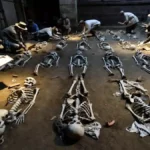
The research team meticulously examined 15 distinct cranial fragments: five from Olèrdola and ten from El Molí d’Espígol. The Olèrdola fragments were successfully reconstructed into the skull of a young male aged between 8 and 15 years old, while the Molí d’Espígol material yielded the remains of three distinct individuals, including another young male.
Under high-powered binocular microscopes, the bones told a gruesome story of precise, post-mortem trauma. The researchers documented a series of sharp, straight-edged cut marks inflicted close to the time of death, perfectly matching blows delivered by heavy metal weaponry like swords or axes.
+-------------------------------------------------------------------------+
|                  FORENSIC INJURY & MODIFICATION PATTERNS                |
+------------------------------------+------------------------------------+
| Observed Skeletal Trauma           | Anthropological Interpretation     |
+------------------------------------+------------------------------------+
| Overlapping, multi-angled frontal  | Multiple strikes to the skull;     |
| bone cuts                          | likely involved multiple people    |
| Micro-incisions along forehead     | Deliberate scalping and removal of |
| and jawline                        | soft facial tissues using needles  |
| Absence of lower rear occipital   | Strongly points to violent, clean  |
| bone                               | decapitation at the neck joint     |
+------------------------------------+------------------------------------+
On the Olèrdola youth’s skull, deep fractures on the left side contrasted with overlapping, multi-angled cuts on the right side. This physical variation indicates that the head received multiple distinct strikes, suggesting a frenzied execution or a ritualized decapitation process involving more than one individual.
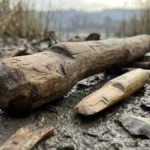
Furthermore, the team detected tiny, hyper-fine incisions tracing around the forehead, temples, and jawlines. These micro-cuts were made using slender metal tools—similar to the iron needles frequently recovered at Iberian sites. These marks provide definitive proof of a deliberate scalping and defleshing process, wherein the executioners carefully scraped away the hair and soft facial tissues to expose the bare bone of the face before public presentation.
Iron Age Embalming: Resins, Waxes, and Chemical Curing
One of the most spectacular breakthroughs of the project came from gas chromatography residue testing performed on the Olèrdola skull fragments. Chemical analysis identified a complex, sticky cocktail bonding agent still fused to the ancient bone matrix.
The substance was composed of concentrated plant resins derived from pine trees, mixed with trace organic compounds of volatile plant oils and animal waxes.
This chemical signature proves that the Iberians were practicing a advanced form of embalming. Coating the defleshed, severed head in boiling pine resin and wax served a crucial dual purpose: it heavily waterproofed the bone against the elements, and it slowed down decay, allowing the gruesome trophy to remain structurally sound and visually terrifying for months or even years while exposed to the open air.
Strategic Placements: Gateway Terrors and Elite Squares
The physical location where these skull fragments were discovered inside the ruins confirms that they were positioned to maximize psychological impact and project political authority.
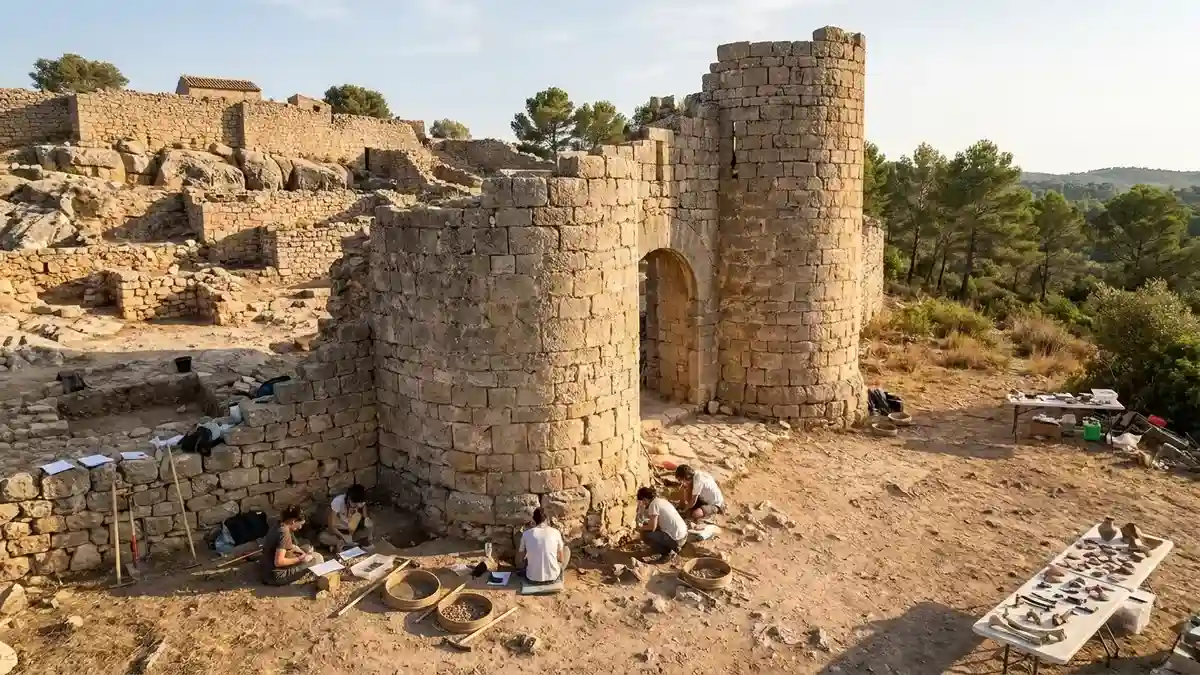
At Olèrdola, the resin-coated skull fragments were found scattered directly at the base of a massive defensive tower flanking the settlement’s primary entrance gateway. Suspending a beautifully preserved, defleshed skull directly over the main gate sent an unmistakable, terrifying warning to any arriving foreign merchants, visitors, or rival armies.
At El Molí d’Espígol, the skeletal clusters were uncovered inside a grand, architecturally elite building situated directly adjacent to a massive open civic square. This placement indicates that head display was also integrated into the core civic, religious, and political spaces of the community, serving as a focal point for tribal gatherings and elite displays of victory.
The Isotope Twist: Wandering Warriors or Plundered Trophies?
To determine who these victims were, scientists conducted stable strontium isotope mapping on the teeth and skull bones. Strontium signatures act as a geographic fingerprint, reflecting the specific geological formations of the soil and water an individual consumed during their childhood.
The strontium values from the Olèrdola youth did not match the local geology surrounding the settlement. Instead, the chemical data proved that the boy spent his childhood in a completely different geographic region characterized by much older, distinct rock formations.
This leaves archaeologists with two fascinating historical possibilities: either the adolescent was a foreign migrant or captive warrior who moved to the settlement before being sacrificed, or an Olèrdola war party raided a distant tribe, decapitated their casualty on the battlefield, and transported the severed head back across long distances to be embalmed and mounted on their defensive gateway.
This sophisticated multi-lens approach—blending forensics, residue chemistry, and isotope science—proves that the Iron Age tribes of Spain were tightly integrated into a broader European cultural phenomenon. Their complex, highly organized rituals of head preservation mirror similar martial traditions documented across Iron Age France and Britain, painting a vivid new picture of the symbolic, violent, and deeply spiritual world of the ancient Iberians.
Frequently Asked Questions
What new discovery was made about Iron Age decapitation rituals in Spain?
Archaeologists proved that the ritual of public head display was not restricted to coastal tribes as previously thought. New evidence shows inland Iberian groups, specifically the Cessetani and Ilergetes tribes, also practiced organized decapitation and head exhibition.
How did the ancient Iberians preserve the severed heads?
Chemical residue testing revealed that the Iberians coated the skulls in a mixture of pine tree resins, plant oils, and animal waxes. This ancient embalming technique waterproofed the bone and prevented rapid decay, allowing the heads to be displayed outside for long periods.
What did the microscopic cut marks on the skulls reveal?
The micro-cuts showed that the victims suffered heavy, straight-edged blows from sharp metal weapons close to the time of death. Fine incisions around the forehead and jaw prove that the executioners deliberately removed the hair and facial tissues before displaying the skull.
Where exactly were the severed heads displayed within the towns?
At Olèrdola, the skulls were mounted on a massive defensive tower overlooking the main entrance gateway to terrify visitors. At El Molí d’Espígol, they were displayed inside an important elite building facing a major public plaza.
Were the victims local to the towns where their skulls were found?
Strontium isotope analysis showed that the youth found at Olèrdola grew up in a completely different geographic region with older rock formations. This suggests he was either a captured foreigner or his head was taken as a trophy from a distant battlefield.