
Table of Contents
- 1. An Unexpected Discovery on the Riverbed
- 1.1. Flawless Preservation Under the Waves
- 2. Lost Weapon or Sacred Offering?
- 2.1. Theory 1: The Misfortune of a Medieval Warrior
- 2.2. Theory 2: A Calculated Ritual Sacrifice
- 3. A Rising Trend of Underwater Discoveries
- 4. The Path to Restoration and Public Display
- 5. Frequently Asked Questions
- 5.1. Why is the discovery of an 11th-century sword in Poland so important?
- 5.2. How did an iron sword survive in a river for 1,000 years without rusting away?
- 5.3. What was the Piast Dynasty, and what was happening in Poland in the 11th century?
- 5.4. Why did medieval people throw perfectly good weapons into rivers?
- 5.5. What happens to a medieval sword after it is pulled from a river?
Rare 11th-Century Sword Discovered in Poland’s Warta River
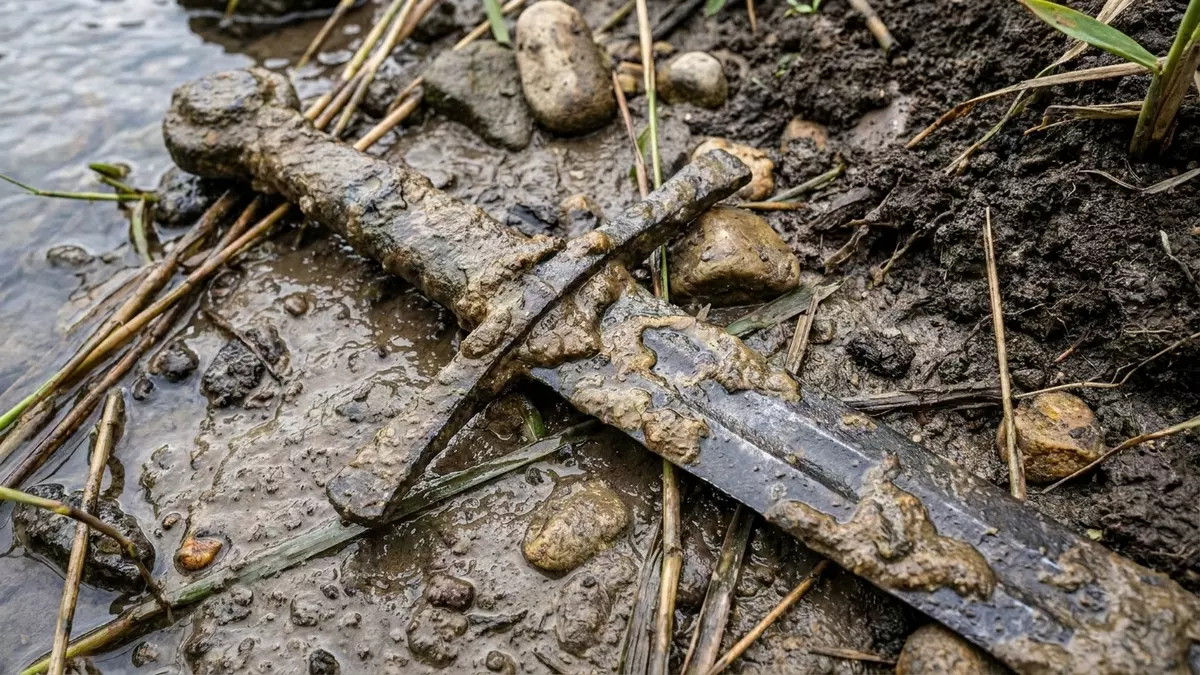
A stunningly intact medieval sword dating back to the 11th century has been pulled from the depths of the Warta River near the town of Wronki in western Poland. Local archaeologists and historians are celebrating the artifact as one of the most significant regional discoveries from the Middle Ages in recent memory, offering a rare window into the turbulent dawn of the Polish state.
Rare 11th-Century Sword Discovered in Poland’s Warta River
An Unexpected Discovery on the Riverbed
The ancient weapon was first spotted by local resident Mirosław Tucholski, who noticed the artifact resting in the river mud and immediately alerted regional historical authorities. Officials at the Museum of the Wronki Region highly commended Tucholski’s swift and responsible action, emphasizing that such prompt reporting is vital for safeguarding fragile cultural heritage and ensuring that invaluable artifacts are recovered under scientifically controlled conditions.
Following an initial inspection, prominent regional archaeologist Ryszard Pietrzak verified the sword’s authenticity, firmly placing its origin in the early Middle Ages. Experts have narrowed the weapon’s production down to the 11th century—a pivotal era deeply intertwined with the rise of the Piast Dynasty, Poland’s first ruling royal house. During this tumultuous time, Central Europe was frequently gripped by brutal warfare, territorial expansions, and intense localized power struggles.
 Nondestructive DNA sampling uncovers 1,300 years of history preserved in ancient parchments
       [ 11th-Century Piast Dynasty Era ]
                       │
       ┌───────────────┴───────────────┐
       ▼                               ▼
[ Era of Heavy Warfare ]    [ Emerging Ritual Practices ]
       │                               │
       └───────────────┬───────────────┘
                       ▼
        [ Artifact Lost in Warta River ]
                       │
                       ▼
         [ 2026: Recovery & Preservation ]
Flawless Preservation Under the Waves
Despite spending roughly a thousand years submerged beneath the flowing waters of the Warta River, the sword managed to survive in an astonishingly well-preserved state. The unique, low-oxygen underwater environment shielded the metal from rapid decay, leaving the weapon remarkably intact.
This level of preservation provides modern researchers with a golden opportunity. Metallurgists and military historians can now study the weapon to decode specific medieval manufacturing methods, analyze ancient metalworking and smithing techniques, and scan for microscopic wear patterns that might indicate whether the blade ever saw active combat.
Lost Weapon or Sacred Offering?
While the physical characteristics of the sword are clear, the exact circumstances that brought it to the bottom of the Warta River remain shrouded in mystery. Archaeologists have put forward two primary, compelling theories to explain its final resting place.

Theory 1: The Misfortune of a Medieval Warrior
The first explanation is grounded in the practical realities of early medieval life and conflict. The Warta River served as a vital transportation highway and a natural defensive barrier during the 11th century. It is entirely plausible that a knight or elite warrior accidentally dropped the highly valuable weapon while attempting to cross the river, or lost it altogether during the chaos of a localized skirmish or military campaign moving through the region.
Theory 2: A Calculated Ritual Sacrifice
The alternative hypothesis hinges on deeply rooted cultural and religious traditions. Throughout the Middle Ages, even as Christianity swept across Central Europe, older pagan traditions continued to influence daily life. Across Europe, it was common practice to cast high-value items—especially weapons like swords and spears—into bodies of water such as rivers, marshes, and lakes. These acts were performed as sacred offerings to deities, intended to secure good fortune, celebrate a victory, or honor the dead.
A Rising Trend of Underwater Discoveries
The Wronki sword is not an isolated event; rather, it is part of an exciting, broader trend of medieval weaponry emerging from Polish waterways over the last few years. Recent notable discoveries include:

2024 (Włocławek): Dredging operations uncovered a pristine sword that some prominent researchers have linked to 10th-century Viking raiders or traders passing through the region.
2025 (Warsaw): An alert angler pulled a remarkably intact 13th-century sword straight out of the water.
This sudden influx of ancient artifacts is closely tied to changing environmental conditions. Sustained drought periods across Europe have caused water levels in Poland’s rivers and lakes to drop to historic lows, exposing riverbeds that have been hidden for a millennium.
While these low waters are a boon for archaeological discovery, they also present a race against time. Once these waterlogged artifacts are exposed to open air and fluctuating temperatures, they begin to degrade rapidly, making immediate professional intervention absolutely vital.
The Path to Restoration and Public Display
To ensure the long-term survival of the Warta River sword, local authorities moved quickly to report the find to the Wielkopolska Voivodeship Conservator of Monuments, securing the weapon under legal protection. Recognizing the immense cultural value of the artifact, Wronki Mayor Rafał Zimny stepped forward to provide the necessary municipal funding to bankroll comprehensive scientific study and specialized restoration work.
The sword has since been transported to the prestigious Nicolaus Copernicus University in Toruń, an institution renowned for its advanced archaeological conservation labs. Over the coming months, specialists will carefully remove mineral crusts, stabilize the ancient iron, and perform structural scans. Once this meticulous restoration process is wrapped up, the sword will return home to go on permanent public display at the Museum of the Wronki Region, allowing visitors to stand face-to-face with a genuine relic of Poland’s warrior past.
Frequently Asked Questions
Why is the discovery of an 11th-century sword in Poland so important?
Finding a sword from the 11th century is rare because weapons were incredibly valuable, highly prized possessions during the early Middle Ages; they were rarely left behind or discarded lightheartedly. This specific discovery aligns directly with the foundational era of Poland’s first ruling family, the Piast Dynasty, making it a critical piece of the puzzle regarding early Polish statehood and military history.
How did an iron sword survive in a river for 1,000 years without rusting away?
The sword survived thanks to the unique environmental conditions at the bottom of the Warta River. When an artifact becomes buried in thick river mud and silt, it enters an anaerobic (oxygen-depleted) environment. Without abundant oxygen, the chemical process of oxidation—which causes iron to rust and disintegrate—is slowed down drastically, locking the weapon in a state of suspended animation.
What was the Piast Dynasty, and what was happening in Poland in the 11th century?
The Piast Dynasty was the founding royal house of Poland, ruling from the late 10th century until the 14th century. The 11th century was a time of immense volatility for the region, characterized by intense Christianization efforts, frequent border wars with neighboring Germanic and Slavic tribes, and internal civil conflicts as various Piast princes vied for the throne.
Why did medieval people throw perfectly good weapons into rivers?
Throwing weapons into water was a widespread ritual tradition across Europe that predated Christianity and lingered long into the medieval era. Water was viewed as a sacred gateway to the spiritual realm. Depositing a highly valuable item like a sword into a river could serve as a votive offering to gods or ancestors, a sacrifice for good health or military triumph, or a ritual destruction of an enemy’s captured gear.
What happens to a medieval sword after it is pulled from a river?
When a waterlogged iron artifact is suddenly exposed to oxygen, it can deteriorate and rust at an accelerated pace. To save it, conservators submerge it in chemical baths to safely strip away corrosive salts and mineral buildup. Afterward, the metal is carefully dried, treated with specialized rust inhibitors, and coated in protective polymers to seal out moisture before it can be safely displayed in a climate-controlled museum case.