
Table of Contents
- 1. The Legacy of Otto the Great
- 2. A Monument in Jeopardy: The Catalyst for the Project
- 2.1. The Hidden Culprits of Decay
- 3. Moving a Monolith and Confirming an Identity
- 4. Unearthing a Subterranean Labyrinth
- 4.1. Reused Stones and Stonemasons’ Marks
- 4.2. The Mystery of the Original Burial Site
- 4.3. Forgotten Corridors
- 5. A Treasure Trove of Everyday Medieval Life
- 6. Embracing History: The Visitor Experience
- 7. Frequently Asked Questions
- 7.1. Whose remains were found inside the Magdeburg Cathedral tomb?
- 7.2. Why did the tomb of Otto I need to be restored?
- 7.3. What did archaeologists find under the tomb’s foundations?
- 7.4. What kind of small artifacts were recovered during the excavation?
- 7.5. Where are the emperor’s remains right now, and when will they return?
Tomb of Emperor Otto I Yields Hidden Medieval Secrets in Germany
A massive conservation project at Germany’s iconic Magdeburg Cathedral has transformed into a stunning archaeological journey. While treating structural decay on the tomb of Emperor Otto I (Otto the Great), researchers dismantled the monument to find a complex network of medieval foundation layers, long-lost passageways, and centuries of historical artifacts hidden directly beneath the burial site.
This historic undertaking—uniting the Saxony-Anhalt Cultural Foundation, the State Office for Heritage Management and Archaeology, and German church authorities—is providing a rare look at the structural history of one of Europe’s most significant medieval rulers.
Tomb of Emperor Otto I Yields Hidden Medieval Secrets in Germany
The Legacy of Otto the Great
Otto I, a powerhouse of the Liudolfing dynasty, was instrumental in forging the geopolitical landscape of medieval Europe. His reign laid the foundations for what would evolve into the Holy Roman Empire.

Otto held a deep personal and political connection to Magdeburg, elevating the city into a dominant cultural and religious epicenter and securing its status as an archbishopric in 968 CE. Upon his death in 973 CE, the emperor was laid to rest inside the cathedral alongside his first wife, Queen Editha.
A Monument in Jeopardy: The Catalyst for the Project
The current scientific investigation was born out of urgent necessity. During routine structural assessments in 2024, conservation specialists noticed severe, advancing deterioration afflicting the emperor’s limestone sarcophagus and the materials left behind by past restoration attempts.
The Hidden Culprits of Decay
Closer analysis revealed that a combination of environmental factors and well-meaning but flawed 19th-century engineering was destroying the monument:
Subterranean Elements: Rising ground moisture and migrating salts were slowly weakening the limestone from the bottom up.
Climate Fluctuations: Shifting temperature and humidity levels inside the cathedral exacerbated the stone’s vulnerability.
Corrosive Repairs: 19th-century restorers used iron nails and heavy metal clamps to reinforce the tomb. Over the decades, these iron pieces corroded, expanded, and exerted immense internal pressure on the ancient stone, threatening to split the sarcophagus open.

Moving a Monolith and Confirming an Identity
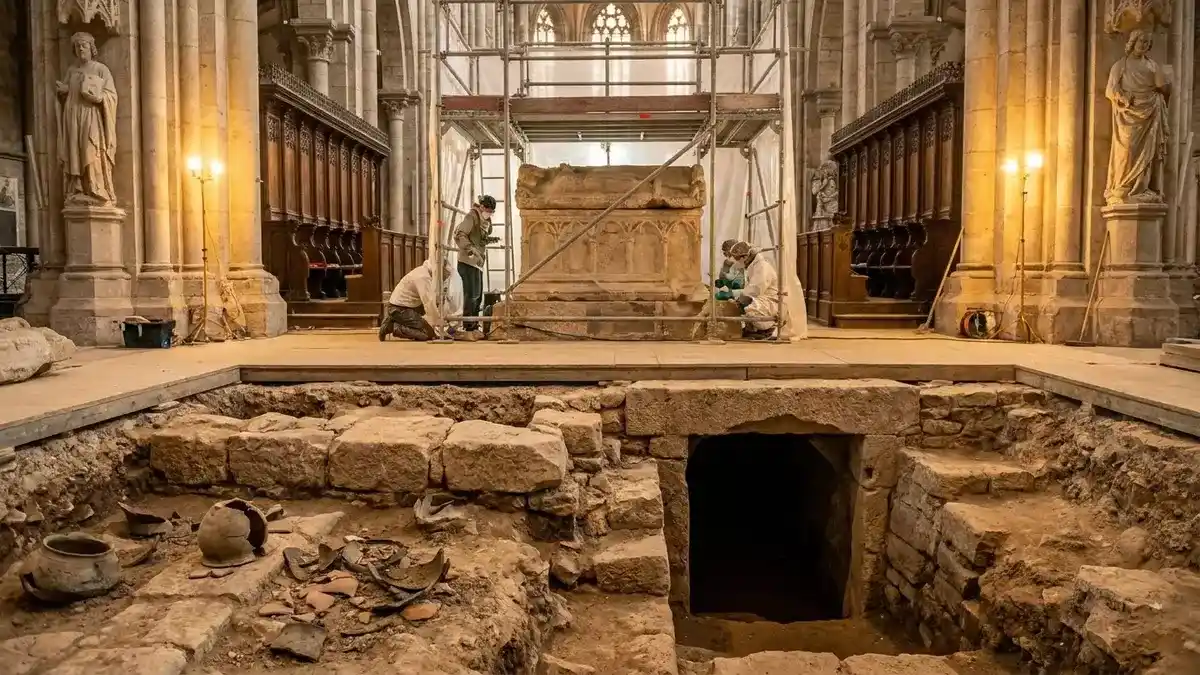
To save the monument, specialists engineered a custom transport system in early 2026 to gently slide the massive limestone sarcophagus out of its centuries-old resting place in the cathedral’s High Choir. It was transferred to a climate-controlled, protective enclosure built directly inside the church, allowing restorers to safely extract the rusted iron components and meticulously clean the pristine marble lid.
This delicate phase followed a rigorous preliminary documentation process. Conservators previously lifted the monumental, 300-kilogram marble cover slab to inspect the interior. Inside, they opened a weathered wooden coffin containing human remains. Subsequent anthropological and genetic testing officially confirmed that the bones belong to Emperor Otto I.
Looking Ahead: The historic remains of Emperor Otto I are scheduled to be reburied within Magdeburg Cathedral in September 2026, placed inside a beautifully crafted, modern coffin designed specifically for the permanent installation.
Unearthing a Subterranean Labyrinth
Moving the sarcophagus offered archaeologists a fleeting, highly anticipated window to excavate the earth directly beneath the tomb’s footprint. The resulting discoveries have rewritten parts of the cathedral’s structural timeline.
Reused Stones and Stonemasons’ Marks
Excavators discovered that the heavy sarcophagus rested on a platform of substantial sandstone blocks oriented to the east and west. Tucked directly beneath these platform supports were even older, recycled building blocks. Two of these architectural pieces feature distinct, late-medieval stonemasons’ marks. This crucial detail proves that the emperor’s tomb was physically relocated multiple times throughout the Middle Ages.
The Mystery of the Original Burial Site
Despite these breakthroughs, one major historical riddle remains unsolved. The underground excavation yielded absolutely no evidence that Otto’s tomb sat in this exact location prior to the construction of the current Gothic cathedral. Because the original, pre-Gothic building layout was entirely replaced, the exact spot where the emperor was initially buried in 973 CE remains a mystery.
Forgotten Corridors
Digging deeper through successive layers of historic rubble and construction fill, teams mapped out a forgotten network of subterranean tunnels running directly beneath the choir floor. Historical data suggests that the majority of this ancient passageway system was deliberately packed with dense fill during the 19th century to reinforce the structural integrity of the heavy flooring above.
A Treasure Trove of Everyday Medieval Life
Beyond the architectural foundations, the soil beneath the High Choir served as a time capsule, yielding an array of smaller, fascinating artifacts dropped or discarded across the centuries.
| Artifact Type | Historical Significance |
| Painted Plaster Fragments | The single largest group of finds; points to highly vibrant, richly decorated interiors of the older church structures that preceded the Gothic cathedral. |
| Crystalline Gypsum | Exceptionally rare fragments of transparent gypsum stone, which served as primitive window glazing before modern glass production. |
| Daily Life Items | Lost coins, glass jewelry beads, early pottery shards, and clothing pins dropped by churchgoers and pilgrims hundreds of years ago. |
| A Lead Bullet | A stark reminder of Magdeburg’s incredibly turbulent and violent military history during the early modern era. |
Embracing History: The Visitor Experience
The comprehensive restoration and excavation initiative will continue throughout the remainder of 2026. Fortunately for travelers and locals alike, daily cathedral services remain completely undisrupted by the science taking place behind the screens.
The public still enjoys nearly full access to the High Choir, including the magnificent historic choir stalls and the world-famous 13th-century sculptures of Saint Maurice and Saint Catherine. For those eager to learn more about the project as it unfolds, newly updated educational displays have been installed adjacent to the restoration enclosure, providing real-time updates on the preservation work and the latest treasures pulled from the dirt.
Frequently Asked Questions
Whose remains were found inside the Magdeburg Cathedral tomb?
Anthropological and genetic testing confirmed that the remains inside the tomb belong to Emperor Otto I (Otto the Great), the monumental 10th-century ruler who helped establish the political foundations of the Holy Roman Empire.
Why did the tomb of Otto I need to be restored?
The monument was suffering from severe structural threats, including ground moisture, salt damage, and fluctuating indoor climates. Additionally, 19th-century iron repair clamps had rusted and expanded inside the stone, creating a high risk of catastrophic cracking.
What did archaeologists find under the tomb’s foundations?
Excavators uncovered large sandstone foundation blocks bearing late-medieval stonemasons’ marks, a filled-in network of historic underground passageways, and layers of construction debris charting centuries of architectural changes.
What kind of small artifacts were recovered during the excavation?
Teams recovered a rich variety of items, including vibrant pieces of painted wall plaster from earlier iterations of the church, rare crystalline gypsum window glazing fragments, old coins, glass beads, medieval clothing pins, and a historic lead bullet.
Where are the emperor’s remains right now, and when will they return?
The sarcophagus is currently housed in a specialized protective enclosure inside the cathedral for cleaning and metal extraction. Emperor Otto I’s remains are scheduled to be reburied in a brand-new, custom-designed coffin beneath the High Choir in September 2026.