
Table of Contents
- 1. Mosaic Anatomy: A Blend of Old and New
- 2. Rethinking the “Out of Africa” Migration
- 3. Innovation Without Linear Progress
- 4. A Complex Evolutionary Transition
- 5. Frequently Asked Questions (FAQ)
- 5.1. 1. What is the DAN5 fossil?
- 5.2. 2. Why does the fossil puzzle scientists?
- 5.3. 3. Does this change the theory of how humans left Africa?
- 5.4. 4. What does the discovery suggest about stone tools?
- 5.5. 5. Why is this finding important for the future of evolution studies?
Ancient Face Reconstruction Redefines Human Evolution
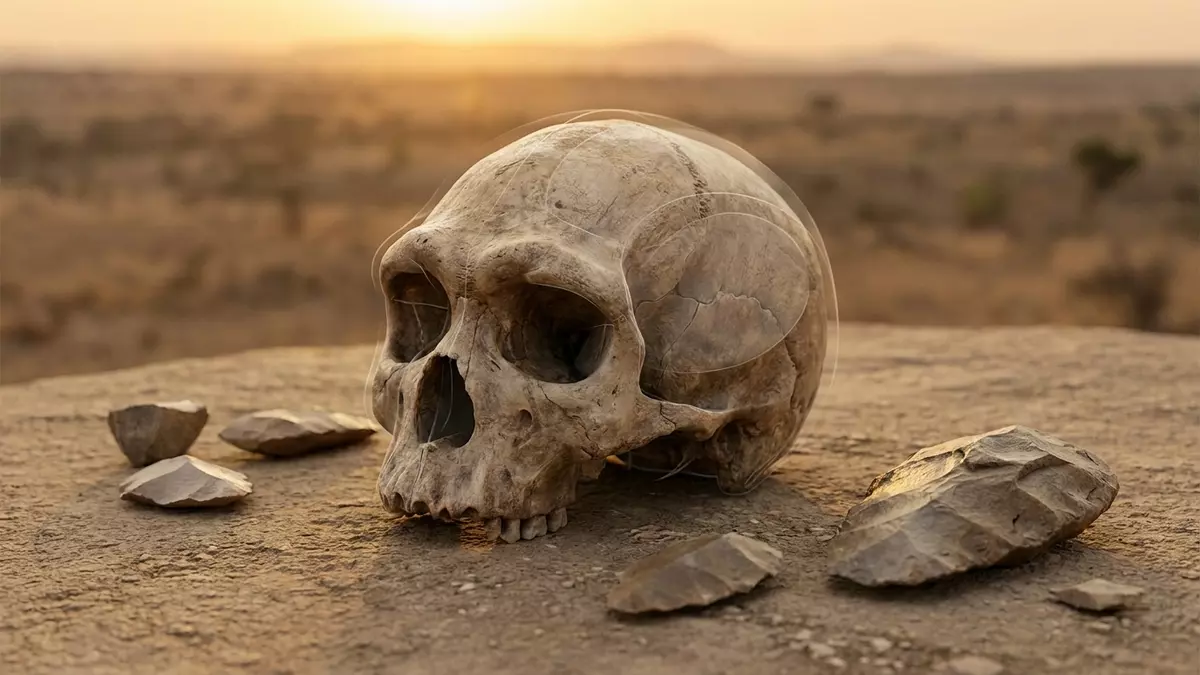
A remarkable new virtual reconstruction of a 1.5-million-year-old fossil cranium is challenging the established narrative of human evolution. The fossil, known as DAN5, was unearthed at the Gona site in Ethiopia’s Afar region—a landscape world-famous for its critical role in the history of our species. By digitally reassembling fragmented facial bones and teeth, researchers have revealed a creature that defies simple classification, suggesting that our ancestor Homo erectus was far more diverse and complex than previously thought.

Ancient Face Reconstruction Redefines Human Evolution
Mosaic Anatomy: A Blend of Old and New
The DAN5 cranium is a biological puzzle. Its braincase exhibits the hallmarks of Homo erectus—the famous ancestor credited with modern body proportions, long-distance migration, and the mastery of advanced stone tools. However, the rest of the skull tells a different story.
The fossil features a narrow, primitive nasal bridge and large molars more reminiscent of older species like Homo habilis. Furthermore, its brain size is smaller than most other African Homo erectus specimens from the same era. This “mosaic anatomy”—where archaic and modern features coexist—suggests that early human evolution was not a straightforward, linear progression from “primitive” to “advanced.”

Rethinking the “Out of Africa” Migration
For years, many paleontologists looked to the 1.8-million-year-old fossils from Dmanisi, Georgia, as evidence that Homo erectus might have evolved outside of Africa. The DAN5 fossil complicates this theory significantly. By demonstrating that transitional, “archaic-looking” forms persisted in Africa for hundreds of thousands of years after the first groups left the continent, the Ethiopian find proves that this diversity was a standard feature of the African landscape.
Rather than a single, uniform population spreading out of Africa, it appears that early Homo populations were highly variable. This diversity was likely the result of overlapping lineages and potentially even interbreeding among different groups as they adapted to local environments across Africa and Eurasia.
Innovation Without Linear Progress
Beyond anatomy, DAN5 provides a critical link to early human behavior. The fossil was discovered alongside both simple Oldowan stone tools and early Acheulian hand axes. This is the oldest direct evidence that a single species of hominin was capable of producing two distinct tool technologies.

This finding is revolutionary because it demonstrates that technological innovation was not strictly tied to a specific “advanced” body type or brain size. It implies that these ancestors were versatile problem-solvers, capable of adapting their toolkits to different tasks and environmental challenges regardless of their archaic physical traits.
A Complex Evolutionary Transition
The reconstruction of DAN5 underscores the idea that the emergence of Homo erectus was a gradual, complex transition rather than a sharp evolutionary boundary. By highlighting the existence of small-brained, archaic-looking humans living alongside more derived populations, the study provides strong evidence for a messy, branching evolutionary tree.
As researchers continue to compare DAN5 with younger fossils from Europe—such as Homo antecessor—they hope to map the precise journey of facial diversity as our ancestors spread across the Old World. For now, the DAN5 reconstruction stands as a humbling reminder of how much of our ancestral story remains buried beneath the earth, waiting to be digitally pieced together.

Frequently Asked Questions (FAQ)
1. What is the DAN5 fossil?
DAN5 is a 1.5-million-year-old hominin cranium found in Gona, Ethiopia. It is the most complete Early Pleistocene human ancestor fossil ever found in the Horn of Africa.
2. Why does the fossil puzzle scientists?
It has a “mosaic” anatomy. Its braincase looks like Homo erectus, but its face and teeth are much more primitive, resembling older species like Homo habilis. This mix of archaic and modern traits was unexpected.
3. Does this change the theory of how humans left Africa?
Yes. It challenges the idea that a single, uniform species of Homo erectus marched out of Africa. Instead, it suggests that early Homo populations were highly diverse, and that this diversity was present in Africa long after the first migrations began.
4. What does the discovery suggest about stone tools?
It shows that a single species of human ancestor was capable of making both simple and advanced stone tools (Oldowan and Acheulian). This proves that technological complexity didn’t require a “more modern” looking body or a larger brain.
5. Why is this finding important for the future of evolution studies?
It replaces the idea of a simple, linear human family tree with a more complex, branching model. It suggests that there were many overlapping groups of early humans, making the “transition” to more modern humans a much more complicated and prolonged process.