
Table of Contents
- 1. A Precision-Dated Window into the Past
- 2. Bridging the Evolutionary Gap
- 3. Life in a Carnivore Den
- 4. Northwest Africa as a Center of Evolution
- 5. A New Understanding of Our Origins
- 6. Frequently Asked Questions (FAQ)
- 6.1. 1. Why are the Casablanca fossils significant?
- 6.2. 2. How did researchers date these fossils so precisely?
- 6.3. 3. Are these fossils modern humans or Neanderthals?
- 6.4. 4. What does the site tell us about their daily lives?
- 6.5. 5. Does this change where we think humans evolved?
773,000-Year-Old Fossils Rewrite Human Ancestry
A groundbreaking discovery at the Grotte à Hominidés in Casablanca, Morocco, is fundamentally shifting the map of human evolution. New research published in Nature (2026) reveals that a key ancestral population of modern humans and Neanderthals inhabited northwest Africa approximately 773,000 years ago. These fossils provide the “missing link” researchers have sought for decades, placing the roots of our lineage firmly within Africa during a pivotal window of time.
773,000-Year-Old Fossils Rewrite Human Ancestry
A Precision-Dated Window into the Past
The study, led by an international team of researchers, focuses on a collection of partial lower jaws, teeth, and vertebrae unearthed at the Thomas Quarry I site. What makes this find particularly extraordinary is the level of chronological precision.
By testing 180 sediment samples from the cave, the team successfully tracked the “Matuyama–Brunhes transition”—a global reversal of Earth’s magnetic field that occurred exactly 773,000 years ago. Because the fossils were found within sediments deposited during this precise geological event, researchers have been able to date these human remains with a reliability rarely seen in African Paleolithic studies.
Bridging the Evolutionary Gap
For years, the fossil record between one million and 600,000 years ago remained frustratingly sparse. Genetic studies have long estimated that the last common ancestor of Homo sapiens and Neanderthals existed during this period, but physical evidence to support these models was elusive.
The Casablanca fossils narrow this gap significantly. Analysis of the teeth and jaw structures reveals a mosaic of traits:
Archaic Features: The remains retain some characteristics reminiscent of Homo erectus.
Derived Traits: The fossils simultaneously display newer anatomical features that align with later human lineages.

This combination of traits suggests that the individuals from Thomas Quarry I were near the basal point of the lineage that would eventually branch into modern humans, Neanderthals, and Denisovans. Crucially, these specimens do not match Homo antecessor—a human group found in Spain from a similar period—suggesting that early human evolution was characterized by significant population diversity rather than a single, uniform ancestral form.
Life in a Carnivore Den
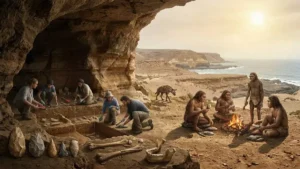
The site offers more than just anatomical data; it provides a snapshot of early human life. The Grotte à Hominidés served as a carnivore den during the Early Pleistocene, and the fossil record bears the marks of this harsh environment—including distinct bite marks left by hyenas on human bone.

However, these early hominins were far from helpless. Excavations uncovered stone tools belonging to early Acheulean technology. The presence of these tools alongside the remains confirms that these ancestors were active participants in their landscape, possessing the cognitive and technical ability to fashion implements for butchery and survival.
Northwest Africa as a Center of Evolution
Historically, evolutionary research focused heavily on East and South Africa as the primary “cradles” of humanity. The Casablanca findings pull the spotlight toward northwest Africa. This region, with its raised Atlantic shorelines and complex cave systems, likely acted as a crossroads for population movements. During wetter climate phases, the Sahara would have functioned as a corridor rather than a barrier, facilitating the movement of diverse groups across the continent.
This discovery also creates a direct lineage trajectory within Morocco itself. With the earliest known Homo sapiens fossils (dating to 300,000 years ago at Jebel Irhoud) also found in Morocco, the Thomas Quarry hominins now provide a 500,000-year deep-time context for the evolution of our species within the same geographic region.
A New Understanding of Our Origins
The timeline suggested by these fossils aligns perfectly with genetic estimates, which place the split between modern humans and Neanderthals between roughly 765,000 and 550,000 years ago. By placing this ancestral population in northwest Africa at the very dawn of that genetic window, the Casablanca fossils confirm that our deep history is far more complex, and more African, than previously realized. As we continue to uncover the story of these ancient ancestors, northwest Africa now stands as a central pillar in the grand narrative of human evolution.
Frequently Asked Questions (FAQ)
1. Why are the Casablanca fossils significant?
They represent a key ancestral population that lived about 773,000 years ago, sitting at the base of the lineage that would later branch into modern humans and Neanderthals. They help fill a major gap in the human fossil record.
2. How did researchers date these fossils so precisely?
The team used the “Matuyama–Brunhes transition,” a global reversal of Earth’s magnetic field that occurred 773,000 years ago. Because the fossils were found in sediments formed exactly during this event, researchers have a highly reliable “time stamp” for the remains.
3. Are these fossils modern humans or Neanderthals?
They are neither. They are an older, ancestral population that shows a mix of archaic (Homo erectus-like) and modern features, representing a group that existed before the lineages of modern humans and Neanderthals fully diverged.
4. What does the site tell us about their daily lives?
The fossils were found in a site that functioned as a carnivore den (hyenas were present). However, the humans there were skilled toolmakers who used early Acheulean stone technology to process food and survive in a challenging environment.
5. Does this change where we think humans evolved?
Yes. It shifts the focus of early human evolution toward northwest Africa. It proves that crucial stages of our development were occurring in this region, rather than just in eastern or southern Africa, highlighting the continent-wide diversity of early human ancestors.