
Illuminating Prehistoric Rituals: Ancient “Cornet” Lamps Revealed
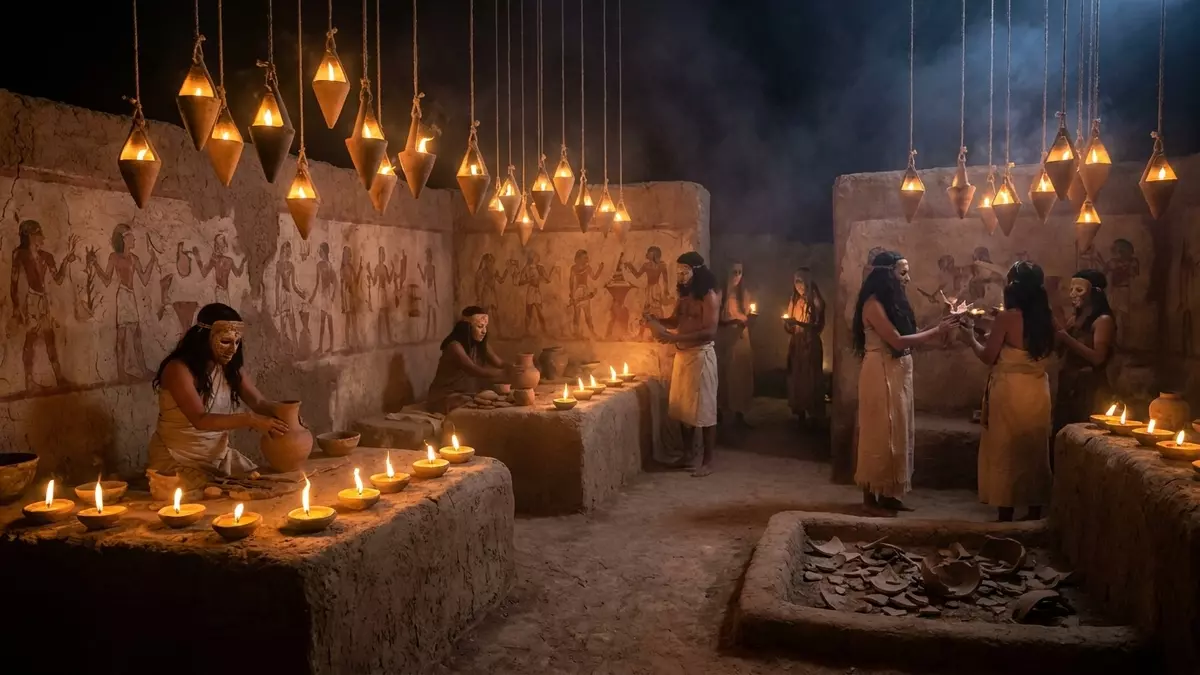
For decades, archaeologists working in the Levant have been puzzled by “cornets”—small, cone-shaped ceramic vessels unique to the Chalcolithic period (circa 4500–3500 BCE). Found in large clusters at some sites and entirely absent at others, these objects have been theorized to be everything from dairy churns to industrial tools for copper metallurgy. Now, a systematic analysis of the massive collection from Teleilat Ghassul in Jordan has finally provided a compelling answer: these were ritual lamps, designed for collective nighttime vigils.
Illuminating Prehistoric Rituals Ancient Cornet Lamps Revealed
A Ritual “Disposable” Technology
The study, which examined over 550 fragments and 35 complete vessels, reveals that cornets were not prestige items created by master artisans. Instead, they were “disposable” ritual technology.
Experimental archaeology—where researchers recreated the vessels using period-appropriate techniques—showed that a skilled person could form a cornet from a single lump of clay in just ten minutes. This suggests that the vessels were likely produced on-site by participants themselves as part of the ritual preparation. While a few high-quality specimens (Type 3) suggest the work of more skilled potters, the vast majority of the assemblage is characterized by simple, varied forms that required very little technical expertise.

The Case for the “Vigil Lamp”
The most significant breakthrough in the study is the functional testing of the cornets as lamps. By filling clay replicas with beeswax, researchers discovered that the vessel’s unique, elongated cone shape is perfectly engineered for light:
Efficiency: Placing a small amount of clay at the bottom of the cornet raises the wax closer to the rim, reducing the amount of fuel needed while keeping the flame stable.
Duration: A single cornet filled halfway with beeswax burns steadily for up to nine hours.
Utility: Some specimens feature four small handles, indicating they could be hung from a structure or suspended by a rope, making them ideal for illuminating dark ritual spaces.
The presence of internal soot traces—previously overlooked or dismissed in earlier studies—confirms that these vessels were indeed used to hold fire.
Ritual Context and “Ceremonial Destruction”
Teleilat Ghassul is famous for its intricate wall paintings depicting masked figures and processions. Cornets were discovered almost exclusively in areas associated with these ritual spaces.
 Ancient shipwreck with 300 amphorae found off Italy could reshape views of Mediterranean wine trade
The researchers noted a specific pattern of disposal: the vessels were rarely found intact. Instead, they were discovered as fragments in concentrated dumps, showing breakage patterns consistent with deliberate, ritualized destruction. This lifecycle—creating a vessel, using it to light a nocturnal ceremony, and then breaking it once the vigil was over—points to a highly choreographed religious event, likely involving participants who traveled from surrounding villages to gather for these night-time spectacles.
Redefining Chalcolithic Social Life
This discovery shifts our understanding of Chalcolithic community life. These gatherings were not private affairs; they were collective, public, or semi-public events that required coordinated effort—from the harvesting of beeswax to the mass production of clay lamps.
The distribution of these objects also suggests social stratification and network building. The fact that cornets appear in massive numbers at sites like Teleilat Ghassul, but are entirely absent at neighboring settlements, indicates that these ceremonies were site-specific and potentially acted as a “social glue,” drawing people from across the landscape to participate in shared religious identity.
By connecting the physical production of the vessels to their functional performance as lamps and their eventual ritualized destruction, this study offers the most complete “life cycle” analysis of a prehistoric artifact ever conducted in the region. It turns these mysterious, cone-shaped vessels from objects of debate into the literal light sources of the Chalcolithic world.
Frequently Asked Questions
What exactly is a Chalcolithic “cornet”?
A cornet is a small, cone-shaped ceramic vessel that appears exclusively in the Chalcolithic period. They are often pointed at the base, have varying numbers of handles, and are sometimes coated in a light or red slip.
Why did previous researchers doubt they were lamps?
Earlier studies focused on the lack of visible soot on many specimens. However, this study used experimental replication to show that if beeswax is used correctly and the wick is positioned well, the vessels produce stable, long-lasting light, and the soot can be easily cleaned or worn away over time.
Why would they break them after use?
“Ceremonial destruction” is a well-documented practice in prehistoric archaeology. Breaking the vessel after the vigil likely served a symbolic purpose, marking the end of the ritual and preventing the object from being used for “mundane” tasks afterwards.
Does this change how we view prehistoric trade?
Yes. The fact that the majority of these were made from local clay suggests that they were produced at the ritual site. This implies that visitors didn’t bring the lamps with them; they brought the idea of the ritual and the fuel (beeswax) and created the vessels on-site.
Why are they only found at some sites?
The uneven distribution suggests that specific sites—like Teleilat Ghassul—were regional “centers of ritual.” People likely traveled to these specific locations to participate in these massive, candle-lit vigils, making these sites crucial for maintaining social and religious cohesion among dispersed prehistoric communities.