
Digital Reassembly: 3D Metrology Reunites Dispersed Egyptian Antiquities
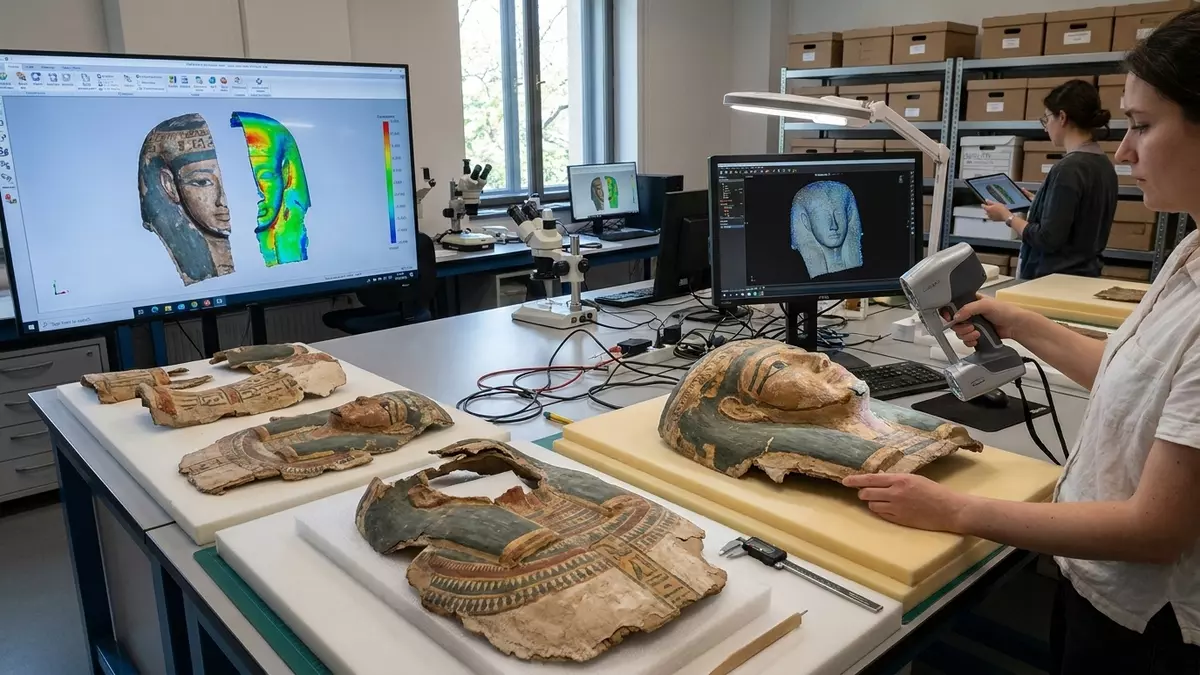
For decades, the study of ancient Egyptian funerary art has been plagued by a “puzzle with missing pieces” problem. Due to the chaotic history of 19th and early 20th-century archaeology, countless artifacts—especially fragile funerary masks—were broken, stripped from their original tombs, and scattered across the globe into different museum collections. Now, a groundbreaking study published in Heritage Science has introduced a high-tech solution: 3D metrological analysis.
Digital Reassembly 3D Metrology Reunites Dispersed Egyptian Antiquities
The Problem: Subjectivity in Archaeology
When an ancient Egyptian cartonnage mask (made of layered linen or papyrus coated in plaster) breaks, it often creates dozens of fragments. In the past, historians relied on the “eye test”—subjective visual comparisons—to determine if a piece in a London collection belonged to a mask in a New York museum. This method was inherently flawed, relying on curator intuition rather than objective proof.
The new research, led by Carlo Rindi Nuzzolo, replaces this subjective guesswork with a rigorous, reproducible framework based on digital geometry.
How 3D Metrology Works
The research team developed a workflow that transforms physical fragments into highly accurate digital models. The process involves four key technological pillars:
3D Laser Scanning: Every fragment is scanned to capture its exact surface geometry, including microscopic imperfections.
Edge Mapping: The team focuses on “break lines”—the jagged edges where the material snapped centuries ago. By mapping these edges, they can see if two pieces physically “unlock” together.
Curvature Analysis: Because cartonnage masks were molded to fit the specific shape of a human face, every fragment has a unique radius of curvature. The researchers calculate these mathematical curves to ensure that two pieces don’t just look like they fit; they actually conform to the same anatomical shape.
Deviation Modeling: The team uses software to calculate the “deviation value” between two edges. If the digital gap between two pieces is within a microscopic tolerance range, the physical match is confirmed with scientific certainty.
Reconstructing History, One Fragment at a Time
The study proved its effectiveness by successfully reuniting fragments of cartonnage masks that had spent years in separate institutions. In one significant case, fragments of a forehead and cheek, stored thousands of miles apart, were digitally overlaid. The edges fit with such precision that it left no doubt: they were once part of the same funerary masterpiece.

Beyond simply matching pieces, this method is a powerful tool for provenience attribution. If a set of fragments matches in thickness, plaster composition, and layer structure, researchers can prove they came from the same specific tomb, even if the original excavation records were destroyed or lost.
A New Era of Digital Collaboration
This technology changes the landscape of museum collaboration. Previously, reuniting Egyptian antiquities required the expensive and dangerous transport of fragile, millennia-old materials. Now, institutions can simply share high-resolution 3D models. Researchers in different countries can “test-fit” fragments digitally to see if they belong together, all without the objects ever leaving their climate-controlled displays.
By moving from subjective stylistic opinion to quantitative data, archaeologists are finally closing the gaps in our knowledge. This method not only restores the physical integrity of ancient Egyptian art but also repairs the historical record, ensuring that the stories of the deceased—and the magnificent funerary art created for them—can be viewed as they were intended thousands of years ago.
Frequently Asked Questions
Why were these masks fragmented in the first place?
Many Egyptian funerary objects suffered from “post-depositional disturbance.” This includes tomb robberies in ancient times, the physical stresses of the burial process, and the often rough methods used by early 20th-century excavators to extract items from tombs.
Why is visual comparison not enough?
Human judgment is subjective. Two pieces might look similar because they belong to the same period or were made by the same workshop, but that doesn’t mean they are part of the same object. Metrological analysis provides the objective, mathematical proof required to confirm a physical join.
What is “cartonnage”?
Cartonnage is a material similar to papier-mâché, consisting of layers of linen or papyrus stuck together with plaster or animal glue. Once dry, it was incredibly hard and could be painted with intricate designs, making it the perfect medium for mummy masks.
How does this help museums?
It fosters a new era of digital collaboration. Instead of shipping fragile artifacts, museums can share digital 3D models. This allows them to discover if their collections contain missing pieces of a larger whole held by another institution, without risking damage to the objects.
Can this be used for other types of artifacts?
Yes. While this study focused on Egyptian cartonnage masks, the method of 3D metrological analysis can be applied to almost any fragmented material, including pottery, stone statues, and glass, making it a major advancement for the field of archaeology as a whole.