
Sunken Secrets: First Real Pirate Shipwrecks Found in Bahamas
For centuries, the legend of the “Golden Age of Piracy” has been dominated by Hollywood portrayals of treasure-laden galleons and swashbuckling high-seas drama. However, reality has finally surfaced in the waters of the Bahamas. Underwater archaeologists, conducting an unprecedented expedition in and around Nassau, have officially identified three shipwrecks directly linked to the notorious pirates who once called the capital of New Providence their home base.
Sunken Secrets First Real Pirate Shipwrecks Found in Bahamas
Decoding the Pirate Legacy in Nassau Harbor
The Golden Age of Piracy, spanning from the 1680s to the 1720s, transformed the port of Nassau into a lawless refuge for some of history’s most infamous figures, including Blackbeard, Anne Bonny, and “Calico Jack” Rackham. While historical accounts—such as those from Woodes Rogers, the colonial governor of New Providence in 1718—mentioned dozens of pirate vessels burned and scuttled off the coast, none had been formally excavated until now.
In a mission conducted in late 2025, a team from the New Providence Pirates Expedition and Wreckwatch TV successfully located six shipwrecks, three of which are confirmed to date to this volatile era.
The Evidence of “Pirate Mischief”
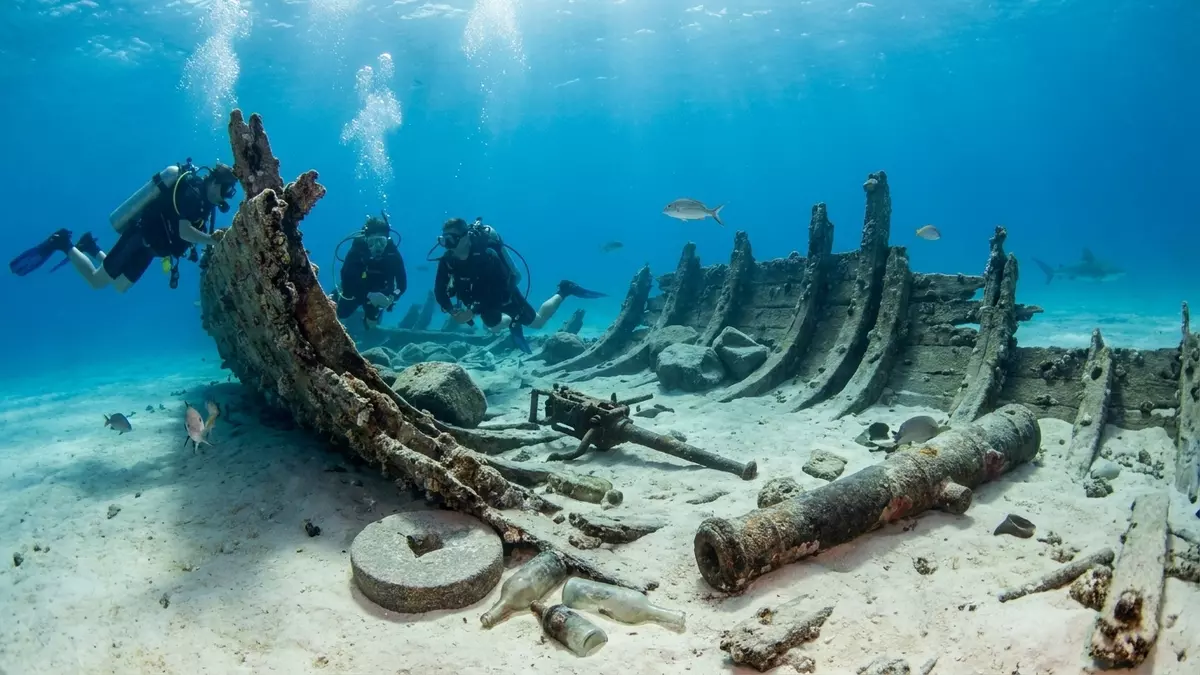
One of the most significant finds lies deep within Nassau’s harbor. The site consists of a submerged wooden hull, burned down to the waterline, stabilized by heavy ballast stones. According to Michael Pateman, director of the Bahamas Maritime Museum, this was a classic “pirate tactic.”
“After seizing a ship and taking its cargo, cannon and fittings, pirates had to get rid of all signs of their crime,” Pateman explained. By burning the vessel to the waterline, pirates ensured that the physical evidence of their felony disappeared beneath the waves, making it impossible for authorities to link the ship back to a specific crime.
Artifacts of the High Seas
Approximately 22 miles east of Nassau, the team discovered the remains of an 18th-century armed sloop. This vessel provided a trove of historical data, including:

Weaponry: A large deck cannon and an iron swivel gun, both hallmarks of an armed vessel of the era.
Personal Gear: A specialized grinding stone, likely used by a pirate or crew member to keep cutlasses and swords battle-ready.
Ammunition: Multiple lead musket balls and additional cannonballs, reinforcing the vessel’s status as a warship.

Archaeologist Sean Kingsley noted that the complete lack of merchant cargo at this site strongly supports the theory that it was a pirate vessel, rather than a defenseless merchant ship.
Life Beyond the Hollywood Myth
The expedition also explored a third wreck beneath Nassau’s old bridge—a site guarded, somewhat fittingly, by a bull shark. This vessel appears to have met its end not by fire, but by nature; the team believes it struck an underwater sandbank during a storm. Despite its poor preservation, the site yielded rigging, cooking bricks, and glass bottles, offering a tactile connection to the daily lives of 18th-century sailors.
The team’s research also extended beyond the seafloor. By analyzing 300-year-old maps and local documentation, they aimed to deconstruct the “Hollywood fantasy.” Contrary to popular culture, Nassau was less of a romanticized pirate kingdom and more of a rugged, dangerous “cowboy frontier town” mixed with the chaotic conditions of a primitive 18th-century maritime camp.
A Transitioning Era
Not all findings from the expedition were related to active piracy. In addition to the pirate wrecks, the team unearthed remains from the 1740s, including shipping containers and clay tobacco pipes bearing the British coat of arms. These artifacts represent the period immediately following the pirate era, when Nassau was transitioning back to a more structured, colonial existence and the threat of sea raiders had finally subsided.
This expedition marks the first time that divers have received permission to explore the “closed zone” of Nassau harbor, and the documentation provided by the team offers the most accurate look yet at how these legendary sea outlaws truly operated.
Frequently Asked Questions
How were the ships confirmed as “pirate” vessels?
The ships were identified through a combination of their construction methods—such as the use of 18th-century wooden treenails—and the presence of war-related armaments like swivel guns and cannons. The absence of commercial cargo, combined with evidence of intentional burning to hide crimes, points strongly toward pirate activity.
Why haven’t these ships been found before?
Nassau’s harbor is notoriously difficult to navigate, characterized by dangerous currents and an abundance of marine predators. Until the New Providence Pirates Expedition gained specific permits to dive in restricted zones in 2025, these wrecks remained largely unexplored by legitimate archaeological teams.
Were there really 40 pirate ships sunk in Nassau?
Historical reports from Governor Woodes Rogers in 1718 suggest as many as 40 ships were burnt or sunk in the area. The recent discovery of six wrecks suggests that many more may still be hidden under the sediment of the harbor, waiting to be identified.
What is a “treenail,” and why does it matter?
A treenail (short for “tree nail”) is a wooden pin or dowel used to fasten timbers together. Because these were standard in 18th-century shipbuilding, they help archaeologists date the wrecks to the precise time when piracy was at its peak in the Bahamas.
What happens to the items found at these sites?
The findings are being documented by the New Providence Pirates Expedition and Wreckwatch TV. Preliminary results are being shared through scientific reports to the Bahamian antiquities authority, and the story of these discoveries is being featured in a dedicated documentary series to ensure the public can learn from these underwater time capsules.