
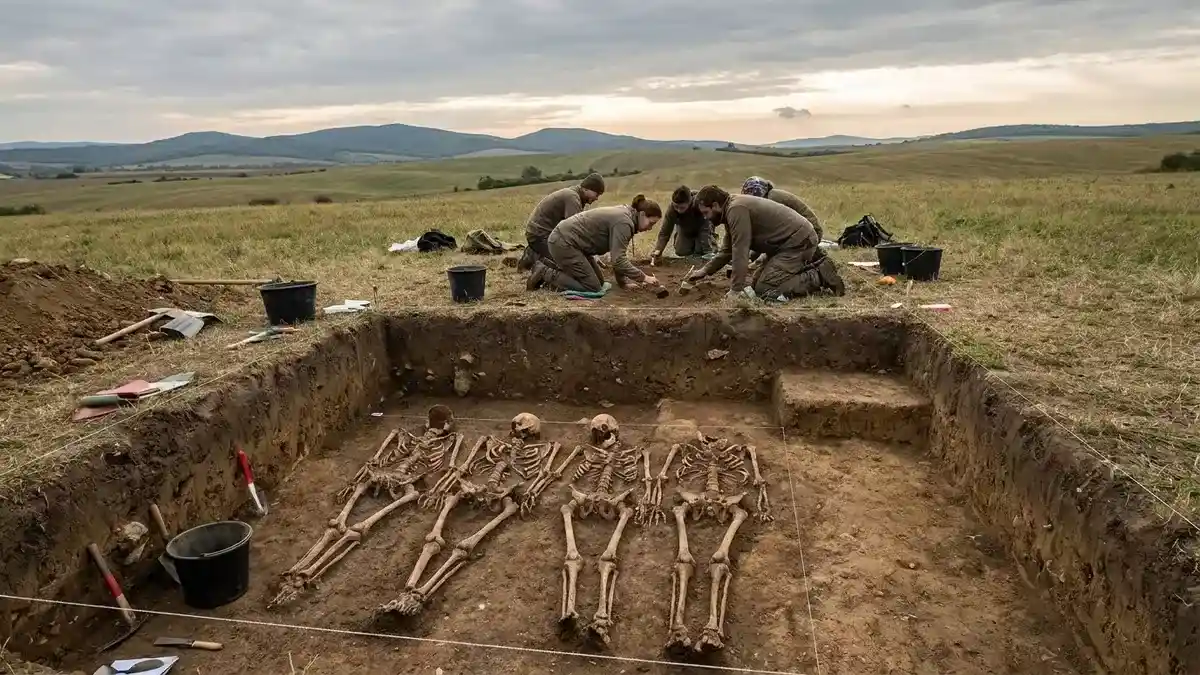
77 Headless Skeletons Unearthed in 7,000-Year-Old Slovakian Ditch
The sleepy landscape of southwest Slovakia is hiding a dark, 7,000-year-old secret that is currently rewriting what we know about Neolithic burial customs. At the archaeological site of Vráble, researchers have uncovered a sprawling defensive ditch filled with the remains of dozens of individuals—all of whom share a haunting similarity: they are entirely headless.
While the grisly nature of the discovery might initially suggest a scene of ancient warfare or mass execution, the reality appears to be far more nuanced. Archaeologists suggest that these remains are not the victims of a brutal slaughter, but rather the subjects of a sophisticated and enigmatic ritualized burial process.
77 Headless Skeletons Unearthed in 7,000-Year-Old Slovakian Ditch
The Neolithic Mystery of Vráble
The Vráble settlement, a major hub for the Linear Pottery culture (LBK), dates back to between 5250 and 4950 B.C. The LBK people are well-known to historians for their distinct pottery styles, defined by intricate parallel lines, which have been traced across vast swathes of Central Europe.
First investigated in 2012, Vráble was a massive undertaking for its time. It consisted of over 300 houses organized into three distinct neighborhoods. One of these sectors was protected by a massive double-ditch fortification stretching approximately 0.8 miles (1.3 kilometers). It is within this defensive structure that archaeologists made their most unsettling find.
Since 2022, excavations of the ditch have revealed four pairs of headless skeletons, alongside a harrowing mass grave containing at least 77 individuals. With a single exception—a child whose skull remained intact—every body discovered in the ditch had been methodically separated from its head.
Ritual vs. Massacre: Deconstructing the Evidence
The primary challenge facing the team from Kiel University, who published their preliminary findings in the Proceedings of the Prehistoric Society, is determining whether this was a site of violence or a cemetery of religious significance.
Biological anthropologist Katharina Fuchs, a co-author of the study, noted that the remains show clear signs of “skilful removal of the skulls.” Detailed analysis of the upper neck vertebrae revealed sharp, precise cut marks, suggesting that the decapitations were performed using sharp tools, likely after death.
The deliberate nature of these cuts indicates a high level of anatomical knowledge. Furthermore, the lower jaws of the individuals were also missing. This suggests that the heads were not merely discarded; they were handled as significant, perhaps even sacred, objects. Because the neck vertebrae of many of the skeletons were found resting against the ditch walls, researchers believe the bodies were carefully deposited in the trench, rather than thrown in haphazardly as one would expect after a battlefield massacre.
The Search for the Missing Skulls
A central mystery persists: Where are the heads? Unlike other Neolithic sites in Europe, such as those in Italy where caches of skulls have been recovered, the skulls at Vráble are entirely “archaeologically invisible.”

This absence complicates the narrative. If the heads were being venerated—as was common in other Neolithic Near East societies, where ancestors’ skulls were often plastered, painted, and displayed—they would typically be found in homes or communal shrines. At Vráble, the skulls have simply vanished.
Archaeologists posit a few theories:
Ancestor Worship: The heads may have been removed as part of a complex ritual to memorialize the dead, later being moved to another location that has not yet been discovered.
Social Signifiers: The act of removing the head could have been a way to preserve the “personhood” of the deceased for a specific ritualistic purpose.
Community Tension: Given that only one of the three neighborhoods was heavily fortified, the ditch may have served as a symbolic barrier. The burial of these individuals there could have been an attempt to “mark” the territory or protect the community from spiritual forces, using the remains of their own ancestors as a buffer.
Insights into Early Farming Societies
The Vráble excavation is providing a rare window into the social fabric of early European farming societies. The fact that some individuals were buried in pairs suggests that familial or social bonds were maintained even in death. This indicates that the Neolithic population possessed a complex understanding of mortality, identity, and group belonging that went far beyond mere survival.
Archaeologist Martin Furholt, the study’s lead author, believes this site is critical for understanding how Neolithic people perceived the body. These findings challenge the assumption that prehistoric societies were purely pragmatic; instead, they reveal a culture deeply invested in symbolic and recurring rituals that helped define their social order.
As excavations continue, researchers hope to find clues that might explain the mysterious absence of the skulls. Until then, the ditch at Vráble remains one of the most enigmatic archaeological puzzles in Europe, serving as a silent, headless testament to a culture that viewed the boundary between life and death as a fluid, meaningful space.
Frequently Asked Questions
Were these 77 people killed in a battle?
Current evidence suggests otherwise. The precision of the cut marks on the vertebrae points toward a calculated, postmortem procedure rather than the chaotic violence typical of a battle or an impulsive massacre.
Why was the Vráble settlement surrounded by a ditch?
The ditch likely served as a defensive fortification. Its location around only one of the three neighborhoods suggests a potential social stratification or rising tensions between different groups within the settlement, with the ditch acting as a physical and symbolic boundary.
Are there other examples of headless burials in the Neolithic period?
Yes. Headless bodies or isolated skulls have been found at various Neolithic sites across Europe and the Near East. However, the sheer scale of the mass burial at Vráble and the complete absence of the skulls make this particular discovery highly unusual.
What does the lack of skulls tell us?
The absence of skulls suggests they were potentially removed for use in other rituals or ancestor worship practices. In many Neolithic cultures, skulls were prized as physical links to ancestors and were often decorated or displayed, which may have happened here.
Will there be more information from this site?
Yes. Archaeologists have not yet finished excavating the entire ditch. Future seasons of field work will focus on unearthing the remainder of the trench, which may provide the final keys to understanding the ritualistic purpose behind these headless remains.