
Table of Contents
- 1. A Golden Age of Samaritan Prosperity
- 1.1. The Artichokes and Asparagus of Late Antiquity
- 2. High-Volume Industry and the Law of Ritual Purity
- 3. Surviving the Fire of the Samaritan Revolts
- 4. Frequently Asked Questions
- 4.1. Who were the Samaritans of late antiquity?
- 4.2. What unique food items are illustrated on the estate’s mosaics?
- 4.3. Why did the ancient farmers build a ritual bath inside an oil factory?
- 4.4. What were the Samaritan Revolts, and how did they affect this site?
- 4.5. How do archaeologists know the estate remained Samaritan after the wars?
1,600-Year-Old Imperial Samaritan Estate With Rich Mosaics Excavated in Israel
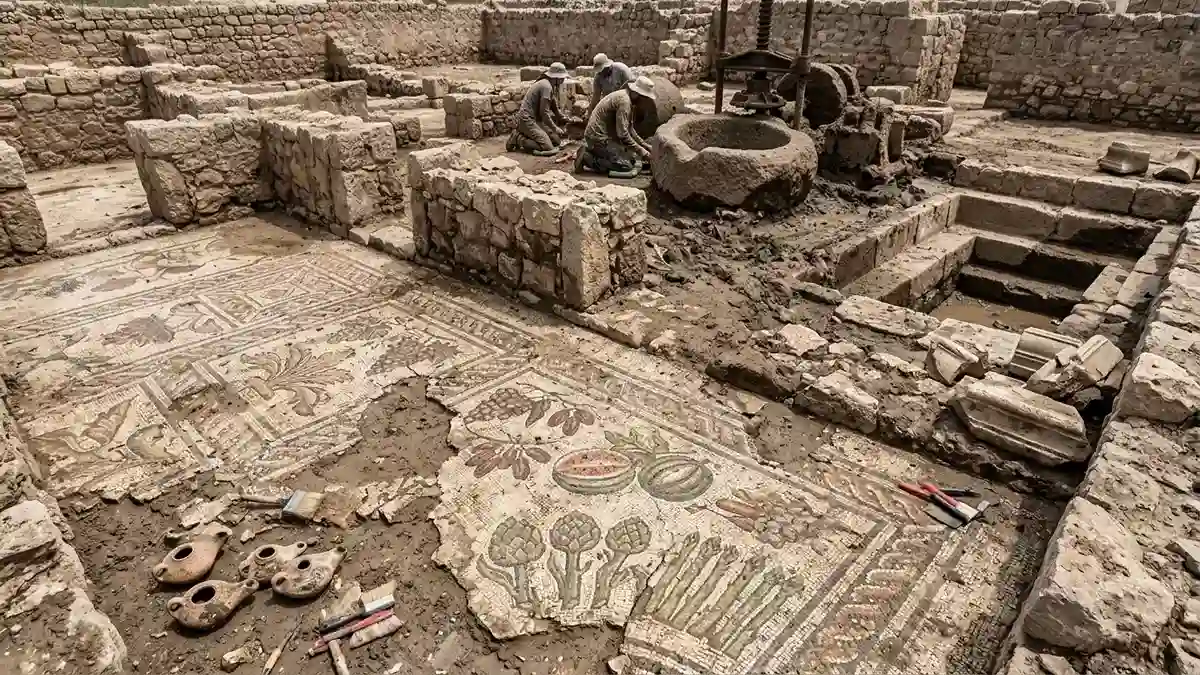
Archaeologists in Kafr Qasim, located in central Israel, have uncovered a sprawling, highly luxurious 1,600-year-old agricultural estate. The discovery offers an unprecedented glimpse into the massive wealth, economic durability, and resilience of the local Samaritan community during late antiquity.
The excavation at the site of Khirbet Kafr Ḥatta was coordinated by the Israel Antiquities Authority (IAA) and funded ahead of a major municipal expansion by the Ministry of Construction and Housing. Historically, the location carries deep spiritual weight: early religious texts record Khirbet Kafr Ḥatta as the ancestral birthplace of Menander, a famous first-century Samaritan magician who studied directly under Simon Magus—the historical figure widely considered the founding father of Gnostic Christian sects.
1,600-Year-Old Imperial Samaritan Estate With Rich Mosaics Excavated in Israel
A Golden Age of Samaritan Prosperity
Excavation directors Alla Nagorsky and Dr. Daniel Leahy Griswold date the active lifespan of the estate to a 400-year window stretching from the late Roman through the Byzantine periods (the 4th to the 7th centuries CE).
 4,000-Year-Old Child’s Skull Surgery Uncovered in Uzbekistan Changes Ancient Medical History
During this era, the property functioned as a massive, high-yield agribusiness. The sheer architectural scale of the residential quarters, paired with complex industrial farming installations, completely dispels the old historical notion that late-antiquity Samaritans lived exclusively in impoverished, isolated agrarian enclaves.
The Artichokes and Asparagus of Late Antiquity
The artistic crown jewel of the estate is a sprawling, masterfully crafted mosaic floor. The colored stone tiles are arranged into dense geometric borders, winding acanthus leaves, and uniquely lifelike illustrations of local produce, including:
Plump clusters of grapes and ripe dates
Watermelons and artichokes
Unusually clear, precise rows of asparagus
Directly at the threshold of this mosaic room, archaeologists exposed a formal Greek mosaic inscription welcoming visitors with a cheerful phrase: “Good Luck!” The inscription explicitly names the wealthy estate owner, utilizing a traditional surname that numismatists and linguists confirm was highly popular among prominent Samaritan families of the era.
High-Volume Industry and the Law of Ritual Purity
The northern sector of the compound was dedicated entirely to processing the estate’s primary cash crop: olive oil.
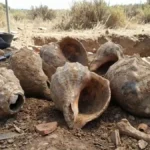
The industrial complex features a highly specialized layout, dividing a massive olive press facility into two distinct functional wings. One wing housed the raw production equipment—including heavy stone crushing basins and a series of sophisticated iron screw presses—while the auxiliary wing contained storage rooms and a large warehouse packed with transport jars.
[Crushing Basin & Screw Presses] ──> Liquid Extraction ──> [Adjacent Miqveh Purification] ──> Ritually Pure Oil
Farming Under Divine Law: Directly adjacent to the olive press, architects built an authentic miqveh (a ritual purification bath). Archaeologists state that placing a holy bath within arm’s reach of an industrial oil press confirms that the Samaritan estate workers operated under strict religious laws. They intentionally bathed to maintain absolute ritual purity before touching the machinery, ensuring the resulting olive oil could be certified as holy for temple use.
Surviving the Fire of the Samaritan Revolts
The history of the estate was not entirely peaceful. Over its 400-year existence, the property underwent severe structural trauma. The luxurious residential halls were eventually partitioned by crude stone walls, which sliced through the beautiful fruit mosaics to convert open living rooms into basic grain silos. Furthermore, many finely carved pillars and lintels were ripped from older buildings to be sloppily recycled as foundational blocks for later outhouses.
Historians link these structural downgrades directly to the historic Samaritan Revolts of the 5th and 6th centuries CE. These bloody, anti-Byzantine uprisings erupted across the Levant as Samaritan communities fought back against the oppressive religious restrictions imposed by the Christian Byzantine Empire.
While the imperial military crushed most regional Samaritan strongholds—burning their fields and forcing communities to flee—the estate in Kafr Qasim tells a rare story of survival. Instead of facing total destruction, the occupants successfully navigated the crisis, adapted their luxury home into a fortified farming outpost, and stubbornly held onto their cultural identity. This continuous survival is proven by the discovery of numerous distinct, late-Byzantine Samaritan ceramic oil lamps scattered across the final occupation layers.
To balance modern expansion with historical preservation, the IAA is currently collaborating with urban planners to cleanly integrate the ancient mosaic estate directly into the city’s future public park systems.
Frequently Asked Questions
Who were the Samaritans of late antiquity?
The Samaritans are an ethnoreligious group closely related to the ancient Israelites. During the Roman and Byzantine periods, they numbered in the hundreds of thousands, maintaining a distinct religious identity centered around their holy site at Mount Gerizim and operating vast agricultural networks across the Levant.
What unique food items are illustrated on the estate’s mosaics?
The mosaic floors feature highly detailed, vivid depictions of everyday foods and luxury agricultural products of the Byzantine era, including grapes, dates, watermelons, and surprisingly precise renderings of artichokes and asparagus.
Why did the ancient farmers build a ritual bath inside an oil factory?
The proximity of the miqveh (purification bath) to the olive press was a deliberate design choice. It allowed the estate workers to spiritually purify themselves via immersion before processing the olives, guaranteeing that the oil was manufactured under the strict laws of ritual purity required for religious trade.
What were the Samaritan Revolts, and how did they affect this site?
The Samaritan Revolts were a series of violent uprisings during the 5th and 6th centuries CE against the Byzantine Empire, which sought to suppress religious minorities. While many neighboring settlements were burned to the ground, the Kafr Qasim estate survived the wars, though its luxury halls were permanently modified into functional, utilitarian farming spaces.
How do archaeologists know the estate remained Samaritan after the wars?
Archaeologists confirmed the continuous presence of the original community by uncovering a distinct style of Samaritan ceramic oil lamps inside the upper, late-stage layers of the soil. These artifacts prove the inhabitants never abandoned their distinct cultural and religious heritage despite centuries of political pressure.