
Table of Contents
- 1. Paleoproteomics: The New Frontier of Ancient Genetics
- 2. Upending Decades of Evolutionary Assumptions
- 2.1. Solving the Uniformity Mystery
- 3. Cultural Ritual or a Missing Gene?
- 3.1. 1. Sex-Biased Mortuary Practices
- 3.2. 2. The AMELY Gene Deletion
- 4. An Unexpected Link to an Ancient South African Cousin
- 5. Frequently Asked Questions
- 5.1. Is it completely certain that there are no males in the Rising Star cave?
- 5.2. Why did scientists originally think some of the skeletons were male?
- 5.3. What does this tell us about how Homo naledi treated their dead?
- 5.4. What is paleoproteomics and why is it being used instead of DNA testing?
- 5.5. How old are the Homo naledi fossils analyzed in this study?
Ancient Protein Analysis Reveals All Homo naledi Skeletons From Rising Star Cave May Be Female
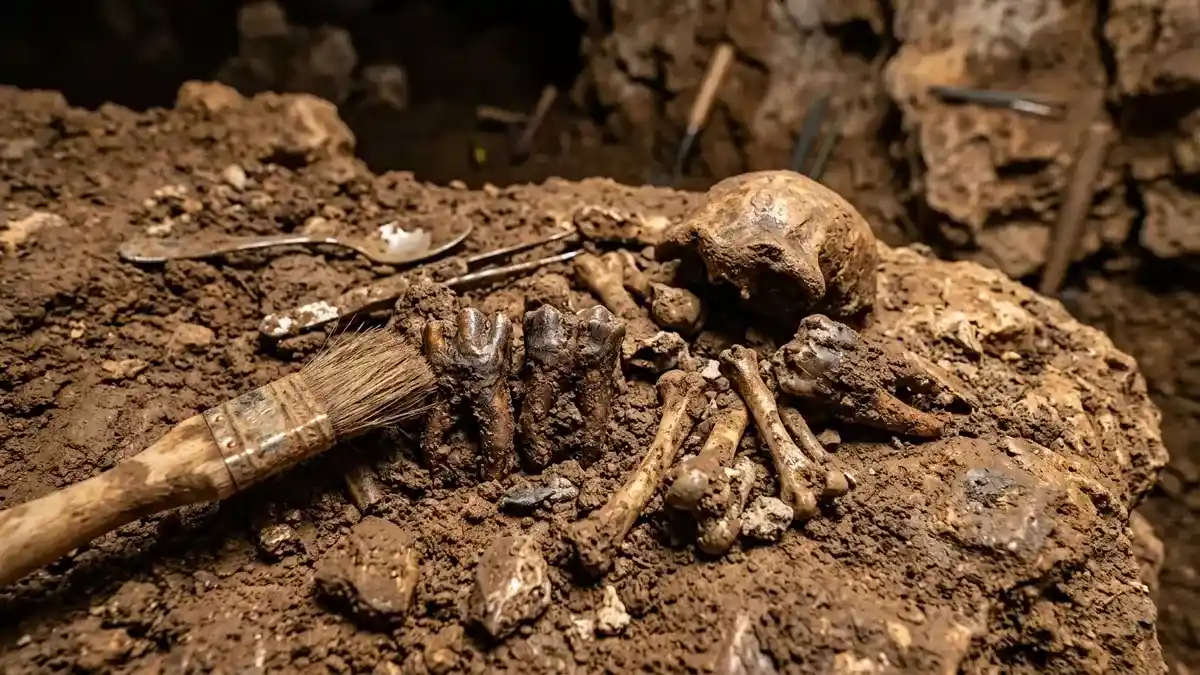
South Africa’s Rising Star cave system has been the epicenter of evolutionary surprises since 2013, when scientists first pulled the bones of an entirely new, primitive human relative from its pitch-black chambers. Named Homo naledi, this ancient hominin combined an orange-sized brain with strikingly modern, human-like hands and feet.
Now, the first genetic-style analysis of the species has delivered a massive shock to the anthropological community: every single individual recovered from the cave system appears to have been biologically female.
The ground-breaking study, published in the journal Cell, analyzed fossilized tooth proteins from at least 20 different individuals. The results completely upend previous assumptions about the species, solve a decade-long anatomical paradox, and offer a tantalizing look into prehistoric social behaviors that occurred between 335,000 and 236,000 years ago.
Ancient Protein Analysis Reveals All Homo naledi Skeletons From Rising Star Cave May Be Female
Paleoproteomics: The New Frontier of Ancient Genetics
In the hot, humid climates of sub-Saharan Africa, ancient DNA breaks down rapidly, usually disintegrating entirely within a few thousand years. To bypass this barrier, an international research team turned to paleoproteomics—the study of ancient proteins.
Proteins trapped inside dental enamel are significantly more durable than DNA and can survive intact for hundreds of thousands, or even millions, of years. Utilizing a cutting-edge, minimally destructive method known as “acid etching,” scientists scraped microscopic amounts of enamel from 23 teeth belonging to the cave’s residents.
The team focused their search on specific sex-linked enamel proteins coded by amelogenin genes:

AMELX: A protein variant coded on the X chromosome, present in both biological males and females.
AMELY: A protein variant coded exclusively on the Y chromosome, present only in biological males.
The laboratory findings were stark. While the female-associated AMELX protein was highly abundant across all 23 samples, the male-specific AMELY protein was entirely absent. After rigorous statistical analysis, the team identified 19 individuals as female with near-absolute confidence, while the 20th specimen also strongly aligned with a female profile.
Upending Decades of Evolutionary Assumptions
This biochemical discovery completely rewrites what anthropologists thought they knew about Homo naledi’s physical appearance.
When the species was first introduced to the world in 2015, researchers observed a distinct size difference among the skeletons. Following the rules of standard human evolution—where males are typically larger and more robust than females—scientists categorized the larger skeletons as male. This included “DH1,” the primary fossil profile used to define the species, and “Neo,” a remarkably complete skeleton found in a secondary chamber.
The protein data has shattered that assumption. Both Neo and DH1 lacked the AMELY male marker. They were not men; they were simply larger females.
Solving the Uniformity Mystery
This revelation beautifully answers a question that has plagued dental anthropologists for years. A 2024 anatomical study noted that Homo naledi’s teeth showed an incredibly low, nearly impossible amount of physical variation for a species containing both sexes. The authors of that study even posited that one sex might be entirely missing from the cave. The new protein analysis validates that theory: the teeth look completely uniform because they all belonged to the exact same sex.
Cultural Ritual or a Missing Gene?
Finding 20 females and zero males in an isolated underground chamber defies random chance. Anthropologists are currently weighing two major explanations for this demographic anomaly.
1. Sex-Biased Mortuary Practices
The primary research team has famously argued that Homo naledi deliberately deposited their dead inside the Rising Star cave system, navigating a terrifyingly narrow, 12-meter vertical chute in pitch-blackness to do so. If the all-female population is a reflection of reality, it strongly suggests that Homo naledi possessed complex, gender-segregated social structures.
The cave may have been an exclusive, sacred burial site specifically reserved for females. While sex-biased cemeteries are well-documented in later Homo sapiens societies, finding such cultural abstraction in a small-brained species living nearly 300,000 years ago is completely unprecedented.
2. The AMELY Gene Deletion
A purely biological alternative is that the Homo naledi population suffered from a systematic genetic mutation. Occasionally, human populations experience an “AMELY deletion,” where the male marker is wiped from the Y chromosome. A male with this deletion still develops normally but will produce a protein profile that looks identical to a female.
While this mutation has been documented in modern humans and in a single Neanderthal fossil, researchers note that it is highly improbable for an entire species’ male population to uniformly carry this rare deletion.
An Unexpected Link to an Ancient South African Cousin
Beyond solving the sex of the skeletons, the proteomic mapping uncovered a shocking evolutionary twist. The Homo naledi teeth contained a unique genetic variant tied to collagen production that is completely absent in modern humans, Neanderthals, and Denisovans.
Instead, this specific collagen marker perfectly matches Paranthropus robustus—a massive-jawed, heavy-chewing human relative that lived in the exact same South African region over a million years earlier.
| Hominin Species | Brain Size | Time Horizon | Shares Collagen Variant? |
| Paranthropus robustus | Small (~500cc) | 1.0 – 2.0 Million Years Ago | Yes |
| Homo naledi | Small (~500cc) | 236,000 – 335,000 Years Ago | Yes |
| Homo sapiens (Modern Humans) | Large (~1350cc) | Present | No |
Whether this shared protein variant means Homo naledi descended directly from Paranthropus, or simply shared a deeply rooted African ancestor, remains a mystery. To find out, scientists will need to use this new, non-destructive paleoproteomic methodology to scan other crucial African fossils, including Homo erectus and Australopithecus africanus.
Frequently Asked Questions
Is it completely certain that there are no males in the Rising Star cave?
Not 100%. While the protein analysis found absolutely zero male AMELY markers across 20 individuals, there is a remote biological possibility that Homo naledi males existed but carried a genetic mutation that deleted their AMELY gene. If they lacked this gene, their protein test results would mimic those of a female. However, researchers view an all-female composition as the more likely scenario.
Why did scientists originally think some of the skeletons were male?
Archaeologists based their initial assessments on physical size and skull robustness. Skeletons like “Neo” were significantly larger than others in the cave, leading scientists to assume they were looking at natural size differences between males and females. The protein data proved that Homo naledi females simply varied greatly in size.
What does this tell us about how Homo naledi treated their dead?
If the cave truly serves as an all-female repository, it strongly reinforces the controversial theory that Homo naledi intentionally buried their dead. It implies they didn’t just crawl into the cave randomly; rather, they deliberately selected this deeply hidden underground chamber as a specialized, sex-segregated ritual site.
What is paleoproteomics and why is it being used instead of DNA testing?
Paleoproteomics is the study of ancient proteins. While DNA is fragile and destroys easily in warm climates, proteins embedded in tooth enamel are incredibly tough and can survive for hundreds of thousands of years. It allows scientists to extract genetic-level data from ancient African fossils where DNA sequencing is impossible.
How old are the Homo naledi fossils analyzed in this study?
The fossils recovered from the Rising Star cave system date back to the Middle Pleistocene epoch, specifically between 335,000 and 236,000 years ago, meaning they lived in Africa at the same time early modern humans were beginning to evolve.