
Table of Contents
- 1. Unearthing the Famed Bavarian Princess
- 2. Redating the Cemetery: Overturning a Century of Assumptions
- 2.1. Bridging the Gap of Fading Roman Power
- 3. The Severin Horizon and the Reality of Medieval Warfare
- 3.1. Anatomy of an Ancient Cavalry Fight
- 4. Filling a Historic Void in Central Europe
- 5. The Modern Value of Rescue Archaeology
- 6. Frequently Asked Questions
- 6.1. What makes the Bad Füssing archaeological site so important?
- 6.2. Who was the “Bavarian princess” found at the site?
- 6.3. What did radiocarbon dating reveal about the cemetery?
- 6.4. What does the horseman’s skeleton tell us about the era?
- 6.5. Did the fall of the Roman Empire cause an immediate population collapse in Bavaria?
Ancient Bavarian Graves Reveal Secrets of Early Medieval Migrations
A routine rescue excavation in the town of Bad Füssing, located in Bavaria’s Passau district, has fundamentally altered our understanding of European history. What field researchers initially assumed would be a standard early medieval cemetery has unfolded into an extraordinary window into a turbulent past. The site preserves vital clues about human migration, violent warfare, and cultural integration during the chaotic twilight of the Roman Empire.
This sprawling burial ground contains approximately 90 graves, offering a rare glimpse into a society navigating a massive geopolitical transition. Rather than documenting a simple, sudden replacement of Roman power by early Germanic tribes, the site tells a story of unexpected cultural continuity, deep-seated regional blending, and sporadic, brutal conflict along the vital Inn Valley trade corridor.
Ancient Bavarian Graves Reveal Secrets of Early Medieval Migrations
Unearthing the Famed Bavarian Princess
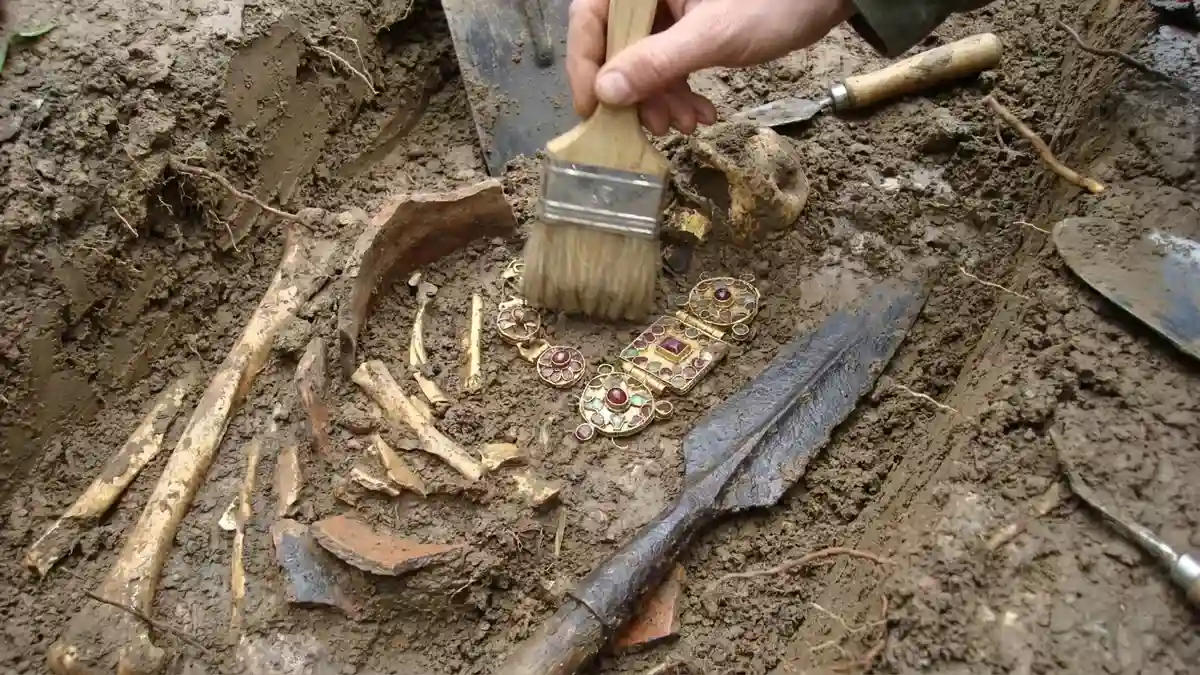
When excavations first got underway, the archaeological team dated the cemetery to the sixth and seventh centuries CE. This timeline aligns perfectly with the historical emergence of the early Bavarian culture. The initial centerpiece of the dig was an incredibly lavish grave belonging to an elite woman. Due to the spectacular nature of her buried treasures, researchers quickly nicknamed her the “Bavarian princess.”
Her resting place contained an array of breathtaking artifacts that highlight the immense wealth and international connections enjoyed by regional elites during this era. Specialized conservators have painstakingly restored her grave goods, which include:
Exquisite Metalwork: Highly detailed decorative clasps and fine jewelry components that showcase advanced metallurgical skills.
Imported Luxury Goods: Rare materials brought to the region through far-reaching trade networks, signaling her elevated social prestige.
However, as archaeologists expanded their focus to the surrounding graves, they encountered a series of glaring anomalies that threatened to overturn their initial theories.
Redating the Cemetery: Overturning a Century of Assumptions
Scattered among the graves traditionally associated with the sixth and seventh centuries were objects that seemed completely out of place. Team members discovered unique ceramic vessels, archaic styles of clothing fasteners, and beautifully preserved glass beakers featuring distinct pointed bases. These items pointed to a chronological horizon far older than the era of the Bavarian princess.

To resolve the chronological confusion, scientists conducted precise radiocarbon dating on sixteen carefully selected skeletons. The laboratory results delivered a major shock to the historic community. The cemetery had actually been established by the middle of the fifth century CE—roughly 120 years before the high-status princess was laid to rest.
Bridging the Gap of Fading Roman Power
This revised timeline places the earliest burials squarely in a period when the Inn region maintained active ties to the decaying infrastructure of Roman administration. This means non-Roman communities had crossed the imperial borders and established a permanent presence in the landscape well before any surviving written texts make mention of a distinct “Bavarian” people.
The overlapping layers of graves demonstrate that the collapse of Roman authority in the region was not a sudden, apocalyptic event that wiped out local populations. Instead, it was a slow process of cultural mixing and migration, where incoming groups peacefully integrated into existing borderland communities, utilizing the same sacred burial spaces over multiple generations.
The Severin Horizon and the Reality of Medieval Warfare
The middle of the fifth century is often referred to by European historians as the “Severin Horizon.” This chaotic era is defined by the final, desperate gasps of Roman administrative order in the Eastern Alps. As central authority dissolved, local populations were forced to defend themselves, leading to an environment ripe with lawlessness and territorial disputes.
The stark reality of this systemic instability is written directly into the bones of the individuals buried at Bad Füssing. Anthropologists conducting skeletal analyses made a chilling discovery while examining the remains of one mid-fifth-century male skeleton.
Anatomy of an Ancient Cavalry Fight
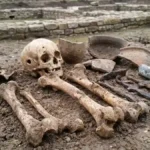
The physical geometry of the man’s thigh bones exhibited severe, characteristic wear patterns that only develop after a lifetime spent on horseback. The inclusion of a iron riding spur inside his grave further confirmed his status as an experienced, mounted warrior. However, it was the nature of his skeleton’s traumatic injuries that captured the attention of researchers.
The forensic analysis indicates that this rider met an incredibly violent end. He sustained a massive, unhealed sword blow to his leg, followed immediately by two crushing, sharp-force strikes to his skull. Archaeologists have reconstructed his final moments as a dramatic, high-stakes cavalry encounter. The man was likely struck while mounted, violently thrown from his horse to the ground, and then quickly executed by an enemy combatant in brutal, close-quarters combat.
Filling a Historic Void in Central Europe
For generations, a frustrating historical blind spot has existed between the formal withdrawal of Roman provincial institutions and the settled establishment of recognized early medieval kingdoms along the Inn River. The discoveries at Bad Füssing are finally filling this immense gap.
The unique value of this cemetery lies in its long-term continuity. It proves that the region remained a dynamic, inhabited zone throughout the worst years of imperial collapse. The people buried here lived through a world in profound flux. They adapted to shifting political borders, welcomed waves of migrating families, altered their personal identities, and occasionally fought to the death to protect their territory.
The Modern Value of Rescue Archaeology
The treasures pulled from the Bavarian mud remind us of the immense value of rescue archaeology. Often triggered by modern construction or infrastructure updates, these time-sensitive digs routinely uncover vital historical evidence that would otherwise be lost forever to bulldozers.
As researchers continue to study the chemical signatures, DNA, and artifacts recovered from Bad Füssing, our understanding of the transition from the ancient world to the Middle Ages will only grow clearer. The site stands as a profound monument to human resilience, demonstrating how an ancient community managed to forge a vibrant, interconnected society right out of the ashes of a fallen empire.
Frequently Asked Questions
What makes the Bad Füssing archaeological site so important?
The site provides a rare, continuous record of human life during the fifth to seventh centuries CE. It bridges the historical gap between the collapse of Roman administrative power in Bavaria and the rise of early medieval Germanic societies.
Who was the “Bavarian princess” found at the site?
The “Bavarian princess” is a nickname given by researchers to a wealthy woman buried in a sixth- or seventh-century grave. Her resting place contained an exceptionally rich collection of restored jewelry, high-status metalwork, and imported luxury materials.
What did radiocarbon dating reveal about the cemetery?
Radiocarbon dating of sixteen skeletons proved that the cemetery was active by the middle of the fifth century CE. This is more than a century earlier than originally thought, placing its earliest use during the final years of Roman regional influence.
What does the horseman’s skeleton tell us about the era?
The horseman’s skeleton provides undeniable physical proof of the violence and instability of the fifth-century “Severin Horizon.” His bones show a lifetime of riding, while unhealed wounds to his leg and skull reveal he died during a brutal, close-quarters battle.
Did the fall of the Roman Empire cause an immediate population collapse in Bavaria?
No. The overlapping burial layers and diverse grave goods at Bad Füssing suggest a gradual transition characterized by migration, cultural mixing, and regional continuity rather than an abrupt, destructive break in history.