
Table of Contents
- 1. Unlocking the Secrets of a 4,000-Year-Old Silver Masterpiece
- 1.1. The First Scene: Facing Primordial Chaos and the Newborn Sun
- 1.2. The Second Scene: The Triumph of Cosmic Order and Balance
- 2. Deep Parallelisms with Sumerian, Akkadian, and Egyptian Ideologies
- 2.1. The Symbolic Role of the Celestial Boat
- 3. Tracking the Ancient Trade Routes of Bronze Age Artisans
- 4. A Lasting Tradition of Cosmological Storytelling
- 5. Frequently Asked Questions
- 5.1. What is the ˁAin Samiya goblet?
- 5.2. Where was the goblet discovered?
- 5.3. How does the new study change our understanding of the artifact?
- 5.4. What do the two main scenes on the goblet represent?
- 5.5. Where was the goblet originally made?
Bronze Age Goblet Rewrites History of Ancient Near East Cosmos
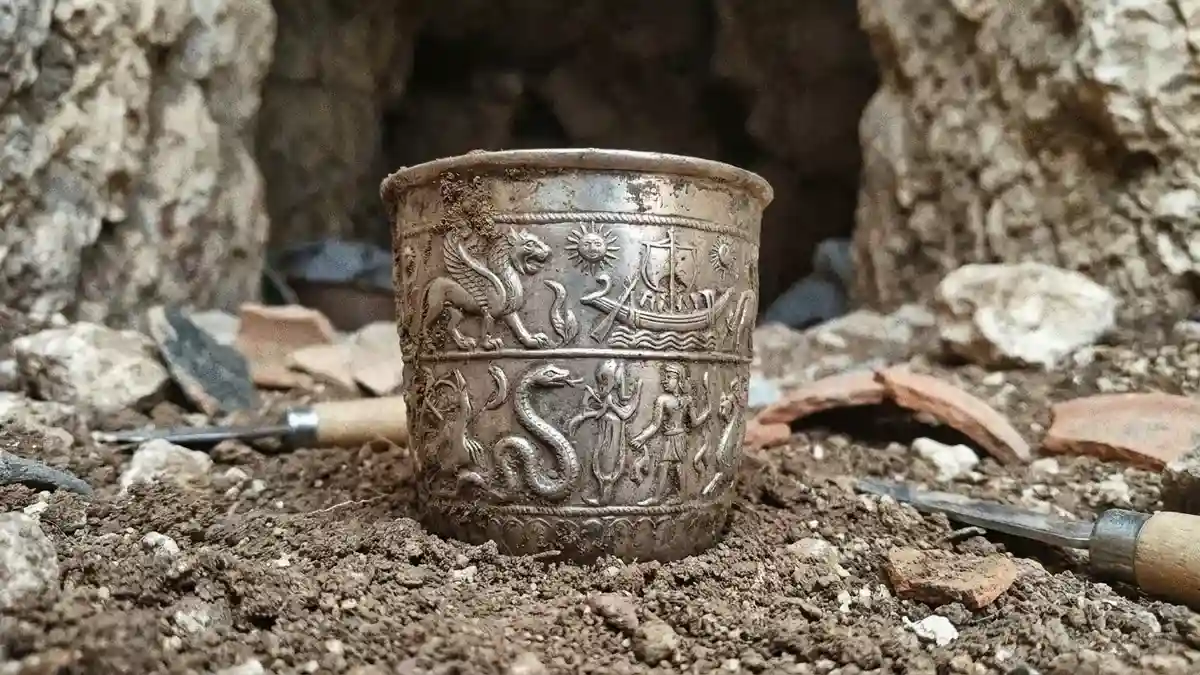
Archaeologists are reexamining one of the most enigmatic artifacts ever recovered from the southern Levant: the ˁAin Samiya goblet. Discovered over five decades ago in a prominent tomb nestled within the Judean Hills, this small silver vessel dates back to the Intermediate Bronze Age. Measuring just 8 centimeters in height, the goblet has captivated and puzzled historians with its intricate, densely packed mythological relief carvings.
For generations, mainstream archaeology attributed the vessel’s detailed imagery to the famous Babylonian creation myth, the Enuma Elish. However, a groundbreaking new study has turned this long-held theory on its head. Researchers now argue that the goblet depicts a much earlier, distinct narrative regarding how ancient human civilizations conceptualized cosmic creation, order, and the cyclical nature of life and death.
Bronze Age Goblet Rewrites History of Ancient Near East Cosmos
Unlocking the Secrets of a 4,000-Year-Old Silver Masterpiece
The ˁAin Samiya goblet stands unique in the archaeological record of the southern Levant. Scholars widely consider it the only surviving true work of complex visual art from its specific Bronze Age timeline in this region. Despite suffering minor historical damage that leaves a small portion of its story incomplete, the remaining surface displays a spectacular, highly deliberate visual sequence.
 Radiocarbon dating confirms Teutonic Knights built Feldioara Fortress in 13th-century Transylvania
The exterior of the silver cup features two distinct, interconnected scenes populated by hybrid beasts, slithering serpents, sacred plant motifs, and powerful celestial symbols.
The First Scene: Facing Primordial Chaos and the Newborn Sun
On one side of the vessel, viewers encounter a striking, chimera-like figure positioned next to a massive serpent. This hybrid entity possesses a human upper body that seamlessly merges into the powerful lower limbs of two bulls. Positioned deliberately between its limbs is a small rosette, which expert iconographers interpret as a newly born sun.
Historically, this specific scene was viewed as a depiction of a chaotic, untamed world. The prominent serpent was traditionally thought to represent primordial disorder and the terrifying unknown. However, when analyzed in tandem with the reverse side of the goblet, a much deeper cosmological journey begins to take shape.

The Second Scene: The Triumph of Cosmic Order and Balance
The opposite side of the vessel offers a profound thematic contrast to the initial imagery. Here, two human figures are depicted lifting the outer edges of a large crescent form. This crescent serves as a cradle for a radiant, fully developed sun, which faces the viewer directly.
In this part of the sequence, the formidable serpent no longer dominates the narrative. Instead, it lies flat, subdued beneath what researchers identify as a celestial boat. The stark transition between the two scenes indicates a structured universe emerging victorious after taming the forces of chaos. Rather than recording a single, violent mythological battle, the imagery captures the overarching Near Eastern philosophy of cosmic organization, balance, and perpetual renewal.
Deep Parallelisms with Sumerian, Akkadian, and Egyptian Ideologies
The new analysis of the ˁAin Samiya goblet links its visual storytelling directly to the core spiritual beliefs of ancient Mesopotamia and neighboring regions. Researchers highlight strong parallels with Sumerian and Akkadian concepts of a dualistic universe. These cultures envisioned the cosmos divided cleanly into two halves: a realm designated for the living and a parallel domain reserved for the deceased.

Both realms were believed to operate under the absolute governance of cosmic cycles—specifically the predictable rebirth of the sun, the phases of the moon, and the changing of the earthly seasons.
The Symbolic Role of the Celestial Boat
The crescent shape featured so prominently on the goblet is now recognized as a depiction of the Celestial Boat. This powerful religious motif appears consistently across the ancient world, including the iconography of:
Ancient Egypt: Where the sun god Ra traversed the heavens and the underworld.
Mesopotamia: Where celestial bodies required divine vessels to navigate the skies.
Anatolia: Where cosmic journeys were inextricably linked to water and sky transport.
The deliberate progression on the artifact—moving from a tiny, fragile “born” sun in the chaotic first scene to a magnificent, fully realized sun in the second—proves that the goblet maps a spiritual and cosmological journey. It highlights a sophisticated understanding of cosmic evolution rather than a simple tale of combat.
Tracking the Ancient Trade Routes of Bronze Age Artisans
Beyond its profound theological meaning, the ˁAin Samiya goblet provides invaluable insights into the economic networks and artisan mobility of the 23rd century BCE. Thorough iconographic comparisons indicate that the master artisan responsible for designing the goblet was likely a southern Mesopotamian native who migrated northward.
However, metallurgical realities suggest a different origin for the physical object itself. Because silver resources were scarce in southern Mesopotamia but highly accessible in northern Syria, experts believe the vessel was manufactured in the north. From there, it traveled south along established Bronze Age trade routes, passing through various hands before finding its final resting place.
Around 2200 BCE, the goblet was placed inside a high-status tomb in the Judean Hills. Archaeologists hypothesize that the cup was not merely a luxury item, but a vital ritual tool. It may have been used during funerary rites to symbolically guide the soul of the deceased person along the exact same cyclical, renewing path taken by the rising and setting sun, promising life after death.
A Lasting Tradition of Cosmological Storytelling
While some conservative corners of the archaeological community urge caution before making definitive declarations, this new research successfully firmly roots the ˁAin Samiya goblet within a massive, interconnected network of Near Eastern storytelling. The artifact stands as a brilliant testament to humanity’s enduring quest to understand the origins of the universe, the victory of order over chaos, and the promise of renewal across the ages.
Frequently Asked Questions
What is the ˁAin Samiya goblet?
The ˁAin Samiya goblet is an 8-centimeter-tall silver vessel dating back to the Intermediate Bronze Age, roughly 4,000 years ago. It is famous for its intricate relief carvings depicting complex mythological and cosmological scenes.
Where was the goblet discovered?
The artifact was discovered over 55 years ago inside a high-status tomb located in the Judean Hills, within the southern Levant region.
How does the new study change our understanding of the artifact?
Previously, scholars believed the imagery on the goblet illustrated scenes from the Babylonian creation epic, the Enuma Elish. The new study demonstrates that it actually represents a much earlier, broader Near Eastern concept of cosmic order, evolution, and the cyclical journey of the sun.
What do the two main scenes on the goblet represent?
The first scene depicts a hybrid human-bull figure and a large serpent alongside a newborn sun, representing primordial chaos. The second scene shows two figures lifting a celestial boat holding a radiant, fully formed sun above a subdued serpent, symbolizing the triumph of cosmic order and balance.
Where was the goblet originally made?
Evidence suggests the designer was an artist from southern Mesopotamia who traveled north. The silver vessel itself was likely manufactured in northern Syria due to the availability of silver, and it was later transported south to the Judean Hills via ancient trade networks.