
Table of Contents
- 1. Challenging the Narrative of Imperial Neglect
- 2. Anatomy of an Elite Cremation
- 3. Merchant, Bureaucrat, or Imperial Liaison?
- 4. Conclusion
- 5. Frequently Asked Questions
- 5.1. Why was cremation so unusual in the Iron Age Southern Levant?
- 5.2. What is a cylinder seal and how was it used?
- 5.3. What is an amphoroid krater?
- 5.4. What was the historical significance of Tel Megiddo in the 7th century BCE?
- 5.5. What does a faience alabastron represent?
Elite Iron Age Cremation Burial Reveals Neo-Assyrian Footprint in the Levant
A stunning archaeological discovery in Israel’s Jezreel Valley is overturning long-held historical assumptions about the extent of Neo-Assyrian imperial control in the Southern Levant. Excavating at the rural site of Horvat Tevet, researchers have uncovered an extraordinarily affluent 7th-century BCE cremation burial dating to the Iron IIC period.
The find represents the richest and most diverse cremation assemblage ever documented in the region. Packed with high-value international imports and administrative tools, the tomb proves that the rural hinterlands of the ancient Levant were deeply integrated into an expansive trade network spanning from Mediterranean coastal ports all the way to the imperial heartlands of Mesopotamia.
Elite Iron Age Cremation Burial Reveals Neo-Assyrian Footprint in the Levant
Challenging the Narrative of Imperial Neglect
For decades, conventional historical narratives argued that following the Neo-Assyrian conquest of the Jezreel Valley, imperial governors focused strictly on aggressive agricultural extraction while leaving the local rural settlements to decay. Because many prominent urban centers in the valley were downsized or abandoned during the 7th century BCE, historians assumed the empire invested very little in the local population.
 Uncovering America’s First War; Contact, Conflict, and Coronado’s Expedition to the Rio Grande
The opulent burial unearthed in Level 3 of Horvat Tevet offers a powerful counterpoint to this theory of regional abandonment. Notably, Horvat Tevet sits just 15 kilometers from Tel Megiddo, which served as the heavily fortified Assyrian provincial capital during this exact era. The sheer wealth found within this rural tomb suggests that the economic and political influence of Megiddo radiated deeply into the surrounding countryside.
       [Jezreel Valley Imperial Dynamics]
 _______________________________________________
| Old Theory:  | Rural abandonment & neglect   |
| New Evidence:| High-status imperial burials  |
| Core Hub:    | Tel Megiddo (Provincial Capital)|
| Impact:      | Direct administrative control |
 _______________________________________________
Anatomy of an Elite Cremation
The burial method itself immediately startled archaeologists. During the Iron Age, cremation was an exceptionally rare practice in the inland Southern Levant, where traditional rock-cut tombs or simple earth inhumations were the norm. The presence of a cremation strongly points to an individual of foreign origin, or someone who had thoroughly adopted the elite customs of the Neo-Assyrian Empire.
The burial complex consisted of two distinct pits:
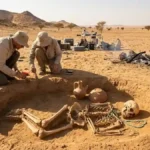
Pit 1: Contained the articulated (skeletally joined) remains of an uncremated adult.
Pit 2 (The Cremation Pit): Contained the cremated remains of an individual distributed across three ceramic urns, alongside a specialized small wall niche filled with accompanying juglets.
While one of the urns held basic, locally manufactured vessels, the remaining two urns contained a collection of luxury commodities virtually unheard of in a small, rural village setting.
                  [Horvat Tevet Cremation Artifacts]
  _________________________________________________________________
 | Luxury Ceramics:  | Amphoroid krater detailed with colored bands |
 | Glyptic & Trade:  | Neo-Assyrian cylinder seal & stone weight   |
 | Exotic Imports:   | Glazed Assyrian bottle & faience alabastron  |
 | Personal Adornment| Fine bronze jewelry and dozens of beads      |
  _________________________________________________________________
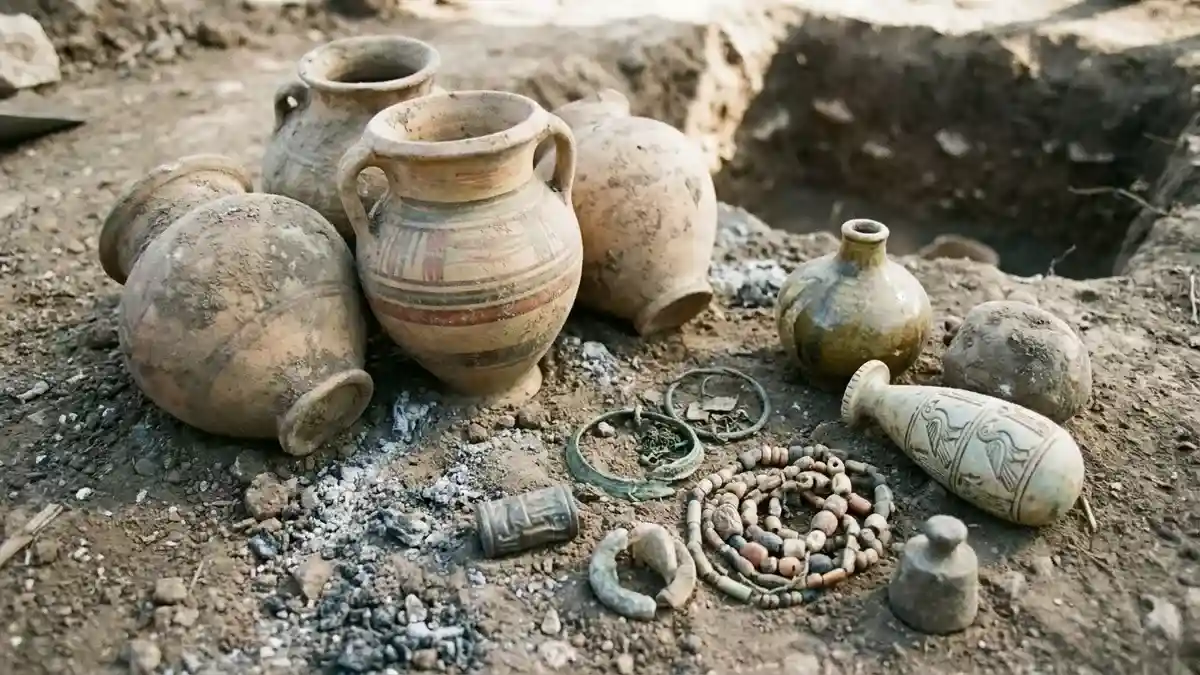
Among the most spectacular objects extracted from the ash were a highly stylized amphoroid krater decorated with bold colored bands, a collection of delicate perfume bottles, bronze jewelry, and dozens of ornamental beads.
The most explicit indicators of elite imperial status, however, were an authentic glazed Assyrian ceramic bottle and an imported faience alabastron—a luxury flask intricately carved with vivid scenes of water birds and papyrus reeds.
Merchant, Bureaucrat, or Imperial Liaison?
The specific combination of items buried with the deceased offers clues regarding their professional life. The discovery of a Neo-Assyrian cylinder seal—used in antiquity to sign official clay documents, secure cargo, and validate contracts—paired with a standardized stone balance weight strongly hints that the individual operated within the upper echelons of the imperial economy.
[Cylinder Seal (Authority)] + [Stone Weight (Commerce)] = Imperial Administrator / Elite Merchant
This individual may have been a high-ranking merchant, an imperial tax official, or a government administrator tasked with managing the agricultural outputs of the fertile valley. The selection of grave goods represents a deliberate display of personal identity tied to the broader imperial world centered at nearby Megiddo.
This opulence stands in sharp contrast to the everyday remains found across the rest of the Horvat Tevet settlement. The village itself shows few signs of wealth during the Iron IIC period, indicating a steep social hierarchy. Because of this stark divide, researchers hypothesize that the individual may have lived and died within the urban center of Tel Megiddo but was intentionally transported into the agricultural hinterland for burial. This act would have served as a highly visible, symbolic statement linking the authority of the provincial capital directly to the fertile lands that fed it.
The presence of this unparalleled burial suggests a calculated Neo-Assyrian strategy to reinforce imperial presence and secure vital trade corridors in the Levant.
Conclusion
The elite cremation burial at Horvat Tevet forces a major reassessment of how the Neo-Assyrian Empire administered its conquered territories in the Southern Levant. Far from being a neglected, passive agricultural zone, the Jezreel Valley was an active, tightly managed economic landscape. By uncovering a cross-continental network of luxury goods, administrative tools, and elite burial practices in a small rural village, archaeology has demonstrated that the hand of Assyria was felt in every corner of its empire, bridging the gap between local farming communities and the centers of Mesopotamian power.
Frequently Asked Questions
Why was cremation so unusual in the Iron Age Southern Levant?
In the ancient Southern Levant, indigenous populations almost exclusively practiced primary inhumation, meaning bodies were buried intact in the earth or placed within family rock-cut tombs. Cremation was an intrusive custom typically associated with foreign populations, such as northern Phoenicians, sea peoples, or specific elite classes influenced by the Neo-Assyrian and Hittite empires.
What is a cylinder seal and how was it used?
A cylinder seal is a small, hollow cylinder usually carved from stone, glass, or faience featuring intricate engraved scenes. When rolled across wet clay, it leaves a continuous, unique impression. In the Neo-Assyrian Empire, these seals functioned as official signatures for kings, governors, merchants, and scribes to ratify documents and secure storehouse goods.
What is an amphoroid krater?
An amphoroid krater is a large, wide-mouthed ceramic vessel characterized by two large handles connecting the rim to the shoulder, historically used for mixing wine with water during elite feasts. The example found at Horvat Tevet is notable for its high-quality construction and decorative colored bands.
What was the historical significance of Tel Megiddo in the 7th century BCE?
Following the Assyrian conquests, Tel Megiddo was transformed into the administrative capital of the imperial province known as Magiddu. The city was completely rebuilt with a highly organized grid system, massive public palaces, and fortified storehouses designed to oversee trade routes and collect agricultural revenue for the Assyrian king.
What does a faience alabastron represent?
An alabastron is a small, elongated flask with a narrow neck used in antiquity for holding precious oils, perfumes, or ointments. The example found at Horvat Tevet was made of faience—a glazed, non-clay ceramic material—and decorated with Egyptian-style motifs of papyrus and birds, representing a valuable luxury import item.