
Table of Contents
- 1. Sealed by Fire: The Sudden End of the Second Temple Era
- 2. Engineering Purity: The Architecture of the Mikveh
- 3. Stone Over Clay: The Material Culture of Ritual Purity
- 4. Mapping a Temple-Centered Urban Landscape
- 5. Conclusion: A Living Community Frozen in Time
- 6. Frequently Asked Questions
- 6.1. What is a mikveh and what was its purpose?
- 6.2. How old is the ritual bath discovered under the Western Wall Plaza?
- 6.3. What do the charcoal ash layers inside the bath signify?
- 6.4. Why were stone vessels found alongside the ancient bath?
- 6.5. Who used this specific ritual bath 2,000 years ago?
Ancient Ritual Bath Found Under Jerusalem Plaza Frozen in 70 CE
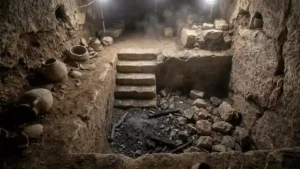
A meticulously preserved Jewish ritual purification bath, known as a mikveh, has been unearthed by archaeologists directly beneath the Western Wall Plaza in Jerusalem. Dating back to the final years of the Second Temple period, the pristine installation provides undeniable physical evidence of Jewish religious life in the capital city at its historical zenith—right before its catastrophic annihilation by the Roman Empire in 70 CE.
Discovered by the Israel Antiquities Authority, the immersion pool offers a poignant, time-capsule look at a functioning religious facility that was suddenly and violently frozen in use. Sealed beneath a thick, suffocating blanket of charcoal ash and rubble, the site chronicles the dramatic final moments of ancient Jerusalem.
Ancient Ritual Bath Found Under Jerusalem Plaza Frozen in 70 CE
Sealed by Fire: The Sudden End of the Second Temple Era
The ritual bath was carved straight into the bedrock of Jerusalem’s lower city, situated just steps away from the majestic Temple Mount complex. For decades, it served local residents and the massive waves of global pilgrims arriving for major seasonal festivals. However, its spiritual function came to a sudden, apocalyptic halt during the First Jewish-Roman War.

Archaeologists found the bath sealed tight beneath a heavy, undisturbed destruction layer left behind by Titus’s invading Roman legions. This grim stratigraphic layer was packed tightly with:
Choked black ash and heavily charred wood fragments.
Massive blocks of collapsed architectural stone masonry.
Shattered domestic household items abandoned in a hurry.
The uniform presence of these materials testifies to the sudden, terrifying violence that brought daily life at the site to an abrupt conclusion.
Engineering Purity: The Architecture of the Mikveh
To satisfy strict ancient religious laws (Halakha), a ritual bath had to be constructed with flawless geometric precision and carved into natural earth or bedrock. This newly uncovered specimen serves as a prime example of high-tier Second Temple engineering, showcasing careful architectural planning and plasterwork.
The bath features a highly functional, rectangular footprint designed to accommodate rapid purification flows. Its precise dimensions measure:
Length: 3.05 meters (10.0 feet)
Width: 1.35 meters (4.4 feet)
Depth/Height: 1.85 meters (6.1 feet)
To ensure the pool could hold water without leaking, the ancient builders coated the raw, hand-carved stone interior walls with a thick layer of specialized hydraulic plaster. Descending from the south side of the installation are four perfectly uniform stone steps, allowing individuals to carefully step down into the water to achieve complete spiritual immersion.
Stone Over Clay: The Material Culture of Ritual Purity
The artifacts recovered directly from the surrounding Roman debris further highlight the intensely devout nature of the neighborhood. Alongside standard household pottery fragments, archaeologists recovered a significant collection of carved stone vessels.
In the late Second Temple era, stone vessels were an expensive luxury, yet they were omnipresent in Jerusalem homes due to specific interpretations of biblical law. Unlike standard earthenware, clay, or metal containers—which had to be broken or discarded if they touched anything deemed ritually unclean—ancient Jewish legal tradition decreed that stone was entirely immune to spiritual contamination.
The presence of these stone cups and bowls directly alongside the bedrock bath confirms that the residents of this sector organized their entire material lives around the meticulous daily maintenance of spiritual purity.
Mapping a Temple-Centered Urban Landscape
The physical location of the bath provides crucial clues about how religion dictated the layout of ancient Jerusalem. The site sits in close proximity to major thoroughfares leading directly into the holy precinct, bounded by the Great Bridge to the north and Robinson’s Arch to the south.
                  [ THE TEMPLE MOUNT ]
                     /            \
                    /              \
         [Great Bridge]          [Robinson's Arch]
              (North)                  (South)
                    \              /
                     \            /
               [ Bedrock-Cut Mikveh ]
               (Western Wall Plaza)
This discovery is part of an emerging archaeological pattern. Past excavations in this immediate perimeter have revealed a dense concentration of other public and private mikva’ot, proving that this entire urban zone acted as a massive purification staging ground. Before setting foot on the sacred Temple Mount platforms, thousands of local citizens and international travelers had to step off the public streets and into these subterranean pools, ensuring the entire city functioned as an integrated, holy ecosystem.
Conclusion: A Living Community Frozen in Time
For historians, the true value of the Western Wall Plaza mikveh extends far beyond its impressive stone architecture. It acts as a powerful historical anchor, directly connecting the physical soil of modern Jerusalem to the dramatic written accounts of the Roman siege left behind by first-century chroniclers like Flavius Josephus.
The ash found resting inside the pool layer turns a static architectural asset into a dynamic witness to history. It provides an unedited, incredibly raw glimpse of a holy infrastructure caught in mid-motion—a vibrant, temple-centered society that was abruptly frozen in time during one of western history’s most defining geopolitical turning points.
Frequently Asked Questions
What is a mikveh and what was its purpose?
A mikveh is a specialized ritual bath used in Judaism for spiritual purification. During the Second Temple period, Jewish law required individuals to fully immerse themselves in these bedrock-cut pools to cleanse themselves of spiritual impurity before engaging in religious activities or entering the Temple.
How old is the ritual bath discovered under the Western Wall Plaza?
The bath dates back to the late Second Temple period, specifically the middle of the 1st century CE. It was sealed during the Roman destruction of Jerusalem in 70 CE, making the installation nearly 2,000 years old.
What do the charcoal ash layers inside the bath signify?
The thick layer of ash, burnt debris, and collapsed structural stones found sealing the bath provides direct archaeological proof of the fiery and violent sacking of Jerusalem by Roman soldiers in 70 CE, showing that the facility was active up until the city fell.
Why were stone vessels found alongside the ancient bath?
According to ancient Jewish purity laws, stone containers were considered completely immune to spiritual impurity, unlike clay or metal vessels. Their high concentration near the mikveh proves that the people living and traveling through this area prioritized maintaining strict biblical purity codes in their daily routines.
Who used this specific ritual bath 2,000 years ago?
Due to its strategic location near major access routes like the Great Bridge and Robinson’s Arch, this bath was used extensively by both local residents of Jerusalem’s upper-class quarters and the thousands of Jewish pilgrims who flooded the capital during major annual religious holidays.