
Table of Contents
- 1. Redefining the Ancient East Asian Narrative
- 2. Mastering the Unpredictable: Advanced Quartz Knapping
- 3. The Mechanics of Hafting: A Multi-Step Innovation
- 4. 90,000 Years of Cultural and Behavioral Stability
- 5. Adding Context to East Asia’s Ancient Human Diversity
- 6. A New Benchmark for Prehistoric Global Innovation
- 7. Frequently Asked Questions
- 7.1. What makes the Xigou stone tool discovery so important?
- 7.2. What is “hafting” and why is it a big deal?
- 7.3. How did ancient humans attach the stones to the handles at Xigou?
- 7.4. Why was making these tools from quartz so impressive?
- 7.5. Who were the humans living in China 160,000 years ago?
160,000-Year-Old Tools Found in China Rewrite East Asian History
A paradigm-shifting archaeological discovery in central China has fundamentally overturned long-held beliefs about prehistoric human intelligence in East Asia. Researchers have identified a sophisticated collection of stone tools engineered for attachment to handles—a technology known as hafting—dating back an astonishing 160,000 years.
For generations, Western-centric narratives characterized the East Asian Paleolithic record as primitive and stagnant compared to contemporary developments in Africa and Europe. However, the remarkable evidence unearthed at the Xigou site shatters this old stereotype, revealing a deeply rooted regional legacy of complex planning, advanced stone-working skills, and multi-generational knowledge systems.
160,000-Year-Old Tools Found in China Rewrite East Asian History

Redefining the Ancient East Asian Narrative
The landmark study, published in Nature Communications, details the extensive excavations at the Xigou site, located within the Danjiang River region of central China. A massive collaborative effort brought together international experts to analyze the site’s rich archaeological layers.
Led by Jian Ping Yue of the Institute of Vertebrate Paleontology and Paleoanthropology (IVPP) and Guo Ding Song of Beijing Union University, the team uncovered more than 2,600 ancient stone artifacts. Microscopic use-wear analysis—led by Andreu Ollé of IPHES-CERCA and Juan Luis Fernández Marchena of the Fundación Atapuerca—offered an unprecedented look at how these tools were manufactured, utilized, and attached to separate shafts.
Mastering the Unpredictable: Advanced Quartz Knapping
One of the most remarkable aspects of the Xigou discovery is the primary material selected by these ancient toolmakers: quartz. To the untrained eye, quartz may seem like a common mineral, but to a prehistoric stone knapper, it is notoriously difficult to manipulate. Unlike flint or obsidian, which fracture along predictable lines, quartz shatters erratically, often breaking into useless fragments.

Despite this material hurdle, the ancient artisans at Xigou demonstrated mastery over their medium. They successfully manufactured small, uniform flakes using two highly sophisticated reduction strategies:
Discoidal Core Systems: A circular reduction method requiring precise control over striking angles to systematically detach specific flakes around a core.
Flake Core Systems: A technique focused on maximizing raw material efficiency by striking off regular flakes with calculated, consistent force.

The presence of highly structured, repetitive manufacturing patterns across different archaeological strata proves that these tools were not the result of random, accidental shaping. Instead, they represent a highly standardized, shared technical tradition that was deliberately practiced and passed down through time.
The Mechanics of Hafting: A Multi-Step Innovation
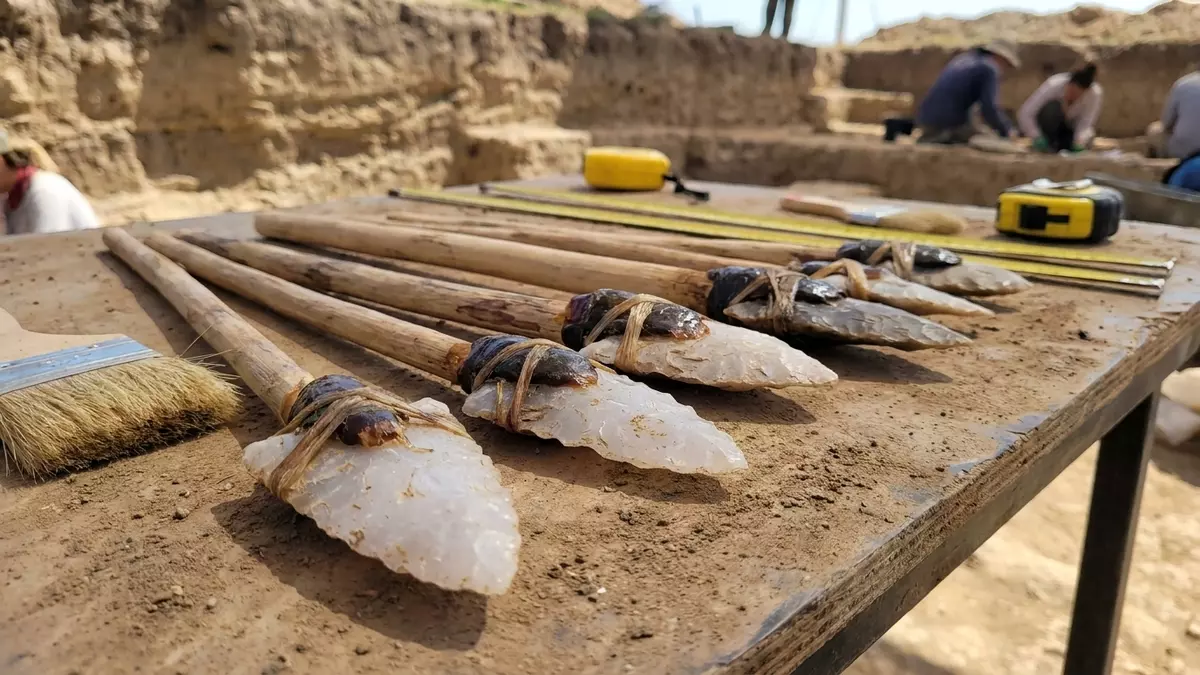
Hafting—the process of binding a stone tool to a wooden or bone handle—marks a monumental leap forward in human cognitive evolution. It transforms a simple hand-held rock into a complex compound tool, drastically increasing mechanical leverage, precision, and physical safety for the user.
The microstructural analysis of the Xigou collection revealed distinct edge rounding, striations, and microscopic polishes associated with diverse tasks such as slicing through plant matter, piercing hides, and heavy cutting. More importantly, the researchers identified unmistakable wear patterns and residue left behind by two distinct mechanical attachment systems.
[System 1: Split-Notch Attachment] ---> Stone base rests inside a carved notch at the handle tip.
[System 2: Hollow Shaft Insertion]  ---> Stone base slides directly into a hollowed-out socket.
To secure these joints, the ancient craftspeople utilized binding materials such as durable plant fibers or animal sinew. Furthermore, chemical and physical residue traces near the tool bases strongly point to the application of organic adhesives, effectively acting as prehistoric glue to permanently cement the stone head to its handle.
Executing this sequence requires advanced mental planning. A toolmaker must visualize the final product, pre-shape the stone to fit a specific socket, harvest and prepare matching handles, and manufacture strong binders or glues before assembly ever begins.
90,000 Years of Cultural and Behavioral Stability
To pinpoint exactly when this technology flourished, scientists utilized advanced luminescence dating methods on six distinct sediment layers enclosing the artifacts. The results yielded an occupation timeframe spanning from 160,000 to 72,000 years ago.
This vast, nearly 90,000-year window of uninterrupted tool production is arguably the site’s most stunning revelation. Throughout this immense epoch, the core tool forms and manufacturing strategies remained remarkably stable. This technical persistence indicates that the region’s inhabitants possessed highly secure, structured social systems capable of teaching and preserving complex technical knowledge across hundreds of generations.
The people of the Danjiang River region successfully returned to the exact same engineering solutions time and again, maintaining their way of life across shifting ice-age climates and changing local environments.
Adding Context to East Asia’s Ancient Human Diversity
The timeframe of the Xigou site coincides with a highly dynamic period of human evolution in East Asia. The region was far from empty; it was home to a diverse tapestry of archaic human populations.
Fossil discoveries from nearby regional sites like Lingjing and Xujiayao have revealed ancient hominins possessing exceptionally large brain volumes. Concurrently, modern genetic research frequently highlights a strong legacy of Denisovan ancestry within regional populations during this era.
The sophisticated behavioral data gathered from Xigou perfectly complements this biological diversity. It proves that the ancient populations inhabiting central China were fully capable of independent technological breakthroughs that rivaled any contemporary advancements occurring in Africa or western Eurasia.
A New Benchmark for Prehistoric Global Innovation
The hafted artifacts from Xigou officially position central China at the very center of global discussions regarding early human innovation. For decades, the earliest hafted tools found in Africa and Europe were widely celebrated as the definitive milestones of early human genius, while East Asia was left out of the conversation.
The evidence from Xigou radically shifts that perspective. It establishes that sophisticated compound technology emerged independently in East Asia far earlier than standard evolutionary models ever predicted, proving that the roots of human ingenuity are truly global.
Frequently Asked Questions
What makes the Xigou stone tool discovery so important?
The discovery at Xigou provides the earliest direct evidence of hafted stone tool technology in East Asia, dating back 160,000 years. It completely rewrites history by proving that prehistoric human technology in ancient China was highly advanced and complex, rather than simple or primitive.
What is “hafting” and why is it a big deal?
Hafting is the technological process of attaching a stone tool head (like a scraper or a point) to a handle made of wood or bone. It represents a massive evolutionary milestone because creating a compound tool requires advanced mental planning, material selection, and multi-step engineering.
How did ancient humans attach the stones to the handles at Xigou?
Microscopic analysis revealed two main methods: splitting/notching the end of a handle to hold the stone, or inserting the stone into a hollowed-out shaft. The joints were then wrapped tightly with plant fibers or animal sinew, and secured with organic adhesives similar to modern glue.
Why was making these tools from quartz so impressive?
Quartz is notoriously difficult to work with because it fractures irregularly and shatters easily into useless shards. The fact that the Xigou toolmakers produced regular, standardized flakes using discoidal and flake core reduction systems proves they possessed extreme physical skill and precise control.
Who were the humans living in China 160,000 years ago?
During this period, China was home to a biologically diverse group of archaic humans, including populations related to the Denisovans and hominins found at sites like Lingjing and Xujiayao who possessed large brain sizes. The Xigou tools provide the crucial behavioral evidence showing just how intelligent these groups were.