
Table of Contents
- 1. The Pitted Ware Culture: Defiant Maritime Foragers
- 2. Decoding the DNA: The Mathematics of Prehistoric Kinship
- 3. Beyond the Nuclear Family: Inside the Shared Graves
- 3.1. The Paternal Aunt and the Siblings
- 3.2. The Reburied Father
- 4. A Borderless Baltic Network
- 5. Future Horizons for Ajvide
- 6. Frequently Asked Questions
- 6.1. What was the Pitted Ware Culture?
- 6.2. Where is the Ajvide archaeological site located?
- 6.3. How do archaeologists use DNA to determine if ancient skeletons were related?
- 6.4. Did the Stone Age people of Gotland live in isolated groups?
- 6.5. What did the burial of the young woman and two children reveal?
5,500-Year-Old DNA Reveals Complex Extended Family Burials in Stone Age Sweden
Deep within the sandy soil of Gotland, an island in the Baltic Sea, a 5,500-year-old cemetery is fundamentally shifting our understanding of Stone Age social structures. By extracting and sequencing ancient DNA from the famous Ajvide archaeological site, an international research team has mapped the biological relationships of one of northern Europe’s last surviving hunter-gatherer societies: the Pitted Ware Culture.
The genetic results reveal a community that deeply valued extended family networks, choosing to bury their dead not by strict nuclear units, but by complex, multi-generational kinship bonds.
5,500-Year-Old DNA Reveals Complex Extended Family Burials in Stone Age Sweden
The Pitted Ware Culture: Defiant Maritime Foragers
The individuals buried at Ajvide lived during a fascinating transitional era in human history. While agricultural communities and farming economies had already swept across most of continental Europe, the Pitted Ware people of Gotland defiantly maintained a highly successful maritime foraging lifestyle. They relied heavily on hunting seals, tracking coastal wildlife, and fishing along the rich Baltic shorelines.
 Harriet and Leon Pomerance Fellowship
The Ajvide cemetery is one of the largest and best-preserved prehistoric hunter-gatherer burial grounds in northern Europe, containing at least 85 documented graves. While most graves hold single occupants, eight specific graves stood out to researchers because they contained multiple individuals buried together.
To explore the social rules behind these shared burials, scientists successfully isolated and analyzed ancient genomic data from 10 individuals spanning four multi-person graves, comparing them to an existing regional database of 24 individuals from neighboring Pitted Ware settlements across the island.
Decoding the DNA: The Mathematics of Prehistoric Kinship
To determine the exact biological connections between the co-buried individuals, laboratory geneticists extracted ancient DNA samples from the dense enamel of teeth and well-preserved petrous bones (part of the skull).
 Inca Empire (Quiz)
The team identified biological sex by analyzing the presence of sex chromosomes (XX for females, XY for males) and calculated the precise degree of relatedness by measuring the exact proportions of shared genomic data:
First-Degree Relatives: Share roughly 50% of their DNA (parents, children, full siblings).
Second-Degree Relatives: Share roughly 25% of their DNA (half-siblings, aunts, uncles, grandparents, nieces, nephews).
Third-Degree Relatives: Share roughly 12.5% of their DNA (first cousins, great-aunts, great-uncles, great-grandparents).
+-------------------------------------------------------------------------+
|                  AJVIDE CO-BURIAL GENETIC ARCHITECTURE                  |
+-------------------+--------------------+--------------------------------+
| Grave Composition | Visual Placement   | Confirmed Genetic Relationship |
+-------------------+--------------------+--------------------------------+
| 1 Adult Woman +   | Woman in center;   | Children are full siblings;    |
| 2 Young Children  | boy and girl on    | woman is their paternal aunt   |
|                   | either side        | (father's sister/half-sister)  |
+-------------------+--------------------+--------------------------------+
| 1 Young Girl +    | Father's skeleton  | Direct first-degree parent-    |
| 1 Adult Man       | placed carefully   | child relationship; father was |
|                   | directly above her | reburied from another location |
+-------------------+--------------------+--------------------------------+
| 2 Young Children  | Side-by-side       | Third-degree relationship;     |
|                   | positioning        | consistent with first cousins  |
+-------------------+--------------------+--------------------------------+
| 1 Young Girl +    | Interred side-by-  | Third-degree relationship;     |
| 1 Young Woman     | side               | likely a great-aunt or cousin  |
+-------------------+--------------------+--------------------------------+
Beyond the Nuclear Family: Inside the Shared Graves
The DNA findings proved that every single shared grave analyzed contained biological relatives. However, the unexpected twist was how often these burials bypassed the traditional nuclear family structure of mother, father, and child. Instead, the placement of bodies within the earth prioritized extended kin.
The Paternal Aunt and the Siblings
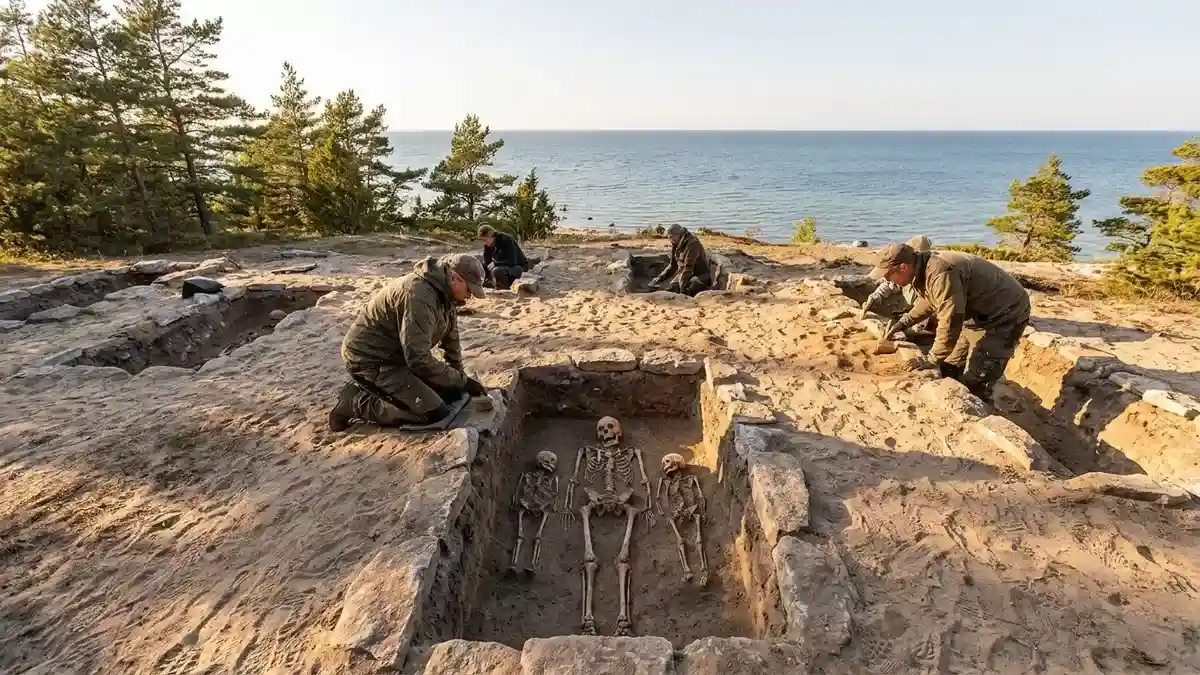
In one striking grave, archaeologists found a young woman, roughly 20 years old, flanked on either side by a young boy and a young girl. While a casual observer might assume this was a tragic scene of a mother buried with her children, the DNA told a completely different story.
The two children were indeed full biological siblings, but the woman was not their mother. Instead, the genomic data proved she was a second-degree relative—most likely their father’s full or half-sister. She had been buried acting as a symbolic, protective maternal figure for her niece and nephew.
The Reburied Father
Another grave revealed a unique funerary sequence: a young girl, aged 12 to 14, lay flat on her back. Arranged carefully directly above her body were the skeletal remains of an adult man.
Genetic testing confirmed that the man was her biological father. Interestingly, structural analysis of the bones suggested that the father’s body had been intentionally exhumed from a completely different geographic location and moved to this grave later on, allowing him to be reunited with his daughter in death.
A Borderless Baltic Network
When researchers zoomed out to look at the broader genetic profile of Gotland’s Stone Age population, they uncovered a distinct ancestral blend. The Pitted Ware individuals carried approximately 80% ancestry from older, indigenous Mesolithic hunter-gatherers and 20% ancestry from Neolithic farming groups who had migrated into Scandinavia.
Furthermore, the team discovered close genetic relatives scattered across completely different, distinct archaeological sites across Gotland. This widespread distribution of close DNA matches proves that the island’s various hunter-gatherer communities were not isolated or insular. Instead, they maintained active, highly mobile social networks, frequently traveling across the island for tribal gatherings, resource trading, and intermarriage.
Future Horizons for Ajvide
Because well-preserved, multi-burial hunter-gatherer cemeteries are extraordinarily rare in global archaeology, the pristine samples from Ajvide offer an invaluable laboratory for studying prehistoric social mechanics.
Building on this success, the research team is already preparing to extract and sequence DNA from more than 70 additional individuals unearthed at the cemetery. This massive upcoming dataset will allow scientists to construct a complete, island-wide family tree, shedding light on ancient mobility patterns, life histories, and the deep emotional and social ties that governed life and death on the prehistoric Baltic coast.
Frequently Asked Questions
What was the Pitted Ware Culture?
The Pitted Ware Culture was a Stone Age population in Scandinavia, living around 5,500 years ago, that maintained a specialized marine hunter-gatherer lifestyle focused on sealing and fishing, even after agricultural farming had spread across most of mainland Europe.
Where is the Ajvide archaeological site located?
Ajvide is a famous prehistoric coastal archaeological site located on the western coast of Gotland, a large Swedish island situated in the Baltic Sea.
How do archaeologists use DNA to determine if ancient skeletons were related?
Scientists extract ancient DNA from teeth or dense bones and measure the exact percentage of shared genetic markers. First-degree relatives (parents/children) share about 50%, second-degree (aunts/uncles/half-siblings) share 25%, and third-degree (first cousins) share roughly 12.5%.
Did the Stone Age people of Gotland live in isolated groups?
No. Genetic mapping showed that close biological relatives were buried at completely different archaeological sites across the island, proving that distinct local communities frequently interacted, traveled, and intermarried.
What did the burial of the young woman and two children reveal?
Though traditionally assumed to be a mother and her children, DNA proved the woman was actually the children’s paternal aunt. This reveals that extended family relationships, rather than just strict nuclear pairings, heavily influenced Stone Age cultural choices and burial practices.