
Table of Contents
- 1. Unlocking the Secrets of Ancient Domestic Shrines
- 1.1. The Materiality of Roman Devotion
- 2. A Surprising Ritual Blend: Local Wine and Imported Luxury
- 2.1. The First Proof of Household Frankincense
- 3. Redefining Ancient Global Trade Networks
- 3.1. From Public Temples to Private Homes
- 4. Connecting Science with Historical Texts
- 5. Frequently Asked Questions
- 5.1. What did researchers find inside the Pompeii incense burners?
- 5.2. Why is the discovery of wine residue in the ash important?
- 5.3. Where did the frankincense used in Pompeii come from?
- 5.4. What do these findings tell us about ancient Roman trade?
- 5.5. How were the scientists able to identify materials in such old ash?
Pompeii Ash Reveals Ancient Roman Secrets
The devastating eruption of Mount Vesuvius in CE 79 frozen the ancient city of Pompeii in time, preserving a stark snapshot of daily Roman life under meters of volcanic ash. While public monuments and grand temples have long dominated our understanding of Roman culture, a groundbreaking archaeological study has opened a rare window into the private, spiritual lives of ordinary citizens. By analyzing the microscopic residue left inside ancient household incense burners, researchers have uncovered the exact ingredients Romans used in their daily religious rituals, revealing a surprising blend of local agriculture and exotic global trade.
For centuries, historians have relied heavily on written texts and artistic depictions to guess what took place during domestic worship. However, this new chemical and microscopic analysis provides the first direct physical evidence of what was actually burned on household altars. The findings confirm long-standing theories about Roman rituals while introducing astonishing new details about the reach of ancient trade networks into the average Roman home.
Pompeii Ash Reveals Ancient Roman Secrets
Unlocking the Secrets of Ancient Domestic Shrines
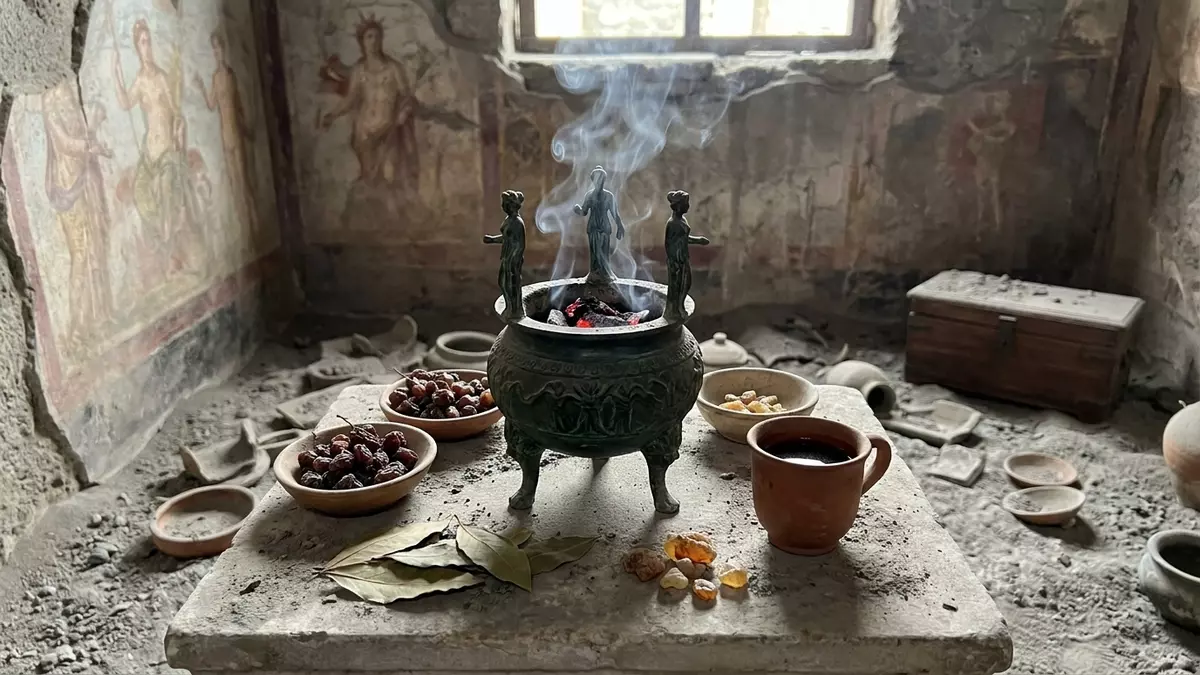
The study focused on the contents of two specific censers, or incense burners, recovered from domestic contexts. One was excavated within the city of Pompeii itself, while the other was discovered in a nearby villa in Boscoreale. Because the volcanic eruption sealed these artifacts instantly, the delicate organic compounds inside were protected from centuries of decay, offering a level of preservation rarely seen at other archaeological sites.
 Ancient secrets of Maya blue revealed: a second method for creating the iconic pigment discovered
To extract information from the centuries-old ash, an international research team utilized a multi-layered scientific approach. They combined advanced chemical analysis with high-powered microscopy to examine organic residues, mineral structures formed during combustion, and phytoliths—tiny silica particles formed within plant tissues that survive burning. This rigorous methodology allowed the team to identify specific plant species and organic materials with incredible precision, moving far beyond the vague descriptions found in ancient literature.
The Materiality of Roman Devotion
One of the studied censers features intricate decorations, including three female figures along its rim. Archaeologists believe these figures likely represent deceased family members who were venerated as ancestral spirits after their deaths. In Roman households, daily worship was highly personalized, centering around the lararium—a domestic shrine dedicated to the protection of the home and family.
The physical structure of the burners themselves, combined with the newly discovered chemical signatures of their contents, shows that these objects were central to maintaining the spiritual harmony of the household. The act of burning precious materials was a daily sensory experience that connected the physical world of the family with the unseen realm of their deities and ancestors.

A Surprising Ritual Blend: Local Wine and Imported Luxury
The scientific results paint a vivid picture of Roman religious practices, illustrating a fascinating combination of local natural resources and luxury imports. Wood from nearby Mediterranean vegetation was present in both burners, indicating that common local flora served as the primary fuel source to keep the embers hot. Additionally, researchers detected chemical traces linked to stone fruit trees and laurel, plants that held deep symbolic and practical value in Roman culture.
However, the most unexpected revelation was the presence of chemical compounds directly associated with grapes. This discovery strongly suggests that wine, or various grape products, was deliberately poured or placed onto the burning embers as part of the ritual offerings. While classical Roman texts frequently describe the use of wine in religious ceremonies, this study marks the first time that physical, archaeological evidence of wine burning has been definitively confirmed within a private, domestic setting.
The First Proof of Household Frankincense
Beyond the local agricultural products, the research team made another landmark discovery: the distinct chemical signature of resin from the Burseraceae plant family, which includes frankincense. This finding represents the very first clear archaeological proof of frankincense burning within the household shrines of Pompeii.

+-----------------------------------------------------------------+
|                  ANCIENT ROMAN RITUAL INGREDIENTS                |
+-----------------------------------------------------------------+
|  LOCAL RESOURCES                |  GLOBAL IMPORTS               |
+-----------------------------------------------------------------+
|  - Local wood fuel              |  - High-grade Frankincense    |
|  - Laurel leaves                |  - Non-Arabian resins         |
|  - Stone fruit wood             |  - Exotic botanical goods     |
|  - Grapes / Red Wine            |  - Long-distance trade items  |
+-----------------------------------------------------------------+
While historical accounts by ancient writers frequently mention the use of imported incense in public state ceremonies and grand temple rituals, finding direct physical traces inside modest home altars has been exceptionally rare. The discovery confirms that the burning of high-value incense was not an exclusive luxury reserved solely for the elite or public priesthoods; it was an integral part of everyday spiritual life for ordinary families.
Redefining Ancient Global Trade Networks
Perhaps the most disruptive aspect of the study lies in the specific origin of the discovered frankincense. For decades, historians assumed that southern Arabia was the primary supplier of incense to the Mediterranean world, dominating the famous overland and maritime trade routes. However, the unique chemical footprint of the Pompeii resin points to a source entirely outside the Mediterranean basin.
The analysis indicates that the resin likely originated from India or parts of sub-Saharan Africa. This geographical shift provides powerful evidence that Roman long-distance trade networks were far more vast, complex, and resilient than previously understood. The fact that exotic goods from thousands of miles away found their way into ordinary domestic spaces highlights the efficiency of the ancient global economy.
From Public Temples to Private Homes
The presence of sub-Saharan or Indian frankincense in everyday household burners demonstrates that global trade items were deeply integrated into the fabric of daily Roman life. These exotic resins were not just hoarding items for the ultra-wealthy or sacred materials restricted to official state temples. Instead, regular citizens had access to international marketplaces, allowing them to purchase imported goods to honor their personal deities and ancestral spirits.
This seamless blending of local resources—like regional wine and firewood—with expensive, imported resins shows how Roman households operated at the intersection of local tradition and global commerce. It reshapes our understanding of the Roman consumer, proving that globalization is not merely a modern phenomenon, but a reality that shaped the sensory and spiritual experiences of an ancient civilization.
Connecting Science with Historical Texts
While the study faces minor limitations due to the lack of highly detailed modern excavation records from the exact moments these artifacts were uncovered decades ago, the striking agreement between the chemical data and the preserved botanical remains provides immense credibility to the conclusions.
By bridging the gap between physical artifacts and surviving classical literature, this research brings us closer to the actual human behaviors of the past. The microscopic ash grains left behind in the shadow of Vesuvius serve as a direct, tangible link to the quiet, everyday moments of worship, demonstrating how ancient Romans expressed their faith, managed their households, and connected with a wider world.
Frequently Asked Questions
What did researchers find inside the Pompeii incense burners?
Scientists discovered a mixture of local and imported materials, including regional firewood, traces of laurel and stone fruit trees, chemical markers for grapes or wine, and rare resin from the Burseraceae family, which is the source of frankincense.
Why is the discovery of wine residue in the ash important?
Although ancient Roman writings frequently mention using wine in religious ceremonies, this study provides the very first physical, archaeological proof that wine or grape products were actually burned as offerings inside private household shrines.
Where did the frankincense used in Pompeii come from?
Chemical analysis revealed that the frankincense did not come from southern Arabia, which was long thought to be Rome’s main supplier. Instead, the unique chemical signature points to origins in India or sub-Saharan Africa, revealing much larger ancient trade routes.
What do these findings tell us about ancient Roman trade?
The presence of exotic, imported resins in average homes proves that long-distance global trade networks reached far into the private lives of regular citizens, rather than being restricted entirely to wealthy elites or official state temples.
How were the scientists able to identify materials in such old ash?
The research team used a combination of advanced chemical analysis and microscopy. This allowed them to study organic residues, mineral structures from burning, and phytoliths (microscopic plant particles), which can survive intense heat and centuries of burial.